

Great products don’t sell themselves. Even the most innovative solutions fail when customers don’t understand their value, can’t find them, or don’t see how they solve a real problem. What is product marketing? It’s the strategic function that bridges this gap—connecting what you build with how the market perceives, adopts, and advocates for it.
What is product marketing in practice? It’s the discipline responsible for bringing a product to market and driving its ongoing success. What is product marketing really about? It sits at the intersection of product, sales, and marketing, focusing on demand generation, adoption, and customer retention rather than just raw lead generation.
This guide answers what is product marketing in comprehensive detail. You’ll learn what is product marketing from definition to execution, what is product marketing through real-world examples, and what is product marketing as a career path. By the end, you’ll understand what is product marketing better than 90% of professionals in the field.
Table of Contents
What Is Product Marketing? Definition & Meaning
Product Marketing Definition
What is product marketing? The simplest answer: product marketing is the process of researching customer needs, positioning a product, creating compelling messaging, planning go-to-market strategies, enabling sales teams, and driving product adoption throughout the entire product lifecycle.
What is product marketing in business terms? Product marketing functions as the connective tissue between product development, sales, and marketing, ensuring that what gets built actually resonates with the right audience and achieves commercial success.
What is product marketing at its core? Product marketing is translating technical capabilities into customer value through coordinated positioning, targeted messaging, and strategic go-to-market execution.
What is product marketing NOT? Product marketing is NOT just about product launches. While launches are a major responsibility, product marketing continues throughout the product’s lifecycle—from discovery to growth to maturity and beyond.
What is product marketing in one sentence? Product marketing makes sure the right product reaches the right customers with the right message at the right time—and that customers keep finding value in it long after purchase.
Why Product Marketing Matters

Understanding what is product marketing requires understanding why it matters. Product marketing delivers tangible business impact across multiple dimensions:
Better Product-Market Fit — Product marketing teams bring customer voice into product decisions. They conduct market research, customer interviews, and competitive analysis to ensure products solve real problems for defined audiences.
Higher Product Adoption — By creating clear positioning and compelling messaging, product marketing helps customers understand a product’s value quickly. This directly impacts activation rates and time-to-value.
Increased Revenue — According to the State of Product Marketing 2026 report, 53.91% of PMM teams are evaluated on go-to-market strategy effectiveness, and the same percentage on new revenue generation. Companies that invest in product marketing see stronger revenue outcomes.
Stronger Competitive Positioning — Product marketing professionals continuously monitor competitive landscapes, identifying gaps and differentiators that give their products a market edge.
Better Customer Retention — Product marketing doesn’t stop at the sale. Ongoing customer education, adoption campaigns, and lifecycle marketing help reduce churn and drive expansion revenue.
Successful Product Launches — Research shows that product launches are 30% more successful when what is product marketing has a formal seat in strategic planning. Product marketing orchestrates launch activities across product, sales, and marketing teams.
Organizations with product-led growth strategies are twice as likely to double year-over-year revenue . Product marketing is the function that makes product-led growth work.
What Does a Product Marketer Do?

Now that you understand what is product marketing, let’s explore what practitioners actually do. According to the 2025 State of Product Marketing report, here are the most common responsibilities:
| Responsibility | % of PMMs Owning It |
|---|---|
| Product positioning and messaging | 91% |
| Managing product launches | 80.9% |
| Sales collateral and internal docs | 80.9% |
| Sales enablement | 78.7% |
| Customer and market research | 69.7% |
| Competitive intelligence | 65.2% |
| Website and customer-facing docs | 65.2% |
| Customer onboarding | 37.5% |
| Product roadmap planning | 28.1% |
Day-to-day activities vary significantly based on company stage and launch cycle. At a Series A startup, a product marketing professional might spend Monday morning on customer interviews, Tuesday afternoon writing positioning docs, and Wednesday in sales calls providing live support. At an enterprise company, the rhythm is more structured.
Common product marketing deliverables include:
- Messaging frameworks and positioning documents
- Go-to-market plans and launch briefs
- Sales enablement assets (battlecards, objection-handling guides)
- Customer research summaries
- Pricing recommendations
- Event and webinar briefs
The Complete Product Marketing Framework (10 Steps)
The product marketing framework provides a structured approach to bringing products to market. Understanding what is product marketing means understanding this framework. Here’s the 10-step product marketing process:
Step 1: Market Research (Discover)
Product marketing begins with research. Product marketing professionals conduct both quantitative and qualitative research:
- Customer interviews and win/loss analysis
- Industry research and trend analysis
- Surveys and feedback collection
- Market size quantification
Deliverable: Market intelligence report documenting target market size, customer needs, and competitive positioning gaps.
Step 2: Customer Segmentation (Discover)
Product marketing transforms broad market data into specific, actionable customer profiles:
- Define Ideal Customer Profile (ICP)
- Create buyer and user personas
- Apply Jobs-to-Be-Done (JTBD) framework
- Validate personas through customer interviews
Deliverable: Validated persona documents for each target segment.
Step 3: Competitive Analysis (Discover)
Product marketing reveals where your product can differentiate:
- Create competitor comparison matrix
- Analyze competitor positioning and messaging
- Identify competitive gaps and opportunities
- Monitor competitor moves
Deliverable: Competitive intelligence report with positioning map.
Step 4: Product Positioning (Define)
Product marketing defines how you want customers to perceive your product:
Positioning Statement Template:
For [target customer] who [statement of need], our [product name] is a [product category] that [key benefit]. Unlike [primary competitor], our product [key differentiation].
Step 5: Messaging Framework (Define)
Product marketing translates positioning into specific language:
- Value proposition
- Primary and secondary messages
- Proof points and evidence
- Brand voice and tone guidelines
Deliverable: Complete messaging hierarchy with audience-specific variations.
Step 6: Pricing Strategy (Strategize)
Product marketing develops pricing that reflects customer value perception:
- Value-based pricing
- Competitive pricing
- Freemium
- Subscription
- Tiered pricing
Deliverable: Pricing recommendations with analysis and rationale.
Step 7: Go-to-Market Strategy (Strategize)
Product marketing turns strategy into coordinated action:
- Launch timeline and milestones
- Channel selection and strategy
- Budget allocation
- Team alignment and roles
Deliverable: Comprehensive GTM plan document.
Step 8: Product Launch (Get Set)
Product marketing executes the launch through coordinated activities:
- Pre-launch: Planning, asset creation, team training
- Launch: Coordinated announcement and first availability
- Post-launch: Monitoring, optimization, follow-up
Deliverable: Executed launch with performance tracking.
Step 9: Sales Enablement (Get Set)
Product marketing equips revenue teams with selling tools:
- Sales deck and presentations
- Battlecards and competitive comparisons
- FAQs and objection-handling guides
- Product demo scripts
- Training sessions
Deliverable: Complete sales enablement toolkit.
Step 10: Measure Success and Optimize (Grow)
Product marketing continues through ongoing measurement:
- Track KPIs and performance metrics
- Collect and analyze customer feedback
- Refine positioning and messaging
- Optimize campaigns and enablement
Deliverable: Performance reports with actionable insights.
Product Marketing Process Explained (End-to-End)
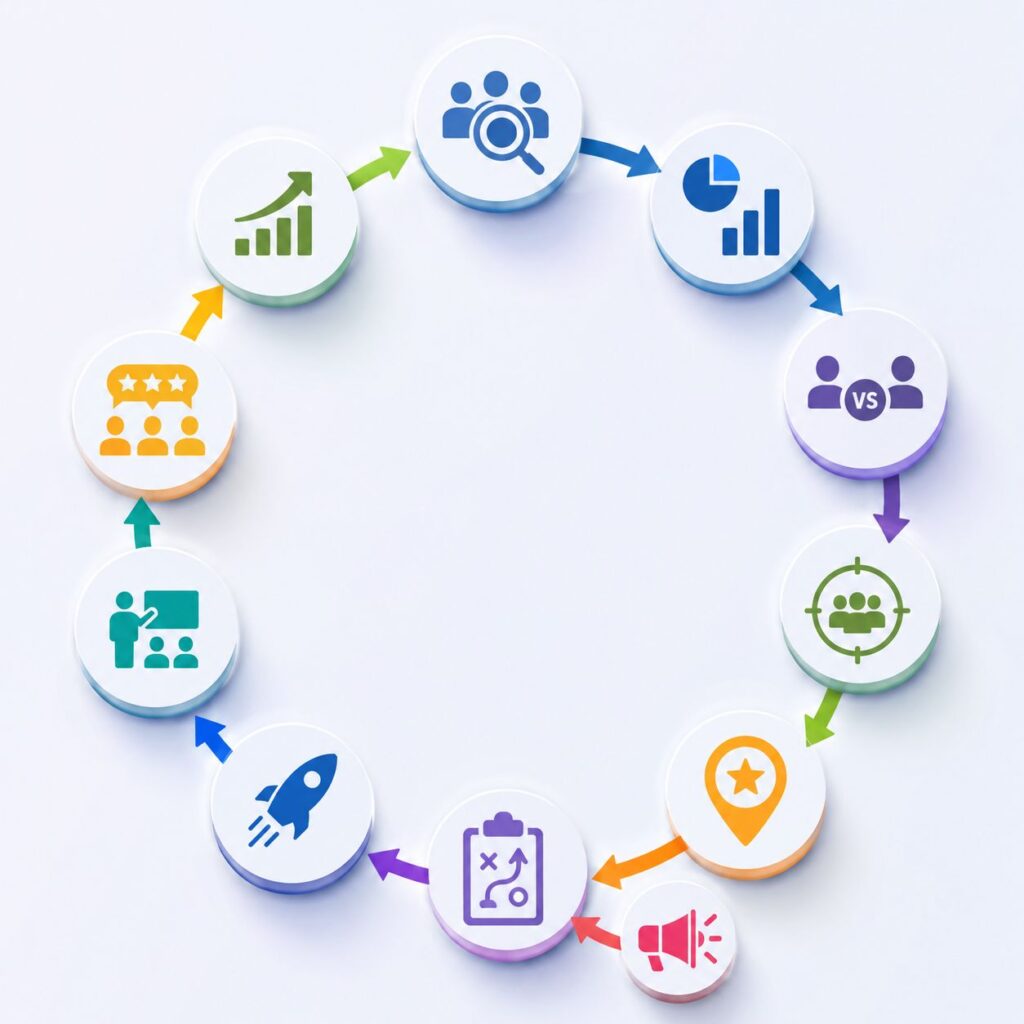
The product marketing process follows a logical flow:
text
Customer Research
        ↓
  Market Analysis
        ↓
  Competitive Research
        ↓
    Segmentation
        ↓
    Positioning
        ↓
    Messaging
        ↓
  Go-to-Market Plan
        ↓
    Launch Execution
        ↓
 Sales Enablement
        ↓
  Customer Adoption
        ↓
    Optimization & Growth
Each step builds on the previous ones, creating a cohesive product marketing approach that aligns product, sales, and marketing teams.
Product Marketing Lifecycle
The product marketing lifecycle identifies how responsibilities evolve at each stage:
| Stage | Product Marketing Focus |
|---|---|
| Discovery | Market research, customer validation, competitive analysis |
| Validation | Testing assumptions, refining positioning, building business case |
| Development | Influencing roadmap with customer insights, preparing messaging |
| Pre-launch | GTM planning, asset creation, sales enablement preparation |
| Launch | Coordinated execution, campaign management, launch monitoring |
| Growth | Adoption campaigns, expansion marketing, new segment targeting |
| Maturity | Defense against competitors, retention marketing, feature updates |
| Decline/Transition | Sunset planning, migration to new products, customer communication |
While the classic lifecycle model identifies these stages, product marketing strategy must adapt at each stage to maintain momentum and revenue.
Real-World Product Marketing Examples
Apple: The Master of Product Launches
Apple’s product marketing creates anticipation and demand through carefully orchestrated launches. Key lessons:
- Build suspense with controlled information release
- Focus on benefits, not just features
- Create a clear narrative connecting products to user aspirations
- Coordinate launch timing across product, marketing, and retail
Slack: Messaging That Resonated
Slack’s product marketing positioned the company as “where work happens” rather than “enterprise messaging.” Key lesson: product marketing positioning should expand your market, not limit it.
Spotify: Growth Through Personalization
Spotify’s product marketing emphasizes personalized experiences (Discover Weekly, Wrapped). Key lesson: product marketing can use product features as marketing assets.
HubSpot: Inbound Product Marketing
HubSpot built an entire ecosystem around inbound product marketing, using educational content and free tools. Key lesson: product marketing can include freemium and educational content strategies.
Notion: Community-Led Growth
Notion’s product marketing grew through a passionate user community creating templates and tutorials. Key lesson: user-generated content can be a powerful product marketing channel.
Canva: Freemium Growth Strategy
Canva’s product marketing drives massive adoption through freemium, with focus on conversion. Key lesson: the product itself can be the primary acquisition channel.
Product Marketing vs Product Management
What is product marketing compared to product management? They work closely but have distinct responsibilities:
| Dimension | Product Manager | Product Marketing Manager |
|---|---|---|
| Core Focus | Building the right product | Bringing product to market successfully |
| Responsibility | Product definition and delivery | Market readiness, narrative, commercialization |
| Primary Output | Product roadmap, feature briefs | Messaging framework, GTM plan, sales enablement |
| Team | Engineering, design | Sales, marketing, customer success |
| Metrics | Product outcomes, roadmap delivery | Adoption, revenue, win rates |
| Accountability | What gets built | How it’s understood and adopted |
Important nuance: Product marketing shouldn’t start only at launch. Product marketing work begins much earlier, feeding insights into the product roadmap. Without that input, companies risk building features customers don’t want.
Product Marketing vs Traditional Marketing
| Dimension | Product Marketing | Traditional Marketing |
|---|---|---|
| Primary Focus | Specific product adoption and revenue | Brand awareness and demand generation |
| Target Audience | Product-specific customer segments | Broad market awareness |
| Timeline | Product lifecycle-driven | Ongoing brand building |
| Success Metrics | Adoption rate, feature usage, LTV | Brand awareness, website traffic, leads |
| Team Collaboration | Product, sales, marketing alignment | Marketing and creative teams |
Both strategies work in harmony when organizations recognize their distinct roles. Traditional marketing creates the foundation that makes product marketing more effective. Product marketing delivers the specific positioning that converts awareness into adoption.
Product Marketing vs Brand Marketing vs Growth Marketing
- Product Marketing: Focuses on specific product success—positioning, messaging, GTM, adoption, and retention for a particular product or product line.
- Brand Marketing: Focuses on overall company reputation, emotional connection, and long-term brand equity.
- Growth Marketing: Focuses on rapid experimentation across channels to drive user acquisition and revenue growth.
These functions complement each other: brand marketing builds awareness, product marketing drives adoption of specific offerings, and growth marketing accelerates expansion.
Key Product Marketing Skills
Hard Skills
- Market Research: Conducting customer interviews, surveys, and market analysis
- Competitive Intelligence: Monitoring competitors and identifying market opportunities
- Positioning: Crafting differentiated product positioning
- Pricing: Developing value-based pricing strategies
- Analytics: Interpreting product and marketing data
- AI Tools: Leveraging AI for research, content, and analysis
- GTM Planning: Orchestrating complex product launches
- SEO: Optimizing content for search visibility
Soft Skills
- Communication: Writing clearly for different audiences
- Storytelling: Creating compelling product narratives
- Leadership: Influencing without authority (71% of PMMs cite this as their biggest daily challenge)
- Critical Thinking: Making data-backed strategic decisions
- Presentation: Presenting to executives and stakeholders
- Collaboration: Working across 6-8 teams regularly
Essential Product Marketing Tools
Customer Research
- Surveys: Typeform, SurveyMonkey
- Interview tools: User Interviews, Respondent
- Feedback: Uservoice, Qualtrics
Competitive Intelligence
- Competitor monitoring: Crayon, Kompyte
- Market analysis: Gartner, Forrester
Analytics
- Product analytics: Mixpanel, Amplitude, Userpilot
- Web analytics: Google Analytics, Segment
- CRM: Salesforce, HubSpot
Design & Collaboration
- Whiteboarding: Miro, Mural
- Documentation: Notion, Confluence
- Presentations: Pitch, Canva
AI Tools
- Content creation: Jasper, Copy.ai
- Research: Perplexity, Claude
- Automation: Zapier, Make
Product Marketing KPIs That Matter in 2026
The State of Product Marketing 2026 report identifies the most important KPIs:
| KPI | % of Teams Tracking |
|---|---|
| Go-to-market strategy effectiveness | 53.91% |
| New revenue generation | 53.91% |
| Win rate improvement | 38.28% |
| Customer retention | 32.03% |
| Sales confidence | 25.39% |
| Asset utilization | 21.48% |
Important distinction: 13.28% of teams have no defined KPIs at all.
Leading vs Lagging Indicators
- Lagging indicators (outcome metrics): Revenue, churn, expansion ARR
- Leading indicators (behavior metrics): Adoption rate, activation rate, sales confidence
Best practice: Track both leading and lagging indicators intentionally. Leading indicators guide execution. Lagging indicators validate revenue impact.
Key Metrics Explained
- Time to Value (TTV): Time from when a customer starts using a product to when they derive value
- Activation Rate: Percentage of users who experience the product’s promised value
- Product Adoption Rate: Number of users adopting the product over time
- Trial-to-Paid Conversion: Percentage of trial users who become paying customers
- Customer Retention: Percentage of customers who continue using the product
- Net Revenue Retention (NRR): Percentage of revenue retained from existing customers
- Product Engagement Score (PES): Composite metric of adoption, stickiness, and growth rates
Common Product Marketing Mistakes
❌ Skipping customer research — Building positioning and messaging without validating with real customers leads to products that miss the mark.
❌ Weak positioning — Poorly differentiated products struggle to stand out. Effective product marketing focuses on being different in ways that matter.
❌ Poor messaging — Messaging that focuses on features rather than customer outcomes fails to resonate. Customers buy outcomes, not capabilities.
❌ Ignoring competitors — Failing to monitor competitive moves leaves you vulnerable. Continuous competitive intelligence is essential for product marketing.
❌ Launching too early — Rushing to launch without complete enablement and readiness undermines launch success.
❌ No sales enablement — Launching without equipping the sales team to sell effectively wastes the product marketing effort.
❌ No KPI tracking — Without defined KPIs, you can’t demonstrate product marketing impact or optimize. Align metrics to objectives before launching.
How to Become a Product Marketer (Career Roadmap)
Step 1: Learn Marketing Fundamentals
Understand core marketing principles—positioning, messaging, segmentation, and campaign management. This is foundational to product marketing.
Step 2: Understand Product Management
Product marketing professionals collaborate closely with product teams. Learn product development, roadmap planning, and Agile methodologies.
Step 3: Build a Portfolio
Create product marketing artifacts: sample positioning documents, messaging frameworks, and GTM plans.
Step 4: Master Positioning
Positioning is the foundation of product marketing. Practice creating differentiated positioning statements.
Step 5: Learn GTM Strategy
Study go-to-market planning, launch execution, and sales enablement—core product marketing competencies.
Step 6: Get Certifications
Consider certifications from Product Marketing Alliance, Pragmatic Institute, or similar organizations focused on product marketing.
Step 7: Apply for PMM Roles
Start with entry-level or associate product marketing roles. Many professionals transition from marketing, product management, or sales.
Career Note: PMM demand has grown over 25% in the last three years. PMMs rank among the top 15 most sought-after positions in global technology.
Frequently Asked Questions (FAQ)
What is product marketing in simple words?
Product marketing is about making sure the right product reaches the right customers with the right message—and that customers keep finding value in it long after purchase. That’s what is product marketing at its simplest.
What does a product marketer do?
Product marketing professionals conduct market research, define positioning, craft messaging, plan and execute go-to-market strategies, enable sales teams, and drive product adoption throughout the product lifecycle.
Why is product marketing important?
Product marketing connects products with customers. It ensures products solve real problems, reach the right audiences, and achieve commercial success through adoption, retention, and revenue growth.
What are the four pillars of product marketing?
Positioning, messaging, go-to-market strategy, and sales enablement. These form the foundation of product marketing work.
What is the difference between product marketing and product management?
Product managers build the right product. Product marketing brings the product to market successfully (market readiness, narrative, commercialization).
Is product marketing a good career?
Yes. PMM demand has grown significantly, with skilled product marketing professionals increasingly indispensable. The role offers creative and strategic diversity, cross-functional visibility, and strong market demand.
What skills are needed for product marketing?
Market research, competitive analysis, positioning, messaging, GTM planning, analytics, storytelling, and collaboration. AI fluency is increasingly critical for product marketing.
What is a product marketing framework?
A structured product marketing approach covering discovery (research), strategy (GTM, pricing), definition (positioning, messaging), preparation (sales enablement), and growth (optimization).
What are the stages of product marketing?
Discovery, Strategy, Definition, Preparation (Get Set), and Growth. These phases cover the full product marketing journey.
How do you create a product marketing strategy?
Start with market research, define target personas, analyze competition, craft positioning and messaging, design the GTM approach, establish cross-functional workflows, and continuously measure and optimize.
What are the KPIs for product marketing?
Revenue, adoption rate, activation rate, win rate, retention, churn, NRR, Product Engagement Score, and sales confidence. Track both leading and lagging indicators.
How long does a product launch take?
Varies widely. Simple launches may take weeks; complex enterprise launches can take months. Pre-launch planning often takes 2-4 months.
What tools do product marketers use?
Customer research (Typeform, User Interviews), competitive intelligence (Crayon), analytics (Mixpanel, Amplitude), CRM (Salesforce), collaboration (Notion, Miro), and AI tools.
What industries hire product marketers?
All industries—SaaS, fintech, healthtech, AI, enterprise software, consumer products, and more. Technology and SaaS are the largest employers.
What certifications are best for product marketing?
Product Marketing Alliance (PMA), Pragmatic Institute, and specialized product marketing courses.
Final Thoughts
What is product marketing? It’s the strategic discipline that turns product potential into market success. Product marketing is where customer understanding, strategic positioning, compelling messaging, go-to-market execution, and continuous optimization converge.
Key takeaways:
- Product marketing connects products with customers—it’s the bridge between what you build and how the market perceives and adopts it
- Product marketing combines research, positioning, messaging, GTM planning, sales enablement, and performance measurement
- Product marketing is continuous—it doesn’t stop at launch day. Ongoing optimization, customer education, and lifecycle marketing are essential
The demand for skilled product marketing professionals has never been higher. With AI transforming how products are built and marketed, product marketing professionals who develop AI fluency, data skills, and strategic thinking will be best positioned for career growth.
Apply the product marketing framework in this guide, build your skills, and start making an impact where it matters most—bringing great products to the customers who need them.