

Table of Contents
A strong product can still struggle to gain traction when customers cannot quickly understand who it is for, what problem it solves, why it is different, and why they should choose it over alternatives.
That is the job of product positioning.
A product positioning framework gives you a structured way to answer those questions before turning them into website copy, sales messaging, advertising campaigns, or product narratives. Instead of describing every feature your product offers, positioning helps you decide which differences matter most to a specific audience.
This guide explains how to build a product positioning framework step by step. You will learn how to identify competitive alternatives, uncover meaningful differentiation, connect product capabilities to customer value, select the right target market and category, create a positioning statement, validate your position, and translate it into messaging.
You will also find a practical product positioning framework template, examples, common mistakes, and a comparison of popular positioning models.
Quick answer: A product positioning framework is a structured method for defining how a product should be perceived by a specific target customer compared with competing products, substitute solutions, and the status quo. A useful framework typically examines competitive alternatives, unique attributes, customer value, target-market characteristics, market category, differentiation, proof, and the resulting positioning statement.
What Is a Product Positioning Framework?
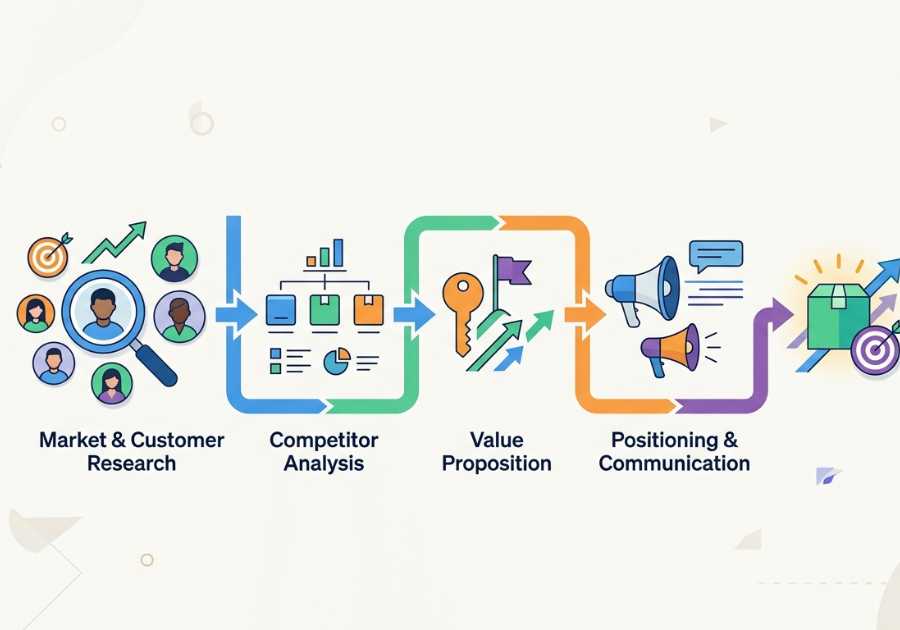
A product positioning framework is a strategic structure that helps a company decide how its product should be understood and evaluated by a particular audience.
It connects several important decisions:
Target customer → Customer problem → Competitive alternatives → Unique attributes → Customer value → Market category → Differentiation → Proof → Positioning
The framework is not simply a catchy sentence.
https://xperiatech.com/positioning-messaging-services/ It is the reasoning behind that sentence.
For example, suppose a company sells project management software. Saying:
“We provide an easy-to-use project management platform.”
is not strong positioning by itself.
Thousands of products can claim to be easy to use.
A stronger positioning process would ask:
- Which customers need this product most?
- What are they currently using?
- What frustrates them about those alternatives?
- What can this product do differently?
- Why does that difference matter?
- Which customer outcome does it improve?
- What category should customers place it in?
- What evidence supports the claim?
Only after answering those questions should the company develop its final positioning statement.
Product positioning framework vs. positioning statement

These concepts are related but not identical.
A product positioning framework is the strategic process used to make positioning decisions.
A positioning statement is a concise expression of those decisions.
Think of it this way:
Framework = strategic thinking
Positioning statement = strategic output
That distinction matters because companies sometimes try to write a positioning statement before understanding their market, customers, alternatives, and differentiation.
The result is usually generic messaging.
Why Does a Product Positioning Framework Matter?

Without clear positioning, marketing teams often try to communicate everything at once.
A product page might list:
- 30 features
- multiple integrations
- several customer segments
- technical specifications
- pricing options
- awards
- testimonials
- benefits
- company history
The customer is left to figure out what actually matters.
Positioning reverses that process.
Instead of asking:
“What can our product do?”
you start asking:
“What should the right customer understand about our product first?”
A strong Product Positioning Framework helps with several areas of business and marketing.
1. It creates clarity
Customers can understand what the product is, who it serves, and why it matters.
2. It improves differentiation
Your team can focus on meaningful differences instead of vague claims such as “best,” “innovative,” or “powerful.”
3. It aligns marketing and sales
Marketing, sales, product, and leadership teams can work from the same strategic narrative.
4. It improves message consistency
Your website, advertisements, sales presentations, social media, and product materials can reinforce the same positioning.
5. It helps attract better-fit customers
Clear positioning can discourage poorly matched prospects while making the product more relevant to the customers who are most likely to value it.
6. It supports go-to-market decisions
Positioning influences which market you enter, which audience you prioritize, which competitors you emphasize, and which benefits you communicate.
Product Positioning Framework vs. Product Positioning Strategy
The terms product positioning framework and product positioning strategy are often used interchangeably, but there is a useful distinction.
A framework is the structure you use to analyze positioning.
A strategy is the set of choices you make based on that analysis.
| Product Positioning Framework | Product Positioning Strategy |
|---|---|
| Provides a structured process | Defines the strategic direction |
| Helps analyze customers and alternatives | Decides how to compete |
| Identifies differentiation | Determines which differentiation to emphasize |
| Helps define a category | Establishes market perception |
| Produces positioning decisions | Applies those decisions across GTM |
For example, your framework might reveal that your product is particularly valuable to fast-growing ecommerce companies that need to reduce repetitive customer-service work.
Your strategy could then focus the product around:
“The customer support platform built for high-volume ecommerce teams that need to automate repetitive support without expanding headcount.”
TheProduct Positioning Frameworkhelped you reach the decision.
The strategy determines how you use it.
The Core Elements of a Product Positioning Framework

A practical product positioning framework should answer eight fundamental questions.
1. What are customers using instead?
Identify direct competitors, indirect competitors, substitute solutions, internal processes, and the status quo.
2. What makes your product meaningfully different?
Identify capabilities or attributes that competitors cannot easily replicate or that they do not prioritize.
3. Why does that difference matter?
TranslateProduct Positioning Framework capabilities into customer value.
4. Who cares about that value most?
Define the best-fit customer rather than trying to appeal to everyone.
5. What category should customers place you in?
Choose a market category that helps customers understand your product while reinforcing your advantage.
6. Why should customers choose you?
Turn differentiation into a clear reason to select your product.
7. What proves your claim?
Support Product Positioning Framework with evidence, customer outcomes, data, demonstrations, or other proof.
8. Can the positioning be expressed clearly?
Convert the strategic decisions into a concise positioning statement that can guide messaging.
These elements create the foundation for a complete product positioning process.
How to Build a Product Positioning Framework Step by Step
Step 1: Identify Your Real Competitive Alternatives
Many positioning exercises start with a list of competitors.
That is useful, but incomplete.
Your real competitive landscape includes everything a customer might reasonably choose instead of your product.
This is known as the competitive alternative.
For example, a customer-support software company may compete against:
- Zendesk
- Intercom
- Freshdesk
- A shared Gmail inbox
- Spreadsheets
- Internal support software
- Hiring another support employee
- Doing nothing
The last few alternatives may not appear in a traditional competitor analysis, but they can strongly influence buying decisions.
Ask these questions
- What does the customer use today?
- What would they use if our product disappeared?
- What manual process does our product replace?
- Could the customer solve the problem internally?
- What software are they already paying for?
- What happens if they decide not to solve the problem?
This prevents a common positioning mistake: defining competition too narrowly.
Build a competitive alternatives table
| Alternative | Why customers choose it | Main limitation | Positioning opportunity |
|---|---|---|---|
| Competitor A | Established brand | Expensive | Cost efficiency |
| Competitor B | Many features | Complex setup | Simplicity |
| Spreadsheet | Familiar | Manual work | Automation |
| Internal process | Full control | Resource intensive | Efficiency |
| Do nothing | No switching cost | Problem remains | Measurable improvement |
Your objective is not to attack competitors.
Your objective is to understand the choice your customer is actually making.
Step 2: Analyze the Competitive Landscape
Once you know the alternatives, compare them based on attributes that customers actually care about.
Do not create a matrix containing dozens of meaningless features.
Focus on decision-making criteria.
For example:
| Attribute | Competitor A | Competitor B | Your Product |
|---|---|---|---|
| Setup time | Medium | Long | Short |
| Automation | High | Medium | High |
| Ease of use | Medium | Low | High |
| Enterprise controls | High | High | Medium |
| Cost | High | Medium | Medium |
| Ecommerce specialization | Low | Medium | High |
The objective is to discover patterns.
You may find that competitors are optimized for enterprise organizations while your product is particularly strong for mid-market companies.
Or you may discover that competitors have extensive functionality but require lengthy implementation.
That creates potential positioning territory.
Use perceptual mapping
A perceptual map can make competitive positioning easier to visualize.
For example, you could compare products on:
Ease of use ↔ complexity
and
General-purpose ↔ industry-specific
Your product might occupy a desirable position:
Industry-specific + easy to use
But the map is only useful if those dimensions matter to buyers.
Never select Product Positioning Framework dimensions simply because they make your product look different.
Step 3: Identify Your Unique Attributes
Now move from the market to your product.
Ask:
What can our product genuinely do that the alternatives cannot, or cannot do as effectively?
This is where many companies make another mistake.
They confuse features with differentiation.
A feature is something your product does.
A differentiator is a meaningful reason that capability makes your product preferable.
Consider this progression:
Feature: Automated reporting
Capability: The platform automatically gathers performance data.
Customer value: Managers spend less time manually preparing reports.
Differentiation: The product enables small teams to generate decision-ready reports without maintaining complex reporting workflows.
The final statement is much more useful for positioning.
Avoid weak differentiators
Words such as these rarely create strong positioning on their own:
- Innovative
- Powerful
- Flexible
- Simple
- Affordable
- Next-generation
- Customer-centric
- Best-in-class
- Easy to use
These claims become meaningful only when supported by something specific.
Instead of:
“We are an innovative CRM.”
consider:
“A CRM designed for small sales teams that automates lead follow-up without requiring dedicated sales operations staff.”
Specificity creates meaning.
Step 4: Translate Product Positioning FrameworkFeatures Into Customer Value
One of the most important exercises in product positioning is moving from what the product does to why the customer should care.
Use the “So what?” test.
Example
Feature: Automated invoice reminders.
So what?
Customers receive reminders without employees sending them manually.
So what?
Employees spend less time following up on unpaid invoices.
So what?
The company can improve cash collection while reducing administrative work.
Now you have a business outcome.
Think in layers of value
Functional value
What does the product help customers accomplish?
Economic value
Does it reduce costs, increase revenue, save time, or improve resource utilization?
Emotional value
Does it reduce stress, uncertainty, or complexity?
Strategic value
Does it help the customer achieve a larger business objective?
StrongProduct Positioning Framework often combines more than one type of value.
Step 5: Identify Your Best-Fit Customer
A positioning strategy becomes weaker when the target market is too broad.
“Businesses” is not a useful target market.
“Small businesses” is better, but still broad.
A more useful definition might be:
Ecommerce brands with 10–50 employees receiving more than 5,000 customer-support requests per month and looking to reduce repetitive support workload.
Now you can ask much better questions.
Define the customer using four dimensions
Firmographic characteristics
- Industry
- Company size
- Revenue
- Geography
- Growth stage
Buyer characteristics
- Job title
- Decision-making authority
- Responsibilities
- Goals
- Concerns
Behavioral characteristics
- Existing tools
- Current workflow
- Buying habits
- Technology adoption
- Switching behavior
Trigger characteristics
What causes the customer to start searching for a solution?
Examples include:
- Rapid growth
- Rising costs
- Operational bottlenecks
- New regulations
- Poor customer experience
- Missed revenue
- Team expansion
- A major change in workflow
Ask the “Who cares most?” question
Your ideal customer is not necessarily the person who can technically use your product.
It is the customer who cares most about the value your product creates.
That distinction can dramatically improve positioning.
Step 6: Choose the Right Market Category
Category selection is one of the most underestimated parts of Product Positioning Framework.
The category you choose affects what customers expect from your product.
Consider a product that automates repetitive workflows.
You might describe it as:
- Workflow software
- Automation software
- Operations platform
- AI assistant
- Business process platform
Each category creates a different mental model.
If customers already understand one category, using it may reduce the explanation required.
But the best category should not simply be familiar.
It should also make your differentiation more relevant.
Use the category test
Ask:
- Does the customer understand this category?
- Does it contain the alternatives customers already consider?
- Does the category make our strengths relevant?
- Does it attract our best-fit customers?
- Can our product credibly meet category expectations?
- Does the category support our long-term growth?
A poor category can force your marketing team to explain the product repeatedly.
A strong category gives customers useful context immediately.
Step 7: Define Your Positioning Statement
Once you have analyzed customers, alternatives, differentiation, value, and category, you can write the positioning statement.
A practical template is:
For [target customer] who [problem or need], [product] is a [market category] that [primary value]. Unlike [competitive alternative], [product] [key differentiation].
Example
For growing ecommerce companies that struggle with high volumes of repetitive customer inquiries, SupportFlow is an AI customer-support platform that helps teams resolve routine requests faster. Unlike traditional help desks, it automates repetitive support workflows while keeping human agents in control of complex conversations.
Notice that the statement includes:
- Audience
- Problem
- Category
- Value
- Alternative
- Differentiation
Your positioning statement is not your homepage headline
This distinction is important.
A positioning statement is an internal strategic tool.
Your website headline should be shorter and more compelling.
For example:
Positioning statement:
For growing ecommerce companies…
Homepage headline:
Resolve more customer requests without expanding your support team.
The second statement is derived from the first.
Step 8: Add Proof to Make Your Product Positioning Framework Credible
A positioning claim without evidence is simply an assertion.
If you claim:
“Reduce support workload by 40%.”
you need evidence.
Proof can include:
- Customer case studies
- Before-and-after results
- Product demonstrations
- Customer testimonials
- Usage statistics
- Independent reviews
- Certifications
- Research
- Third-party validation
- Performance benchmarks
A useful structure is:
Claim → Evidence → Outcome
For example:
Automated ticket classification → 12,000 tickets processed automatically → support agents spend more time on complex customer issues.
Proof is especially important when your differentiation sounds similar to competitors’ claims.
Step 9: Turn Positioning Into Messaging
Positioning determines what you want the market to understand.
Messaging determines how you communicate that position.
A useful hierarchy is:
Positioning → Value proposition → Messaging → Copy
Positioning
Defines your strategic place in the customer’s mind.
Value proposition
Explains the core value you provide.
Messaging
Develops the key ideas used across marketing and sales.
Copywriting
Turns those messages into headlines, ads, landing pages, emails, and other customer-facing content.
For example:
Positioning:
A customer-support platform for high-volume ecommerce brands.
Value proposition:
Reduce repetitive support work while helping customers receive faster responses.
Message:
Automate routine conversations without losing human oversight.
Headline:
Give your support team fewer repetitive tickets to handle.
The strategic idea stays consistent while the communication format changes.
Step 10: Test and Validate YourProduct Positioning Framework
Never assume your positioning works simply because your internal team likes it.
Test whether customers understand it.
Customer interviews
Ask potential customers:
- What do you think this product does?
- Who do you think it is designed for?
- What problem do you think it solves?
- What would you compare it with?
- What seems different?
- What part is unclear?
- What would make you consider buying it?
Pay attention to the words customers naturally use.
Those words can reveal whether your intended positioning is actually being understood.
Test your messaging
You can test positioning through:
- Website headlines
- Landing pages
- Paid advertisements
- Email campaigns
- Sales presentations
- Product demos
- Social media content
Compare performance based on meaningful outcomes rather than clicks alone.
Useful metrics include:
- Qualified lead rate
- Demo conversion rate
- Sales win rate
- Sales cycle length
- Customer acquisition cost
- Conversion rate
- Pricing objections
- Retention
- Expansion revenue
Gather sales feedback
Sales teams hear objections that marketing teams may never see.
Ask:
- Which competitors appear most often?
- What alternatives do prospects mention?
- What benefits create the strongest interest?
- Which claims cause confusion?
- Why do prospects choose competitors?
- Why do customers choose us?
Positioning should evolve based on evidence.
Product Positioning Framework Example
Let’s build a complete example.
Imagine a fictional company called SupportFlow.
It provides customer-support automation for ecommerce brands.
1. Target customer
Growing ecommerce companies with high volumes of repetitive customer inquiries.
2. Customer problem
Support teams spend too much time answering repetitive questions about:
- Shipping
- Returns
- Order status
- Product availability
- Refunds
3. Competitive alternatives
Customers could use:
- Traditional help-desk software
- Shared email inboxes
- Chatbots
- Spreadsheets
- Additional support employees
- Manual workflows
4. Unique attributes
SupportFlow automatically identifies repetitive inquiries and recommends or executes appropriate workflows while allowing human agents to handle complicated cases.
5. Customer value
The platform helps teams:
- Reduce repetitive work
- Respond faster
- Handle greater ticket volume
- Maintain consistent responses
- Scale support operations more efficiently
6. Best-fit customer
Ecommerce companies with growing support volume but limited ability or desire to expand their customer-service team.
7. Market category
AI-powered customer-support automation platform.
8. Differentiation
Instead of simply adding another chatbot layer, SupportFlow focuses on automating repetitive operational support tasks while preserving human involvement where judgment is required.
9. Proof
Suppose the company has customer evidence showing:
- 35% reduction in repetitive support workload
- 25% faster response times
- 10,000+ automated support actions
Those numbers can support the positioning.
10. Positioning statement
For growing ecommerce companies overwhelmed by repetitive customer-support requests, SupportFlow is an AI-powered customer-support automation platform that reduces manual support workload and accelerates response times. Unlike basic chatbots or traditional help desks, SupportFlow automates repetitive support workflows while keeping human agents focused on complex customer needs.
That is the completed positioning framework.
Product Positioning Framework Template
Use the following worksheet to create your own positioning.
Customer
Our best-fit customer:
[Describe the specific customer]
Their biggest problem:
[What problem creates urgency?]
Desired outcome:
[What does success look like?]
Buying trigger:
[What causes them to look for a solution?]
Competitive Alternatives
Direct competitors:
[Products customers compare with yours]
Indirect competitors:
[Alternative categories]
Manual alternatives:
[Spreadsheets, employees, internal processes, etc.]
Status quo:
[What happens if customers do nothing?]
Unique Attributes
Our product can:
[List meaningful capabilities]
Competitors cannot easily:
[Identify genuine differences]
What we do better or differently:
[Prioritize meaningful advantages]
Customer Value
Functional value:
[What becomes easier or possible?]
Economic value:
[How does the customer save or earn?]
Emotional value:
[How does the experience improve?]
Strategic value:
[How does it support a larger business goal?]
Target Market
Primary segment:
[Specific audience]
Best-fit characteristics:
[Company, role, behavioral and trigger characteristics]
Customers we should not prioritize:
[Define boundaries]
Market Category
Current category:
[How customers currently understand the product]
Alternative category:
[Other possible category]
Best category:
[Category that makes your value easiest to understand]
Proof
Customer results:
[Results]
Case studies:
[Relevant examples]
Testimonials:
[Customer evidence]
Data:
[Performance evidence]
Positioning Statement
For [target customer] who [problem/need], [product] is a [category] that [primary value]. Unlike [alternative], [product] [key differentiation].
Product Positioning Frameworks You Can Use
There is no single framework that works perfectly for every company.
Different models solve different positioning problems.
1. April Dunford’s Positioning Framework
One of the most influential approaches to modern product positioning centers on five connected components:
- Competitive alternatives
- Unique attributes
- Value
- Target market characteristics
- Market category
The strength of this approach is that it starts with the customer’s alternatives and asks why your product should be preferred.
It also discourages companies from beginning with generic statements about their product.
When to use it
This framework is particularly useful when:
- Your product has complex differentiation
- Buyers compare several alternatives
- Your category is unclear
- You are repositioning an existing product
- Your product is entering a crowded market
2. STP Framework
STP stands for:
Segmentation → Targeting → Positioning
First, divide the market into meaningful groups.
Then select the segment you want to prioritize.
Finally, establish how your product should be perceived by that segment.
STP is particularly useful for broader marketing strategy.
For example:
A skincare company might segment customers by:
- Age
- Skin concerns
- Lifestyle
- Price sensitivity
- Product preferences
It could then target young professionals with sensitive skin and position its product around convenient daily skincare.
3. Perceptual Mapping
A perceptual map visually compares brands or products using dimensions important to customers.
For example:
Price: Low ↔ High
Specialization: General ↔ Industry-specific
The goal is not simply to find empty space.
An empty space is valuable only when:
- Customers want it
- Customers understand it
- You can credibly deliver it
- Competitors cannot easily eliminate the advantage
4. Value Proposition Canvas
The Value Proposition Canvas focuses on the relationship between customer needs and product value.
It examines:
Customer side
- Jobs
- Pains
- Gains
Product side
- Products and services
- Pain relievers
- Gain creators
This can complement a product positioning framework by helping you understand why specific customer benefits matter.
5. A Practical Product Positioning Canvas
For a simpler implementation, use this seven-part structure:
1. Alternative
What would customers choose instead?
2. Differentiator
What makes your product meaningfully different?
3. Value
Why does that difference matter?
4. Customer
Who values it most?
5. Category
What should customers compare you against?
6. Proof
Why should they believe you?
7. Message
How should the positioning be communicated?
This model is particularly useful for startups and small teams that need a repeatable positioning exercise without building an unnecessarily complicated strategy document.
Product Positioning Framework for SaaS
SaaS companies face a particular positioning challenge because many products can appear similar at first glance.
A SaaS product may compete with:
- Another SaaS product
- A larger platform
- An internal tool
- Spreadsheets
- Manual processes
- Existing software features
- Doing nothing
Focus on the job customers are hiring your product to perform
Instead of saying:
“Our platform includes project management, analytics, collaboration, automation, and integrations.”
ask:
“What important job does our ideal customer need to accomplish better?”
For example:
“Help distributed marketing teams coordinate campaigns without relying on scattered spreadsheets and messaging threads.”
That is more useful than listing features.
SaaS positioning should consider
- ICP
- Use case
- Product category
- Competitive alternatives
- Implementation effort
- Time to value
- Pricing model
- Switching costs
- Integrations
- Product maturity
- Customer outcomes
SaaS positioning also needs to account for the fact that competitors can rapidly introduce similar features.
A durable position should therefore focus on customer value, audience fit, category perception, workflow expertise, or a combination of defensible advantages, rather than a single easily copied feature.
Product Positioning Framework for Startups
Startups often face the opposite problem.
They may not have enough customer data to know exactly how the market perceives them.
Instead of waiting for perfect information, startups can use an iterative positioning process.
Start narrow
Choose a customer segment that experiences the problem intensely.
Study existing alternatives
Find out what customers currently use.
Understand why they tolerate those alternatives
This is critical.
A competitor’s weakness does not automatically create an opportunity.
Customers may tolerate a poor solution because switching is difficult.
Identify the strongest differentiated value
Do not list every advantage.
Choose the difference that matters most to your initial market.
Test before scaling
Use:
- Customer interviews
- Landing pages
- Sales conversations
- Product demos
- Paid campaigns
- Beta customers
The objective is to discover which positioning generates the strongest response.
Once the evidence improves, your positioning can become more precise.
Common Product Positioning Mistakes
1. Positioning around features
Feature lists do not explain why customers should care.
Better: connect features to outcomes.
2. Trying to appeal to everyone
If your positioning targets everyone, it often becomes generic.
Better: identify the customers who value your differentiation most.
3. Copying competitors
If your website sounds almost identical to competitors, customers have little reason to remember you.
Better: analyze competitor positioning and identify an authentic space you can own.
4. Confusing positioning with messaging
A headline is not a positioning strategy.
Better: make the strategic decisions first, then develop messaging.
5. Using vague differentiation
“Better service” and “innovative technology” are difficult to evaluate.
Better: explain exactly what is different and why it matters.
6. Ignoring indirect alternatives
Customers do not always compare you with the company you consider your biggest competitor.
They may compare you with:
- Excel
- Internal staff
- Existing software
- Manual work
- Doing nothing
Better: map the entire decision landscape.
7. Choosing the wrong category
If customers misunderstand what your product is, even strong messaging may fail.
Better: choose a category that creates useful context and supports your differentiation.
8. Making unsupported claims
Statements such as “the world’s leading platform” rarely build trust without evidence.
Better: connect important claims with proof.
9. Changing positioning too frequently
Not every competitor launch requires a new positioning strategy.
Better: change positioning when customer needs, market conditions, product capabilities, or competitive dynamics justify the change.
10. Never validating the positioning
Internal agreement does not prove market understanding.
Better: test your positioning with real customers and prospects.
How to Know if Your Product Positioning Is Working
A strong product positioning framework should ultimately produce positioning that is:
Clear
A customer can explain what your product does without needing a long explanation.
Relevant
The problem and value matter to the target customer.
Different
There is a meaningful reason to choose your product.
Credible
You can support the central claims with evidence.
Focused
The position is designed around a defined audience.
Defensible
The advantage is not simply a feature that competitors can copy immediately.
Consistent
The same strategic idea appears across:
- Website
- Sales
- Advertising
- Product marketing
- Social media
- Content
- Customer communications
You can also monitor commercial indicators.
If better positioning is working, you may see improvements in:
- Qualified traffic
- Conversion rates
- Lead quality
- Sales conversations
- Win rates
- Customer understanding
- Sales-cycle efficiency
- Retention
- Expansion
Positioning does not control all of these metrics by itself, but changes in these indicators can reveal whether the market is responding to your strategic choices.
Product Positioning vs. Related Concepts
Product Positioning vs. Brand Positioning
Product positioning focuses on how a specific product should be perceived relative to alternatives.
Brand positioning focuses on how the broader company or brand should be perceived.
A company can have one brand position while using different product positioning for different products.
Product Positioning vs. Messaging
Positioning determines the strategic perception you want to establish.
Messaging communicates that positioning to customers.
Positioning comes first.
Messaging follows.
Product Positioning vs. Value Proposition
A value proposition communicates the value a customer receives.
Positioning is broader.
It considers:
- Customer
- Alternatives
- Category
- Differentiation
- Value
- Market context
The value proposition is one important expression of the position.
Product Positioning vs. USP
A USP, or unique selling proposition, usually emphasizes a distinctive selling benefit or reason to buy.
Positioning encompasses the larger strategic context surrounding that differentiation.
Product Positioning vs. Product-Market Fit
Product-market fit asks whether a product meaningfully satisfies market demand.
Positioning asks how the product should be understood and differentiated within that market.
A product can have useful positioning before it achieves strong product-market fit, but positioning cannot compensate for a product that fails to deliver meaningful value.
Frequently Asked Questions About Product Positioning Frameworks
What is a product positioning framework?
A product positioning framework is a structured method for determining how a product should be perceived by a specific target customer compared with competitors, substitute solutions, and the status quo. It typically analyzes competitive alternatives, differentiation, customer value, target market, category, proof, and positioning.
What are the main elements of product positioning?
The main elements include the target customer, customer problem, competitive alternatives, unique product attributes, customer value, market category, differentiation, proof, and positioning statement.
How do you create a product positioning framework?
Start by identifying the customer’s real alternatives. Then analyze competitors, identify meaningful product differences, translate those differences into customer value, define the best-fit audience, select an appropriate category, establish differentiation, collect proof, write a positioning statement, and validate it with customers.
What is the best product positioning framework?
There is no universal framework that is best for every company. A practical approach combines competitive alternatives, unique attributes, customer value, target-market characteristics, category, proof, and a positioning statement. April Dunford’s positioning methodology is particularly useful for products that need clear competitive differentiation.
What is an example of product positioning?
A project-management platform could position itself as a workflow solution specifically designed for distributed creative teams that need to coordinate complex projects without relying on scattered spreadsheets and communication tools. The positioning becomes stronger when it identifies a specific customer, problem, category, and differentiating value.
What is the difference between positioning and messaging?
Positioning is the strategic decision about how you want customers to understand your product relative to alternatives. Messaging is the communication system used to express that positioning across websites, sales materials, advertising, email, content, and other channels.
How often should product positioning be updated?
There is no fixed schedule. Review positioning when customer needs, competitive alternatives, product capabilities, category expectations, pricing, or market conditions change significantly. Regular customer and sales feedback can help determine when a repositioning is necessary.
Can startups use a product positioning framework?
Yes. A positioning framework can be particularly valuable for startups because it helps them focus limited resources on a specific customer segment, problem, competitive alternative, and differentiated value instead of trying to appeal to an entire market.
What makes a positioning statement effective?
An effective positioning statement identifies a specific target customer, meaningful problem or need, appropriate category, valuable outcome, relevant alternative, and credible differentiation. It should be specific enough to guide marketing and sales decisions.
Should product positioning focus on features or benefits?
Positioning should ultimately focus on customer value rather than a list of features. Features can support differentiation, but customers need to understand why those features matter and what outcome they create.
A Simple Product Positioning Process You Can Use Today
If you need a shorter version of the entire framework, use these seven questions:
1. What would customers use instead?
List competitors, substitutes, manual processes, internal solutions, and the status quo.
2. What can we genuinely do differently?
Identify capabilities that create meaningful differentiation.
3. Why does that difference matter?
Translate the capability into customer value.
4. Who values that difference most?
Define your best-fit customer.
5. What category helps customers understand us?
Choose the context that makes your value easier to recognize.
6. What proves our claim?
Gather evidence from customers, results, demonstrations, and data.
7. Can we express the position in one clear statement?
If you cannot explain the position clearly, the strategy may still need work.
Final Product Positioning Framework Checklist
Before publishing a website, launching a product, or updating your go-to-market strategy, check whether you can answer all of these questions:
- Who is our best-fit customer?
- What problem matters most to them?
- What triggers them to search for a solution?
- What alternatives do they currently use?
- What direct competitors do they evaluate?
- What indirect alternatives exist?
- What happens if they do nothing?
- What can our product genuinely do differently?
- Which differences actually matter to customers?
- What value does each important difference create?
- Which customer segment values that difference most?
- What category should customers place our product in?
- Why should customers choose us instead of the alternatives?
- What evidence supports our positioning?
- Can our sales team explain the position consistently?
- Can our marketing team turn it into clear messaging?
- Can customers understand the position quickly?
- Have we tested the positioning with real customers?
- Do our website, sales materials, and campaigns reinforce the same strategic idea?
If several answers are unclear, your positioning probably needs more research before you invest heavily in messaging and promotion.
Final Takeaway
A product positioning framework is not a document you create once and forget.
It is a decision-making system that helps you understand where your product fits, who values it most, what alternatives customers consider, and why your product deserves attention.
The most useful positioning process moves beyond:
“What features do we have?”
and asks:
“For whom is our product meaningfully better, compared with what alternative, and why does that difference matter?”
Start with the customer’s real alternatives.
Then identify your genuine differentiators.
Translate those differentiators into customer value.
Determine who cares about that value most.
Choose a category that makes your product easier to understand.
Support your claims with proof.
Then turn the strategic position into messaging that marketing, sales, product, and leadership can consistently use.
The result is more than a positioning statement.
It is a clear strategic foundation for your website, content strategy, sales narrative, advertising, product marketing, and go-to-market decisions.
The strongest product positioning does not try to convince everyone that your product is the best. It makes the right customer understand why your product is the right choice for a specific problem.