
A SaaS product can have excellent features, strong technology, and a capable team—and still struggle to convert prospects if people cannot quickly understand what the product does, who it is for, why it matters, and why it is different.
That is where a product messaging framework for SaaS becomes valuable.
Instead of allowing your website, sales team, advertisements, product pages, emails, and social media to describe the product in different ways, a messaging framework creates one strategic foundation that every team can use.
A strong SaaS messaging framework connects customer problems, product value, differentiation, proof, buyer personas, and business outcomes. Current SaaS messaging guidance increasingly treats messaging as a system that extends beyond a homepage headline into sales enablement, buyer-stage communication, proof points, and measurement. (Rushogen)
This guide explains how to build that system from the ground up.
Quick answer: What is a product messaging framework for SaaS?
A product messaging framework for SaaS is a structured system that defines your ideal customer, the problems they need to solve, your product’s value, competitive differentiation, core messaging pillars, proof points, persona-specific messages, and the language used across the buyer journey.
What Is a Product Messaging Framework for SaaS?
A SaaS product messaging framework is a strategic blueprint for communicating your product consistently and persuasively.
It answers questions such as:
- Who is the product for?
- What problem does it solve?
- Why does that problem matter?
- What outcome does the customer want?
- What alternatives are they considering?
- What makes your product different?
- Why should buyers believe your claims?
- What should you say to different personas?
- How should the message change throughout the buying journey?
- How should marketing and sales use the same message?
Think of the framework as the connection between product positioning and customer-facing communication.
Without a framework, your marketing team may describe your SaaS product one way, sales may explain it another way, and your website may focus on features that customers do not actually care about.
With a framework, everyone starts from the same strategic foundation.
A simple SaaS messaging architecture
Customer + Problem → Positioning → Value Proposition → Messaging Pillars → Proof → Persona Messaging → Buyer-Stage Messaging → Channel Execution
This is important because product messaging is not simply copywriting.
A copywriter can make a sentence sound better. A messaging framework determines which sentence should exist in the first place.
Why Do SaaS Companies Need a Product Messaging Framework?
SaaS companies often have a communication problem rather than a product problem.
The product may solve a legitimate business problem, but the website talks about technology. The sales deck talks about features. The advertisement talks about discounts. The product page talks about integrations.
The buyer is left trying to connect all the pieces.
A clear framework fixes this by establishing a consistent narrative.
1. It makes your product easier to understand
Buyers should not need a product demo to figure out what your product actually does.
Your messaging should communicate:
Who it’s for + what it helps them accomplish + why your approach is different.
When those three elements are clear, prospects can determine relevance faster.
2. It moves the conversation from features to outcomes
A feature describes what your software does.
An outcome explains why the customer should care.
For example:
Feature: Automated sales reporting
Weak message:
“Advanced automated reporting capabilities.”
Outcome-focused message:
“Give sales leaders a live view of pipeline performance without manually building weekly reports.”
The second message connects the capability to a real business situation.
3. It creates differentiation
Many SaaS websites use the same words:
- Powerful
- Simple
- Flexible
- Innovative
- Scalable
- Seamless
- All-in-one
- AI-powered
These descriptions may sound positive, but they rarely create meaningful differentiation.
Your messaging needs to explain why your product is particularly valuable to a particular customer in a particular situation.
4. It aligns marketing and sales
A prospect should not hear one positioning statement from an advertisement and a completely different explanation from a sales representative.
A messaging framework becomes a shared source of truth for:
- Marketing
- Product marketing
- Sales
- Customer success
- Content
- Paid media
- Product teams
- Leadership
5. It improves commercial conversations
Effective messaging should help prospects answer:
“Why should we choose this product instead of another option?”
That makes messaging directly relevant to:
- Lead generation
- Demo conversion
- Trial activation
- Sales conversations
- Win rates
- Customer acquisition
- Revenue growth
Product Messaging vs. Product Positioning vs. Value Proposition
These terms are often used interchangeably, but they serve different purposes.
| Element | Main Question | Typical Output |
|---|---|---|
| Product positioning | Where should the product sit in the buyer’s mind? | Positioning statement |
| Value proposition | Why should the customer care? | Core value proposition |
| Product messaging | What should we communicate? | Messaging framework |
| Messaging pillars | What are the main reasons to believe? | 3–5 supporting messages |
| Proof points | Why should buyers believe us? | Data, results, testimonials |
| Messaging matrix | How should messages change by persona and stage? | Message map |
Positioning
Positioning establishes the strategic context.
It helps customers understand:
“What is this, who is it for, and why should I consider it?”
Value proposition
The value proposition communicates the central benefit.
It answers:
“What valuable outcome can I expect?”
Messaging
Messaging turns the strategy into usable communication.
It answers:
“How do we communicate that value across our website, campaigns, sales conversations, and other channels?”
A useful rule is:
Positioning determines the strategic place you want to own. Messaging expresses that position in language buyers can understand.
Recent SaaS positioning resources similarly distinguish positioning as the strategic context from messaging as the way that context is expressed. (Reely)
The 10-Step Product Messaging Framework for SaaS
Now let’s build the framework.
Instead of stopping at a positioning statement or generic value proposition, this model takes you from customer research all the way to commercial execution and measurement.
Step 1: Define Your Ideal Customer Profile
Your product messaging starts with the customer—not the product.
A common mistake is defining an ICP too broadly.
For example:
“Our SaaS platform is designed for businesses of all sizes.”
That may sound inclusive, but it makes messaging difficult.
A better ICP describes the customer according to the situation in which your product creates the most value.
Consider:
- Industry
- Company size
- Revenue range
- Growth stage
- Business model
- Team structure
- Buyer role
- User role
- Existing technology
- Operational challenges
- Buying triggers
- Business goals
- Current alternatives
Example
Instead of:
“Our platform is for marketing teams.”
Try:
“Our platform is designed for B2B SaaS marketing teams with small content teams that need to increase organic pipeline without adding more writers.”
That statement gives your messaging direction.
ICP template
Use:
Our ideal customer is [specific company/customer type] experiencing [specific situation] and needs to achieve [specific outcome].
The more specific your ICP, the easier it becomes to create relevant messaging.
Step 2: Identify the Problem Behind the Problem
Customers rarely buy software because they dislike a particular feature.
They buy because something in their current situation is creating a cost, risk, delay, frustration, or missed opportunity.
That means you need to go deeper than the surface-level pain point.
Use this structure:
Surface problem → Operational problem → Business problem → Consequence
For example:
Surface problem:
Reports take too long to create.
Operational problem:
Employees manually collect data from multiple systems.
Business problem:
Managers receive important information too late.
Consequence:
Decisions are delayed and revenue opportunities may be missed.
Now your messaging can address the business impact rather than simply advertising “automated reports.”
Ask five questions
- What is happening today?
- Why is it frustrating?
- What does it cost the customer?
- What happens if nothing changes?
- What does the customer ultimately want instead?
The fifth question is particularly important.
Your customer is not buying your software simply to remove a problem.
They are buying a better future state.
Step 3: Map the Buyer’s Competitive Alternatives
One of the biggest mistakes in SaaS positioning is thinking only about named competitors.
Your real competition can include:
- Another SaaS product
- An internal tool
- Spreadsheets
- Manual processes
- Agencies
- Consultants
- Legacy software
- Hiring employees
- Existing technology
- Doing nothing
A buyer may not be comparing your SaaS product with five direct competitors.
They may be comparing:
“Should we buy this software or continue doing this manually?”
That is a completely different competitive situation.
Create an alternatives map
| Alternative | Why Buyers Use It | Weakness | Your Opportunity |
|---|---|---|---|
| Spreadsheet | Familiar and inexpensive | Manual work | Automation |
| Legacy software | Already implemented | Difficult to use | Simpler workflow |
| Competitor A | Established | Limited customization | Specialized capability |
| Internal process | No new software cost | Slow and inconsistent | Efficiency |
| Do nothing | No implementation effort | Problem continues | Quantify cost of inaction |
This exercise helps you identify what your product actually needs to overcome.
Competitive alternatives are also a core input in modern SaaS positioning frameworks because buyers evaluate products against the solutions they could realistically choose—not only direct competitors. (SaasDash.ai)
Step 4: Find Your Real Differentiator
Being “better” is not enough.
You need to explain what makes you different and why that difference matters to the customer.
Weak differentiation:
“Our platform is easier to use.”
Better:
“Marketing teams can build campaign reports without depending on analysts.”
Stronger:
“Built for marketing teams that need campaign-level reporting without waiting for data teams to build custom dashboards.”
The difference is specificity.
Four types of SaaS differentiation
1. Audience differentiation
You are specifically designed for a particular customer.
2. Problem differentiation
You solve a problem others do not address well.
3. Approach differentiation
You solve a familiar problem through a meaningfully different method.
4. Outcome differentiation
You help customers achieve a distinctive or measurable result.
The differentiation test
Ask:
If I removed our company name from this sentence, could it describe five competitors?
If yes, the message is probably too generic.
Step 5: Create Your SaaS Positioning Statement
Now combine the research into a clear positioning statement.
A useful structure is:
For [target customer] who [specific problem], [product] is a [category] that [primary outcome]. Unlike [alternative], it [meaningful differentiator].
Example
For growing B2B SaaS companies that struggle to turn website traffic into qualified pipeline, [Product] is a conversion analytics platform that identifies where high-intent visitors drop out of the buying journey. Unlike general website analytics tools, it connects visitor behavior directly to pipeline outcomes.
Notice that this is not a tagline.
It is a strategic statement that explains:
- Who
- Problem
- Category
- Outcome
- Alternative
- Differentiation
A positioning statement should usually function as an internal strategic tool, while the customer-facing headline can be shorter, sharper, and more persuasive. (SaasDash.ai)
Step 6: Build Your Core Product Value Proposition
Once positioning is established, develop the central value proposition.
A strong SaaS value proposition should communicate:
Audience + Problem + Outcome + Differentiation
Avoid starting with technical specifications.
Feature-first approach
“AI-powered workflow automation with 50+ integrations.”
Customer-centered approach
“Automate repetitive workflows across the tools your team already uses, so work moves forward without constant manual follow-up.”
The feature still matters.
But it supports the outcome instead of becoming the headline.
Use the feature-to-value chain
Feature → Capability → Benefit → Outcome → Business impact
Example:
Feature: Automated lead routing
↓
Capability: Assigns incoming leads based on predefined rules
↓
Benefit: Sales representatives receive the right leads faster
↓
Outcome: Faster response times
↓
Business impact: More opportunities can be engaged before they go cold
This structure gives your sales and marketing teams a much richer messaging system.
Step 7: Create 3–5 Messaging Pillars
Messaging pillars are the major themes supporting your central value proposition.
Current SaaS messaging guidance commonly recommends keeping these pillars limited and connecting each claim with evidence rather than filling the framework with generic benefits. (Rushogen)
A strong pillar should answer:
Why should a buyer choose us?
For every pillar, document:
- Core claim
- Customer outcome
- Product capability
- Proof point
- Competitive angle
Example
| Messaging Pillar | Customer Outcome | Product Capability | Proof |
|---|---|---|---|
| Faster execution | Reduce manual work | Workflow automation | Time saved |
| Better visibility | Make informed decisions | Real-time dashboards | Customer results |
| Lower operational risk | Reduce mistakes | Automated validation | Error reduction |
Weak pillar
“Powerful analytics.”
Strong pillar
“See the metrics that matter without waiting for weekly reports.”
The second statement communicates an actual customer situation.
Step 8: Build Persona-Specific Messaging
B2B SaaS purchases rarely involve only one person.
The user, manager, executive, finance team, IT team, and procurement team may all evaluate the same product differently.
Your core positioning should remain consistent, but the emphasis should change by persona.
Example
Imagine you sell project management software.
Founder
Cares about:
- Growth
- Efficiency
- Cost
- Visibility
Message:
“Scale project delivery without adding unnecessary operational overhead.”
Operations manager
Cares about:
- Workflow
- Coordination
- Accountability
Message:
“Give every team member a clear view of what needs to happen next.”
Team member
Cares about:
- Simplicity
- Workload
- Clarity
Message:
“Know what to work on next without chasing updates across multiple tools.”
Finance leader
Cares about:
- Cost
- Utilization
- Predictability
Message:
“See where project resources are being used and identify operational waste earlier.”
Same product.
Different priorities.
That is why persona messaging is more effective than simply repeating the same paragraph everywhere.
Step 9: Create Your SaaS Messaging Matrix
Your messaging framework becomes significantly more useful when it becomes a matrix.
A basic structure is:
Persona × Buyer Stage × Message × Proof × CTA
Example
| Persona | Awareness | Consideration | Decision |
|---|---|---|---|
| Founder | Business problem | Growth outcome | ROI/demo |
| Marketing leader | Pipeline problem | Product approach | Case study |
| End user | Workflow frustration | Product experience | Trial |
| Finance | Cost/risk | Efficiency | Business case |
This matrix tells your team what to emphasize without forcing every channel to use identical copy.
Your messaging hierarchy
A practical SaaS messaging hierarchy can look like:
Core Message
↓
Messaging Pillar 1
↓
Proof + Feature + Customer Outcome
Messaging Pillar 2
↓
Proof + Feature + Customer Outcome
Messaging Pillar 3
↓
Proof + Feature + Customer Outcome
This resembles the message-house approach used in product messaging, where the central value proposition is supported by message pillars and evidence. (TheProduct.blog)
Step 10: Test, Measure, and Improve Your Messaging
A messaging framework should not be treated as a document you create once and forget.
Your market changes.
Your product changes.
Your customers change.
Competitors change.
Therefore, messaging should evolve.
Test your messaging through:
- Customer interviews
- Sales-call recordings
- Win/loss analysis
- Customer support conversations
- Website experiments
- Landing-page tests
- Ad tests
- Demo feedback
- Email performance
- Sales objections
One of the simplest tests is surprisingly powerful:
Ask an ideal customer to explain your product back to you after seeing your messaging.
If their explanation sounds close to your intended positioning, you have a strong signal.
If they describe something completely different, your messaging may not be clear enough.
Product Messaging Framework Template for SaaS
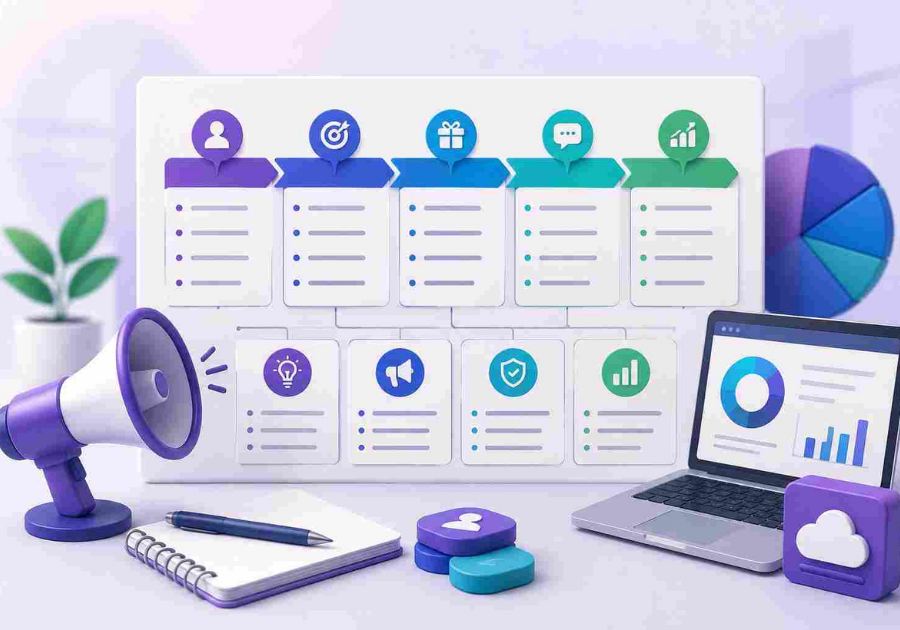
You can turn the framework into a one-page internal document.
1. Ideal Customer
Who are we targeting?
2. Customer Situation
What is happening in their business?
3. Core Problem
What problem are they trying to solve?
4. Desired Outcome
What does success look like?
5. Competitive Alternatives
What would they do if our product did not exist?
6. Differentiator
Why is our approach meaningfully different?
7. Positioning Statement
For [customer] who [problem], [product] is a [category] that [outcome]. Unlike [alternative], it [differentiator].
8. Core Value Proposition
9. Messaging Pillars
Pillar 1: ___________________________
Pillar 2: ___________________________
Pillar 3: ___________________________
10. Proof Points
- Customer results
- Case studies
- Testimonials
- Product data
- Third-party validation
- Demonstrations
11. Persona Messages
12. Buyer-Stage Messages
Awareness: ___________________________
Consideration: ________________________
Decision: _____________________________
13. CTA
This template gives your team a practical SaaS product messaging framework rather than a collection of disconnected copywriting exercises.
How to Turn SaaS Product Features Into Customer-Centered Messaging
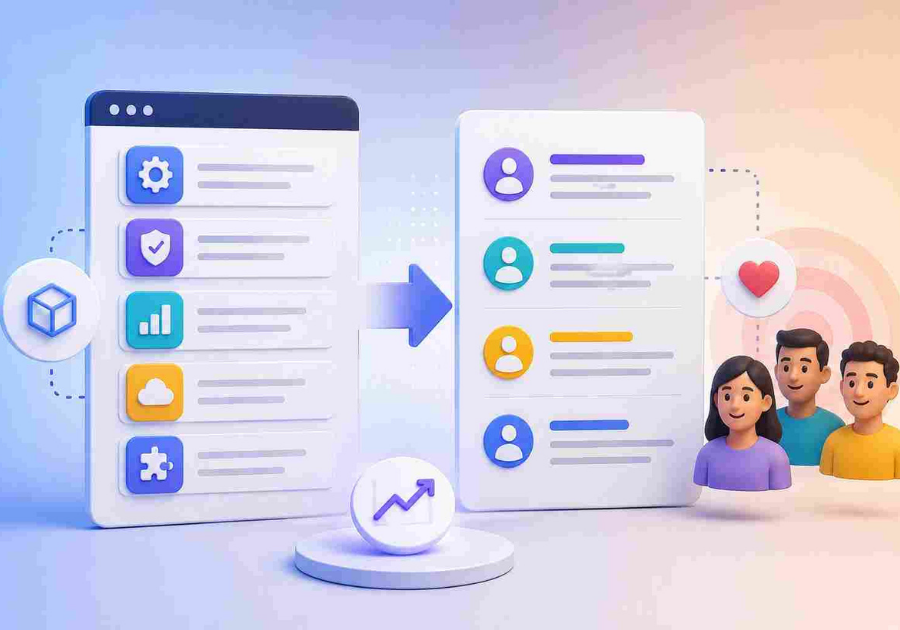
One of the easiest ways to improve SaaS messaging is to stop presenting features as if they are benefits.
Example 1: Analytics software
Feature: Real-time dashboards
Weak:
“Access real-time dashboards.”
Better:
“Monitor performance without waiting for weekly reports.”
Stronger:
“Spot changes in campaign performance while there is still time to act.”
Example 2: CRM software
Feature: Automated follow-ups
Weak:
“Automated follow-up sequences.”
Better:
“Keep leads engaged automatically.”
Stronger:
“Make sure qualified prospects receive timely follow-ups without adding manual work for sales reps.”
Example 3: HR software
Feature: Automated onboarding
Weak:
“Automate employee onboarding.”
Better:
“Reduce manual onboarding work.”
Stronger:
“Give new employees a consistent first-week experience while reducing administrative work for HR.”
The progression is:
What it has → What it does → What the customer gets → Why the business cares
That is the heart of customer-centered product messaging.
SaaS Product Messaging Examples
Let’s look at several practical examples.
Example 1: Project Management SaaS
Feature
Automated task reminders.
Generic message
Powerful project management automation.
Customer-centered message
Keep projects moving without manually chasing every task owner.
Business outcome
More predictable project delivery.
Example 2: Sales SaaS
Feature
Lead scoring.
Generic message
AI-powered lead scoring.
Customer-centered message
Help sales teams focus their time on prospects most likely to convert.
Business outcome
Better sales efficiency.
Example 3: Finance SaaS
Feature
Automated reconciliation.
Generic message
Intelligent reconciliation software.
Customer-centered message
Reduce repetitive reconciliation work so finance teams can close books faster.
Business outcome
Lower manual workload and faster financial reporting.
Example 4: Customer Success SaaS
Feature
Customer health scoring.
Generic message
Advanced customer health analytics.
Customer-centered message
Identify accounts at risk before renewal problems become revenue problems.
Business outcome
Earlier intervention and stronger retention.
How SaaS Messaging Should Change Across the Buyer Journey
One message does not need to perform every job.
Your buyer needs different information depending on where they are in the decision.
Awareness Stage
The customer may not even fully understand the problem.
Focus on:
- Problem
- Cost of the problem
- New perspective
- Desired future state
Example:
“Your sales team may not need more leads. It may need faster follow-up.”
Consideration Stage
The customer understands the problem and is exploring solutions.
Focus on:
- Approach
- Differentiation
- Product value
- Use cases
- Features
- Proof
Example:
“Automatically route and prioritize inbound leads based on fit, intent, and sales capacity.”
Decision Stage
The customer is evaluating whether to buy.
Focus on:
- ROI
- Proof
- Implementation
- Security
- Integrations
- Pricing
- Risk reduction
- Customer results
Example:
“See how SaaS teams reduced manual lead management by 40% after implementation.”
Retention and Expansion
Messaging should not stop after the sale.
Focus on:
- Product adoption
- New use cases
- Business value
- Expansion opportunities
- Customer success
The goal is to continuously remind customers:
“Here is the value you are getting from the product.”
How to Use Your Product Messaging Framework Across Marketing and Sales
A good framework should make execution easier.
Website
Your homepage should communicate the central positioning and value proposition quickly.
The hero section should help visitors understand:
- Who the product is for
- What it helps them do
- What category it belongs to
- Why it matters
Website messaging should prioritize clarity over cleverness. Recent SaaS website guidance similarly emphasizes establishing buyer, capability, and category quickly rather than relying on vague creative headlines. (Minute Creative)
Landing Pages
Use persona or use-case-specific messaging.
For example:
SaaS reporting for revenue teams
can become:
“Give revenue leaders a live view of pipeline performance.”
Paid Ads
Paid ads need compressed messaging.
Use:
Problem + Outcome + Differentiator
Example:
Still building campaign reports manually? Automate reporting and give your team more time to optimize performance.
Email Marketing
Email allows more context.
You can use:
Problem → Insight → Solution → Proof → CTA
Sales Decks
Sales decks can follow:
- Customer problem
- Business impact
- New approach
- Product solution
- Differentiation
- Proof
- ROI
- Implementation
- Next step
Product Demos
Sales representatives should not simply demonstrate every feature.
The demo should reinforce the messaging pillars.
If your core message is about faster execution, demonstrate the workflows that produce faster execution.
If your message is about reducing risk, demonstrate the controls that reduce risk.
Messaging should determine what the sales team demonstrates—not the other way around.
Common SaaS Product Messaging Mistakes
Mistake 1: Starting with features
A feature list is not a value proposition.
Fix: Connect every important feature to a customer outcome.
Mistake 2: Trying to appeal to everyone
When your product is “for everyone,” your message usually becomes generic.
Fix: Identify the customer who receives the strongest value.
Mistake 3: Using empty SaaS language
Words such as “powerful,” “seamless,” and “innovative” do not communicate much without evidence.
Fix: Replace adjectives with specifics.
Instead of:
“Powerful analytics.”
Say:
“See which campaigns generate qualified pipeline.”
Mistake 4: Copying competitors
If your competitors say “simple,” “fast,” and “powerful,” repeating those claims will not differentiate you.
Fix: Identify a distinctive customer problem, approach, or outcome.
Mistake 5: Creating too many messaging pillars
If everything is important, nothing is memorable.
Fix: Prioritize three to five major themes and support each with evidence. (Rushogen)
Mistake 6: Making claims without proof
A message becomes more credible when buyers can verify it.
Use:
- Customer stories
- Quantified results
- Testimonials
- Product demonstrations
- Reviews
- Case studies
- Research
- Certifications where relevant
Mistake 7: Using identical messaging for every persona
The core positioning can remain consistent while the emphasis changes.
Fix: Build a persona-message matrix.
Mistake 8: Treating messaging as a one-time project
Your messaging should evolve based on customer feedback and commercial results.
Fix: Establish a regular messaging review process.
How to Measure Whether Your SaaS Messaging Is Working
Good messaging should eventually show up in customer behavior.
Track metrics such as:
Website
- Visitor-to-demo conversion
- Landing-page conversion
- Engagement
- CTA clicks
Marketing
- Lead conversion
- Cost per qualified lead
- Campaign conversion
- Content-assisted conversions
Sales
- Demo-to-opportunity conversion
- Opportunity-to-customer conversion
- Win rate
- Sales-cycle length
- Common objections
Product
- Trial activation
- Time to value
- Feature adoption
- Trial-to-paid conversion
Revenue
- Average contract value
- Customer acquisition cost
- Retention
- Expansion
- Revenue contribution
But don’t assume that one metric proves your messaging works.
A stronger signal is a combination of:
Better understanding + better-qualified leads + stronger conversion + fewer repeated explanations from sales.
When Should a SaaS Company Rebuild Its Product Messaging?
Your messaging may need a significant update when:
You launch a new product
Your original positioning may no longer describe the product accurately.
You target a new ICP
A message designed for startups may not work for enterprise buyers.
Your market changes
New competitors can change the category and buying criteria.
Your conversion rate declines
A drop in conversion can be a signal that your value proposition is no longer resonating.
Sales keeps explaining the product differently
If every salesperson has their own pitch, your messaging system may be too weak.
Customers misunderstand what you do
This is one of the strongest warning signs.
Ask five customers:
“What does this product do?”
If you receive five dramatically different answers, revisit your messaging.
Your product has become more complex
As SaaS platforms add features, the original message can become diluted.
A Simple SaaS Messaging Review Process
You don’t necessarily need to rewrite your entire website immediately.
Start with a messaging audit.
Step 1: Collect your current messaging
Review:
- Homepage
- Product pages
- Sales deck
- Ads
- Email campaigns
- Demo script
- Social profiles
- Case studies
Step 2: Highlight repeated claims
What does your company repeatedly say?
Step 3: Compare those claims with customer language
Review:
- Customer interviews
- Reviews
- Sales calls
- Support tickets
- Win/loss notes
Step 4: Identify the gaps
Ask:
Are we talking about what we built, or what customers want to accomplish?
Step 5: Rebuild the messaging hierarchy
Create:
Core Message → Pillars → Proof → Persona Messages → Channel Messages
Step 6: Test
Put the new messaging in front of real buyers.
Step 7: Roll it out
Give marketing, sales, product, and customer success a shared messaging guide.
Product Messaging Framework vs. Messaging Guide
These are related but not identical.
A product messaging framework establishes the strategic logic.
A messaging guide translates that logic into practical language.
For example:
Framework
We help growing SaaS companies reduce manual reporting work.
Messaging guide
Homepage:
Turn recurring reports into automated dashboards.
Sales pitch:
Your team shouldn’t spend Friday afternoon compiling data that your systems already contain.
Ad:
Stop building reports manually.
Email:
What would your team do with five hours back every week?
The underlying message remains consistent while the expression changes.
How to Create a Strong Messaging Hierarchy
A practical messaging hierarchy can have five levels.
Level 1: Core value proposition
The main promise.
Level 2: Messaging pillars
Three to five reasons to believe the promise.
Level 3: Benefits
The customer outcomes created by each pillar.
Level 4: Features
The capabilities that make those benefits possible.
Level 5: Proof
The evidence supporting your claims.
For example:
Core value:
Help sales teams convert more qualified opportunities.
Pillar:
Respond faster.
Benefit:
Reduce delays between lead arrival and sales engagement.
Feature:
Automated lead routing.
Proof:
Customer results or measured response-time improvement.
This structure prevents the product from becoming a random collection of features.
Frequently Asked Questions About SaaS Product Messaging
What is a product messaging framework?
A product messaging framework is a structured system for defining how a product should be communicated to its target customers. It typically includes the ideal customer, problem, desired outcome, positioning, value proposition, messaging pillars, differentiation, proof points, persona messages, and buyer-stage messaging.
What should a SaaS messaging framework include?
A strong SaaS messaging framework should include your ICP, customer problems, desired outcomes, competitive alternatives, differentiation, positioning statement, core value proposition, messaging pillars, proof points, persona messaging, buyer-stage messaging, objections, CTAs, and measurement criteria.
What is the difference between SaaS positioning and messaging?
SaaS positioning defines how you want buyers to understand your product relative to alternatives. SaaS messaging translates that positioning into words, claims, examples, proof points, and communication used across marketing and sales.
How do you create a SaaS product messaging framework?
Start by researching your ideal customer and their problems. Map competitive alternatives, identify meaningful differentiation, write your positioning statement, develop your value proposition, create three to five messaging pillars, add proof, adapt the messages to buyer personas and stages, and test the framework with real customers.
How many messaging pillars should a SaaS company have?
Three to five messaging pillars are generally easier to remember and execute than a long list of themes. Each pillar should represent a meaningful customer benefit and should be supported by product capabilities and proof.
What is a messaging matrix?
A messaging matrix maps what your company should communicate across different audiences, buyer stages, problems, benefits, proof points, channels, and calls to action. It helps teams maintain strategic consistency while adapting the message to specific situations.
Should SaaS messaging focus on features or benefits?
SaaS messaging should generally lead with customer outcomes and benefits, while features provide the mechanism that makes those outcomes possible. A useful sequence is feature → capability → benefit → outcome → business impact.
How often should SaaS messaging be updated?
There is no universal schedule. Review messaging whenever your ICP, product, market, competitive environment, positioning, or business strategy changes. Even without a major change, periodic customer and sales feedback can reveal opportunities to improve clarity.
How do you test SaaS product messaging?
Test messaging through customer interviews, sales conversations, win/loss analysis, website experiments, landing-page tests, advertisements, emails, demos, and qualitative buyer feedback. A particularly useful test is asking target buyers to explain your product and its value in their own words.
SaaS Product Messaging Framework Checklist
Before publishing your messaging, check every box:
- Is the ideal customer clearly defined?
- Is the customer’s current situation understood?
- Is the underlying problem identified?
- Is the desired outcome clear?
- Have direct and indirect alternatives been mapped?
- Is your differentiation specific?
- Is the positioning statement clear?
- Does the value proposition focus on customer value?
- Are there three to five strong messaging pillars?
- Does every pillar have proof?
- Are features connected to outcomes?
- Is messaging adapted for different personas?
- Is messaging mapped across the buyer journey?
- Does sales use the same strategic narrative?
- Does your website reinforce the positioning?
- Are claims supported by evidence?
- Have real buyers tested the message?
- Are commercial metrics being tracked?
- Is there a process for updating the framework?
If you cannot check several of these boxes, your messaging may need more strategic work before you invest heavily in campaigns.
Final Thoughts: Build a Messaging System, Not Just a Tagline
A SaaS product messaging framework should do more than produce a clever homepage headline.
It should give your company a repeatable system for explaining value.
The strongest framework connects:
Ideal Customer
↓
Customer Problem
↓
Desired Outcome
↓
Competitive Alternatives
↓
Differentiation
↓
Positioning
↓
Value Proposition
↓
Messaging Pillars
↓
Proof
↓
Persona Messaging
↓
Buyer-Stage Messaging
↓
Sales & Marketing Execution
↓
Measurement & Optimization
That system turns product messaging from a copywriting exercise into a commercial asset.
The goal isn’t to make your SaaS product sound impressive.
The goal is to make the right buyer think:
“This product understands my problem, offers the outcome I need, and has a credible reason to be different.”
When your messaging can consistently create that reaction across your website, sales conversations, campaigns, product pages, and buyer journey, it becomes much more than marketing copy.
It becomes part of your go-to-market strategy.
And that is what makes a product messaging framework valuable for SaaS companies: it gives every customer-facing team a clear answer to the same fundamental question—
Why should this customer choose us?
Key Takeaways
- A product messaging framework for SaaS defines how your product communicates value across the customer journey.
- Start with the customer and their situation, not your feature list.
- Go beyond surface-level pain points to understand the business consequences.
- Map competitive alternatives, including manual processes and doing nothing.
- Create differentiation around something your ideal customer genuinely values.
- Use positioning to establish the strategic context before writing customer-facing messages.
- Translate features into benefits, outcomes, and business impact.
- Build three to five messaging pillars and support them with proof.
- Adapt messaging for different buyer personas and stages without changing the core positioning.
- Turn the framework into a messaging matrix that marketing and sales can actually use.
- Test messaging with real customers instead of relying only on internal opinions.
- Measure whether messaging improves understanding, lead quality, conversion, sales efficiency, and revenue.
- Treat your messaging framework as a living system that evolves with your product, customers, and market.
Suggested SEO Title
Product Messaging Framework for SaaS: 10-Step Guide
Suggested Meta Description
Learn how to build a SaaS product messaging framework with ICP research, positioning, value propositions, messaging pillars, proof points, templates, examples, and buyer-stage strategies.
Suggested URL Slug
/product-messaging-framework-for-saas/
Primary Keyword
product messaging framework for SaaS
Secondary Keywords
SaaS product messaging framework, SaaS messaging framework, product messaging strategy, SaaS messaging strategy, SaaS positioning framework, product messaging template, SaaS messaging template, product positioning and messaging, SaaS value proposition, messaging pillars, messaging matrix, SaaS product messaging examples