

Table of Contents
Launching a product without a structured plan often leads to poor positioning, unclear messaging, low adoption, and missed revenue opportunities. That’s where a well-defined Product Marketing Process becomes essential. In today’s competitive landscape, companies can no longer afford to release products and hope for the best. They need a systematic approach that ensures every product reaches its full market potential.
Product marketing connects what a company builds with what customers actually need. It ensures your product reaches the right audience, communicates the right value, and enters the market with a strategy designed to drive adoption and growth. Whether you’re introducing a new product or improving an existing one, following a structured Product Marketing Process reduces uncertainty and improves decision-making across every stage.
In this comprehensive guide, we’ll break down the complete Product Marketing Process step by step, exploring each stage in depth and providing actionable insights that will transform how you bring products to market.
Understanding the Product Marketing Process
What Is Product Marketing?
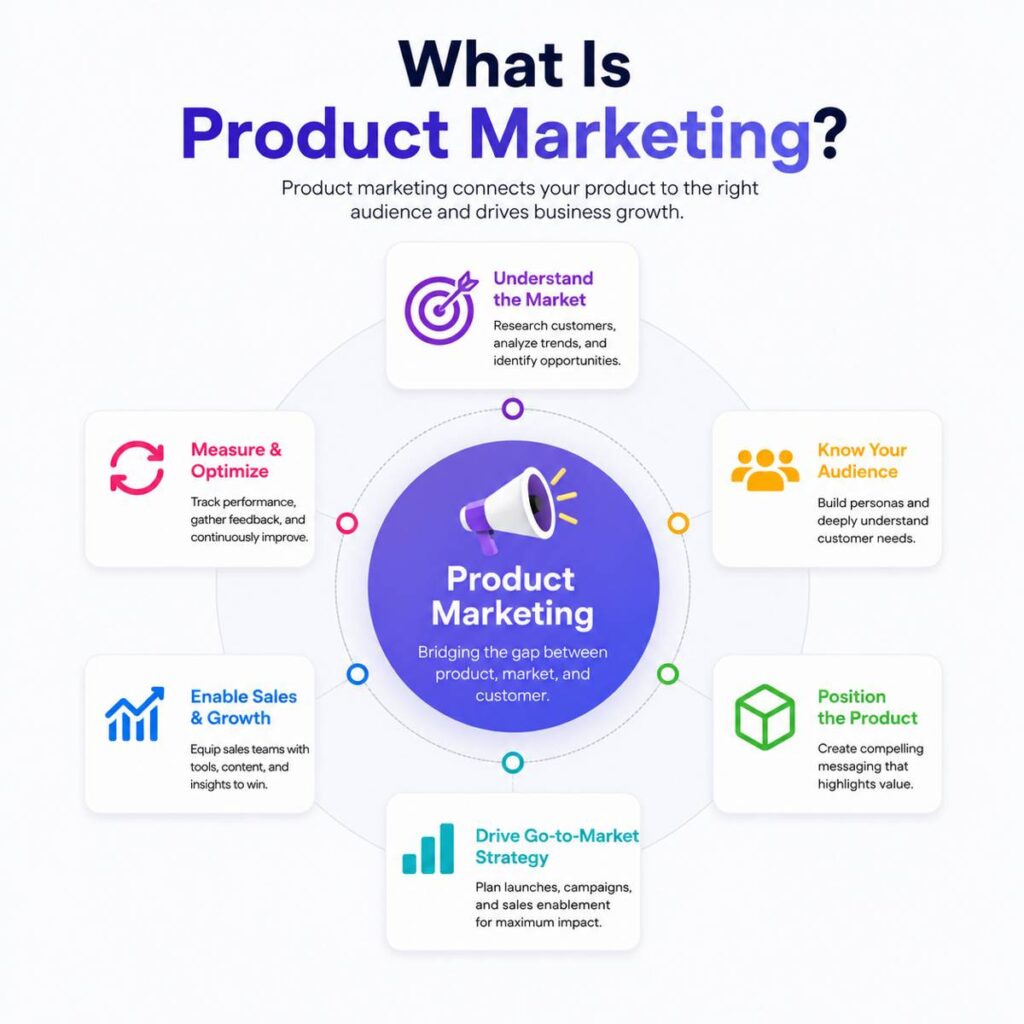
Product marketing is the process of bringing a product to market and ensuring it reaches, engages, and converts the right customers. It combines customer insights, market research, positioning, messaging, go-to-market planning, sales enablement, and performance measurement. Unlike general marketing—which focuses on generating awareness—product marketing focuses on connecting the product with customer needs and driving adoption.
The Product Marketing Process serves as the bridge between product development and sales. While product managers focus on building the right features, and sales teams focus on closing deals, product marketers ensure that what’s being built actually resonates with the target audience and that sales teams have the tools they need to succeed.
Product Marketing vs Traditional Marketing
Understanding the distinction between product marketing and traditional marketing is crucial for implementing an effective Product Marketing Process.
| Aspect | Product Marketing | Traditional Marketing |
|---|---|---|
| Primary Focus | Product adoption and growth | Brand awareness and visibility |
| Decision Drivers | Customer insights and market research | Campaign goals and creative execution |
| Core Objective | Driving product usage and retention | Generating audience interest |
| Cross-functional Work | Close collaboration with product, sales, and engineering | Primarily works within marketing channels |
| Success Metrics | Adoption rates, retention, revenue growth | Impressions, engagement, click-through rates |
| Timeline | Long-term product lifecycle focus | Campaign-based, often short-term |
Traditional marketing excels at building brand equity and generating awareness, but without a structured Product Marketing Process, that awareness rarely translates into adoption and revenue.
Why Businesses Need a Product Marketing Process
A structured Product Marketing Process helps organizations achieve multiple critical objectives:
1. Understand Customer Needs Before Investing Resources
The most expensive mistake companies make is building products nobody wants. A proper Product Marketing Process begins with research, validating that there’s actual demand before significant development investment occurs. This approach saves millions in wasted development costs.
2. Differentiate Products in Competitive Markets
In saturated markets, differentiation is survival. The Product Marketing Process helps identify unique value propositions that set your product apart from competitors, giving customers compelling reasons to choose you.
3. Build Stronger Positioning and Messaging
Without a structured Product Marketing Process, messaging becomes inconsistent and confusing. A systematic approach ensures every communication reinforces the same core value proposition, creating clarity that drives conversion.
4. Launch Products More Effectively
The Product Marketing Process provides a launch framework that coordinates every moving part—from internal training to external campaigns—ensuring products enter the market with momentum rather than confusion.
5. Improve Customer Acquisition and Retention
When products are marketed to the right people with the right message, acquisition costs decrease and retention improves. The Product Marketing Process creates this alignment.
6. Create Alignment Across Marketing, Sales, and Product Teams
Silos destroy product success. The Product Marketing Process serves as the connective tissue between teams, ensuring everyone works toward the same goals with shared understanding.
Without this process, teams often rely on assumptions instead of customer insights, leading to products that miss the mark and campaigns that fail to convert.
The 8 Stages of the Product Marketing Process
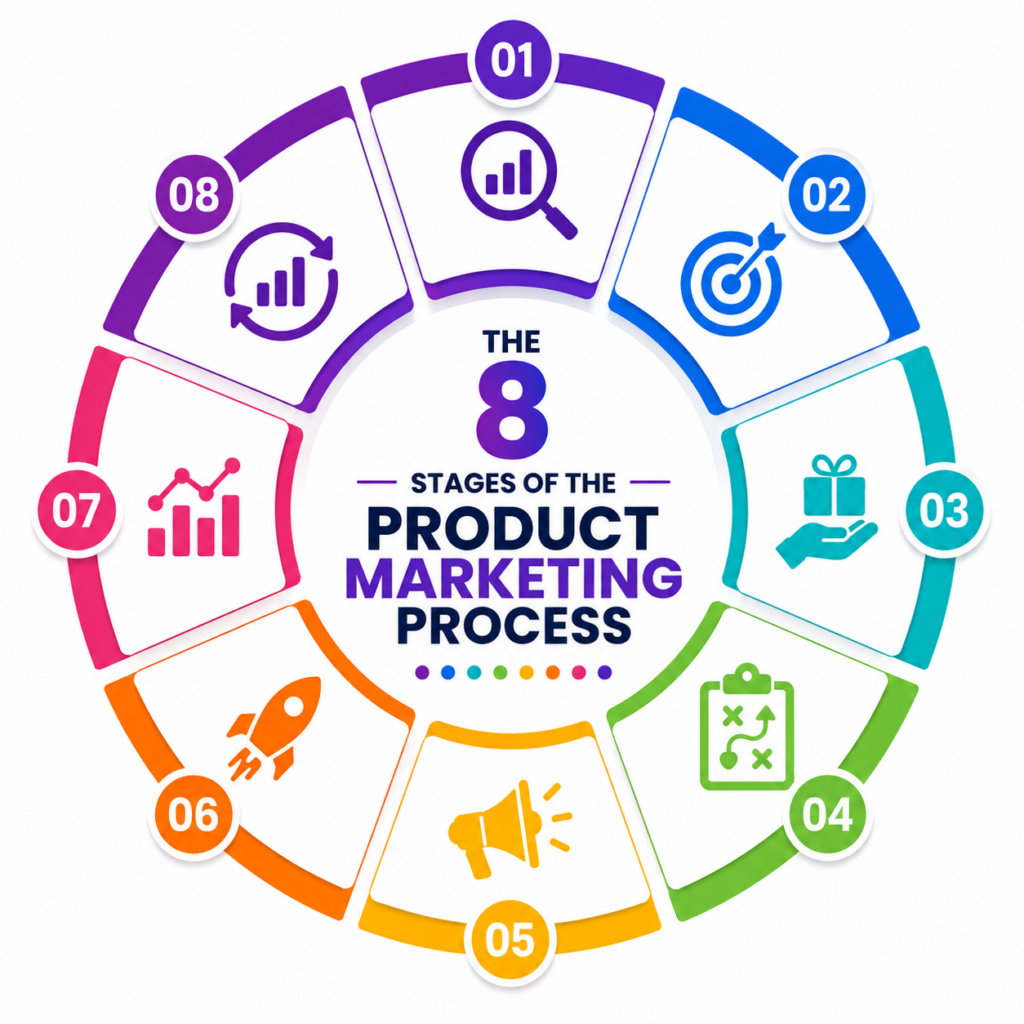
Let’s explore each stage of the Product Marketing Process in comprehensive detail, providing actionable frameworks and real-world applications.
Stage 1: Conduct Market Research and Opportunity Analysis
Every successful Product Marketing Process begins with understanding the market. This foundational stage establishes whether there’s genuine demand for your solution and identifies the specific opportunities available.
Why Market Research Matters
The Product Marketing Process starts with research because decisions based on data outperform decisions based on intuition. Market research helps businesses identify demand, validate opportunities, reduce uncertainty, and build confidence before committing significant resources.
Key Activities in the Research Stage
Identify Customer Problems
The first step in the Product Marketing Process is understanding what customers actually struggle with. This requires moving beyond surface-level complaints to identify root problems that your product can solve.
To identify customer problems, you need to understand:
- What customers struggle with in their daily operations
- Existing alternatives they currently use
- The workarounds they’ve developed
- Desired outcomes they’re not achieving
- The emotional impact of their current challenges
- The financial cost of unsolved problems
Methods for Problem Discovery
Effective problem discovery in the Product Marketing Process employs multiple research methods:
- In-Depth Customer Interviews: One-on-one conversations that explore challenges in depth
- Surveys: Quantitative data collection from broader audiences
- Customer Review Analysis: Studying what customers say about competitors
- Support Ticket Analysis: Understanding recurring issues and frustrations
- Social Listening: Monitoring social media conversations about problems
- Forum and Community Research: Learning from discussions in relevant communities
- Sales Call Transcripts: Analyzing what prospects mention as challenges
Analyze Competitors
Understanding the competitive landscape is essential in the Product Marketing Process. You need to know who you’re competing against, how they position themselves, and where opportunities exist.
Study Competitor Elements:
- Messaging and positioning strategies
- Pricing models and packaging
- Content strategy and thought leadership
- Customer sentiment and reviews
- Feature sets and capabilities
- Target audience focus
- Go-to-market approaches
- Sales and support processes
Questions to Ask About Competitors:
- What do competitors do exceptionally well?
- Where are they vulnerable or weak?
- What market gaps exist that they’re not addressing?
- Which customer segments are they ignoring?
- What complaints frequently appear in their reviews?
- How do their customers describe their limitations?
Validate Market Demand
Before proceeding in the Product Marketing Process, you must validate actual demand. This means confirming that:
- The problem is real and significant
- Customers recognize the problem
- There’s willingness to pay for a solution
- The market is large enough to support your business
- Timing is right for market entry
Validation Techniques:
- Landing page tests with email capture
- Pre-sale campaigns
- Crowdfunding campaigns
- Beta testing with waiting lists
- Paid advertising tests
- Concept validation interviews
- Competitor analysis showing market size
Deliverables from Stage 1
A thorough first stage of the Product Marketing Process produces:
- Market Analysis Report: Comprehensive overview of market conditions
- Competitor Matrix: Side-by-side comparison of competitive offerings
- Customer Insight Summary: Documented findings from customer research
- Opportunity Assessment: Clear analysis of market potential
- Validation Evidence: Proof of demand through research
Stage 2: Define Buyer Personas
You cannot market effectively to everyone. The second stage of the Product Marketing Process involves creating detailed buyer personas that represent your ideal customers based on research and behavior patterns.
Why Personas Are Critical
Personas are foundational to the Product Marketing Process because they:
- Focus marketing efforts on the most promising segments
- Enable personalized, relevant messaging
- Guide product decisions toward customer needs
- Align sales and marketing on target audiences
- Improve conversion rates through better targeting
- Reduce wasted marketing spend on unqualified audiences
Elements of Effective Buyer Personas
The Product Marketing Process requires personas built around specific, research-backed attributes:
Demographics
- Age range and generation
- Gender (when relevant)
- Geographic location
- Education level
- Income range
Professional Profile
- Industry
- Company size and type
- Job title and role
- Decision-making authority
- Team size and structure
- Career trajectory
Goals and Objectives
- Business objectives they need to achieve
- Personal career goals
- Success metrics they’re measured against
- Desired outcomes from using your product
Challenges and Pain Points
- Current obstacles they face
- Operational barriers
- Resource limitations
- Emotional frustrations
- Risks they’re trying to avoid
Decision Triggers
- Budget availability and approval process
- Timeline for purchase decisions
- Stakeholder involvement and influence
- Evaluation criteria they use
- Risk tolerance
Example Buyer Persona
Name: Marketing Operations Director
Age: 35-45
Industry: SaaS and Technology
Company Size: 200-2,000 employees
Goals: Increase marketing efficiency, prove ROI, scale campaigns effectively
Challenges: Limited marketing resources, data silos, attribution difficulties
Decision Trigger: Need for faster execution and measurable ROI
Primary Channels: LinkedIn, industry events, peer recommendations
Persona Refinement Process
The Product Marketing Process treats personas as living documents that evolve:
- Initial Creation: Based on research and assumptions
- Validation: Testing personas against real customer data
- Refinement: Updating based on new insights
- Segmentation: Creating sub-personas for different use cases
- Documentation: Creating shareable persona profiles
Well-defined personas improve targeting and messaging quality throughout the Product Marketing Process, ensuring every campaign reaches the right people with the right message.
Stage 3: Build Product Positioning
Positioning defines how your audience should think about your product. It’s arguably the most critical decision in the Product Marketing Process because it determines how everything else—messaging, pricing, marketing channels—will be structured.
What Is Product Positioning?
Product positioning is the strategic act of creating a distinct place for your product in the minds of your target customers. Strong positioning answers one essential question: Why should customers choose you instead of alternatives?
The Product Marketing Process treats positioning as a foundational element because it shapes:
- How customers perceive your brand
- Which features you emphasize
- What pricing you can command
- Which competitors you compete against
- What messaging resonates
The Positioning Framework
A structured Product Marketing Process uses a clear framework for positioning:
Target Audience
Who is the product specifically for? This narrows your focus and increases relevance.
Problem
What challenge or need does your product address? What’s the pain point?
Solution
How does your product solve the problem? What’s the mechanism?
Differentiator
What makes your solution uniquely valuable? Why should anyone care?
Category
What market space do you operate in? How do you frame the offering?
Example Positioning Statement
Using this framework in the Product Marketing Process produces statements like:
“For growing SaaS companies seeking to scale effectively, our product marketing services help launch and expand products through research-driven positioning and go-to-market execution that drives measurable adoption.”
Positioning Types
The Product Marketing Process can employ various positioning approaches:
Functional Positioning
Focuses on features and capabilities. Example: “The most comprehensive analytics platform.”
Emotional Positioning
Focuses on feelings and identity. Example: “The marketing tool that makes you look brilliant.”
Competitive Positioning
Directly contrasts with competitors. Example: “The only analytics tool that doesn’t require data science skills.”
Cultural Positioning
Connects to broader movements. Example: “Built for the modern, distributed workforce.”
Value-Based Positioning
Focuses on ROI and results. Example: “Achieve 3x faster campaign launch with less effort.”
Outcomes of Good Positioning
When positioning is executed well in the Product Marketing Process, you achieve:
- Clear Differentiation: Customers immediately understand why you’re different
- Higher Conversion Rates: Messaging resonates because it’s relevant
- Better Customer Understanding: Prospects recognize themselves in your communication
- Stronger Market Presence: Your brand occupies a clear mental space
- Premium Pricing Capability: Differentiation justifies higher prices
- Reduced Price Sensitivity: Value is perceived beyond cost
Stage 4: Develop Product Messaging
Positioning explains where you fit in the market. Messaging explains why customers should care. This stage of the Product Marketing Process transforms strategic positioning into compelling communication that drives action.
The Difference Between Positioning and Messaging
- Positioning: Where your product fits in the market relative to competitors
- Messaging: What you say to customers about why they should buy
Good product messaging in the Product Marketing Process turns features into customer value, making the abstract concrete and the generic specific.
Creating a Messaging Hierarchy
The Product Marketing Process organizes messaging in a hierarchy that ensures consistency across all communications:
Core Message (The “Big Idea”)
The single most important thing customers should remember. Usually one sentence or phrase that captures your value proposition.
Supporting Messages
Key benefits that support the core message. Each should be distinct and compelling.
Proof Points
Evidence that supports your claims. This includes data, testimonials, case studies, and social proof.
Features with Benefits
Individual features translated into customer benefits.
Features vs Benefits Translation
The Product Marketing Process requires translating features into benefits:
| Feature | Benefit |
|---|---|
| Comprehensive market analysis | Make better business decisions with less risk |
| Detailed persona research | Run more relevant campaigns that convert |
| Sales enablement materials | Improve conversion rates with aligned teams |
| Automated reporting | Save hours of manual analysis time |
| Integration with existing tools | Reduce disruption and training requirements |
| AI-powered recommendations | Improve campaign performance without data expertise |
Effective Messaging Principles
The Product Marketing Process follows these messaging principles:
Focus on Outcomes, Not Features
Customers buy better outcomes, not features. Your messaging should emphasize what customers achieve, not what the product does.
Use Customer Language
Avoid internal jargon and technical terminology. Use the words customers themselves use to describe their problems and desired solutions.
Be Specific
Vague claims aren’t convincing. Specificity builds credibility. Instead of “improve efficiency,” use “reduce campaign setup time by 60%.”
Maintain Consistency
Every piece of communication should reinforce the same core message. Inconsistent messaging confuses customers and weakens your brand.
Test and Refine
Messaging should be continuously tested through A/B testing, customer feedback, and conversion analysis.
Messaging Framework Example
Here’s how a complete messaging hierarchy might look:
Core Message: “Transform how you launch products with data-driven marketing that actually works.”
Supporting Messages:
- Save 40% of time on market research
- Reduce launch risk through validation
- Increase adoption rates with better targeting
Proof Points:
- 92% customer retention rate
- Featured in top industry publications
- Trusted by 500+ SaaS companies
Feature-to-Benefit:
- Feature: Competitive analysis tools
- Benefit: Instantly identify market gaps and opportunities
Stage 5: Create a Go-To-Market Strategy
Your GTM strategy determines how your product reaches customers. This stage of the Product Marketing Process translates positioning and messaging into an actionable plan for market entry and growth.
What Is a Go-To-Market Strategy?
A GTM strategy is the comprehensive plan for launching and scaling a product. In the Product Marketing Process, it answers critical questions:
- Who are we specifically targeting with our launch?
- Which channels and tactics will we use to reach them?
- How will we generate demand and interest?
- How will sales convert interest into revenue?
- What’s our pricing and packaging strategy?
- What resources and timeline do we need?
Key Components of a GTM Strategy
The Product Marketing Process builds GTM strategies around these core elements:
Channel Selection
Choosing the right channels is crucial to the Product Marketing Process. Options include:
- Search Engine Optimization (SEO)
- Paid Advertising (Google, LinkedIn, Facebook)
- Social Media Marketing
- Strategic Partnerships and Alliances
- Email Marketing Campaigns
- Content Marketing (blogs, whitepapers, videos)
- Webinars and Virtual Events
- Industry Events and Conferences
- Direct Sales Outreach
- Public Relations and Media
Channel Selection Criteria:
- Where does your target audience spend time?
- What channels will your competitors use?
- What’s your budget and resource capacity?
- Which channels offer the best ROI potential?
- What’s the timeline for channel activation?
Pricing and Packaging Strategy
Pricing decisions in the Product Marketing Process consider:
- Value delivered to customers
- Competitive pricing landscape
- Customer willingness to pay
- Cost structure and desired margins
- Pricing psychology and perception
- Tiered or tierless packaging
- Subscription vs one-time pricing
- Enterprise vs SMB pricing
Pricing Models:
- Value-based pricing: Price according to value delivered
- Competitor-based pricing: Align with market rates
- Cost-plus pricing: Add margin to costs
- Penetration pricing: Enter with low initial prices
- Skimming pricing: Start high, lower over time
Demand Generation
Building awareness and interest through:
- Content marketing strategies
- Thought leadership content
- Product demonstrations
- Case studies and testimonials
- Free trials and freemium models
- Referral programs
- Influencer partnerships
- Co-marketing opportunities
Sales Planning
Equipping sales teams with:
- Pitch decks and presentations
- Messaging guides and scripts
- Objection handling documents
- Competitive battlecards
- Product training and certifications
- Sales playbooks
- Demo scripts and guides
Stage 6: Prepare the Product Launch Strategy
Launching is more than publishing a webpage. It requires coordinated execution across multiple teams and channels. This stage of the Product Marketing Process ensures everything comes together for maximum impact.
Types of Product Launches
The Product Marketing Process distinguishes between various launch types:
New Product Launch
Introducing an entirely new product to the market.
Product Update Launch
Launching significant new features or improvements.
New Market Launch
Taking an existing product into new geographic or demographic markets.
Pivot or Repositioning Launch
Changing how an existing product is positioned in the market.
Product Launch Checklist
A comprehensive Product Marketing Process includes a detailed launch checklist:
Pre-Launch Phase (4-8 Weeks Before):
- Finalize product positioning and messaging
- Prepare landing pages and website updates
- Train internal teams (sales, support, customer success)
- Build launch campaigns and assets
- Prepare press releases and media materials
- Create demo videos and product walkthroughs
- Set up analytics and tracking
- Establish launch KPIs and benchmarks
- Plan launch day activities
- Coordinate with product teams on readiness
Launch Day Execution:
- Announce product across all channels
- Activate advertising campaigns
- Send launch emails to database
- Engage social media audiences
- Monitor engagement and sentiment
- Track initial metrics
- Address any launch issues
- Activate PR and media coverage
- Host launch events or webinars
Post-Launch Activities (1-4 Weeks After):
- Collect and analyze customer feedback
- Measure performance against KPIs
- Identify areas for improvement
- Adjust campaigns based on performance
- Develop case studies from early adopters
- Address product issues and bugs
- Plan follow-up campaigns
- Optimize based on learnings
Launch Channels and Tactics
The Product Marketing Process employs multiple channels for launch:
Digital Channels:
- Website and dedicated landing pages
- Email marketing to existing database
- Social media campaigns
- Paid advertising
- Content marketing
- SEO optimization
- Webinars and live streams
Traditional Channels:
- Press releases
- Media relations
- Industry analyst briefings
- Events and trade shows
- Direct mail
Sales Channels:
- Direct sales outreach
- Partner and channel sales
- Strategic account campaigns
Creating Launch Momentum
The Product Marketing Process focuses on building launch momentum through:
Teaser Campaigns
Building anticipation before launch date through hints and previews.
Early Access Programs
Giving select customers early access to generate testimonials and case studies.
Launch Events
Creating memorable launch experiences through virtual or in-person events.
Influencer Amplification
Leveraging industry influencers to expand reach.
User-Generated Content
Encouraging customers to share their experiences.
Stage 7: Enable Sales Teams
Sales enablement ensures customer-facing teams communicate product value consistently and effectively. This stage of the Product Marketing Process bridges the gap between marketing and sales.
What Is Sales Enablement?
Sales enablement is the process of providing sales teams with everything they need to sell effectively. In the Product Marketing Process, it ensures that:
- Sales teams understand product positioning and messaging
- They can communicate value propositions clearly
- They have the materials and training needed to sell
- They’re prepared for objections and competitive situations
Essential Sales Enablement Materials
The Product Marketing Process creates comprehensive sales enablement assets:
Product Deck
A clear, compelling presentation that covers:
- Overview of the product and its value
- Key features and benefits
- Target audience and ideal customer profile
- Competitive differentiation
- Pricing and packaging
- Customer success stories
Battlecards
Competitive comparison documents that help sales teams:
- Understand competitor strengths and weaknesses
- Position against specific competitors
- Address competitive objections
- Highlight differentiation clearly
Objection Handling Documents
Prepared responses to common concerns:
- “Why is your product better than X?”
- “You’re more expensive than competition.”
- “We’re happy with our current solution.”
- “The implementation looks complex.”
- “Why should we switch now?”
Objection Handling Framework:
- Acknowledge the objection
- Validate the concern
- Address with facts and benefits
- Provide proof points
- Offer a path forward
Sales Playbooks
Comprehensive guides covering:
- Ideal customer profiles
- Prospect identification strategies
- Outreach scripts and templates
- Sales call frameworks
- Demo scripts
- Pricing strategy and negotiation
- Closing techniques
Product Training
Ensuring sales teams understand:
- Product features and capabilities
- Customer use cases and applications
- Technical specifications and requirements
- Implementation and onboarding processes
- Support and service offerings
The Sales Enablement Process
The Product Marketing Process implements sales enablement through:
Training Sessions
Initial training before launch plus ongoing refreshers.
Resource Centers
Centralized repositories for all sales materials.
Competitive Intelligence
Continuous updates on competitor activity and positioning.
Sales Support
Ongoing assistance from product marketing and product teams.
Performance Tracking
Monitoring which materials and approaches are most effective.
Stage 8: Measure Performance and Optimize
The Product Marketing Process doesn’t end after launch. Continuous measurement creates long-term growth and ensures ongoing improvement.
Why Measurement Matters
Without measurement, the Product Marketing Process becomes guesswork. Measurement enables:
- Understanding what’s working and what isn’t
- Making data-driven decisions
- Proving marketing ROI
- Justifying budget and resources
- Identifying optimization opportunities
- Demonstrating business impact
Key Product Marketing KPIs
Customer Acquisition Cost (CAC)
How much it costs to acquire a new customer. Critical in the Product Marketing Process because it directly impacts profitability.
Formula: Total marketing and sales costs / Number of new customers acquired
Conversion Rate
Percentage of visitors or leads who become customers. Shows how effectively your Product Marketing Process is converting interest into revenue.
Formula: Number of customers / Number of leads × 100
Product Adoption Rate
How actively users engage with your product. Measures whether your Product Marketing Process is driving actual usage.
Formula: Number of active users / Total number of users × 100
Retention Rate
Customer loyalty over time. High retention suggests your Product Marketing Process has found product-market fit.
Formula: (Customers at end of period – New customers) / Customers at start of period × 100
Revenue Growth
Business impact generated by your efforts. The ultimate measure of Product Marketing Process success.
Formula: (Current period revenue – Previous period revenue) / Previous period revenue × 100
Marketing Qualified Leads (MQLs)
Leads that marketing has determined are ready for sales engagement.
Sales Qualified Leads (SQLs)
Leads that sales has confirmed as genuine opportunities.
Pipeline Velocity
How quickly leads move through the sales funnel.
Customer Lifetime Value (CLV)
Total revenue expected from a customer over their relationship with your company.
Building a Feedback Loop
The Product Marketing Process thrives on continuous feedback:
Customer Feedback Sources:
- Surveys and NPS scores
- Customer interviews
- Support ticket analysis
- Social media monitoring
- Review sites and testimonials
- Usage analytics
Sales Feedback Sources:
- Sales call recordings
- Win/loss analysis
- Competitive feedback
- Sales team surveys
- Deal review discussions
Product Feedback Sources:
- Feature requests
- Usage patterns
- Bug reports
- Customer success interactions
Continuous Optimization
Based on measurement and feedback, the Product Marketing Process continuously refines:
Positioning
Adjusting based on competitive changes and customer perceptions.
Messaging
Optimizing based on what resonates with target audiences.
GTM Strategy
Shifting channels and tactics based on performance data.
Launch Execution
Improving based on what worked and what didn’t.
Sales Enablement
Updating materials and training based on sales feedback.
Common Mistakes in the Product Marketing Process
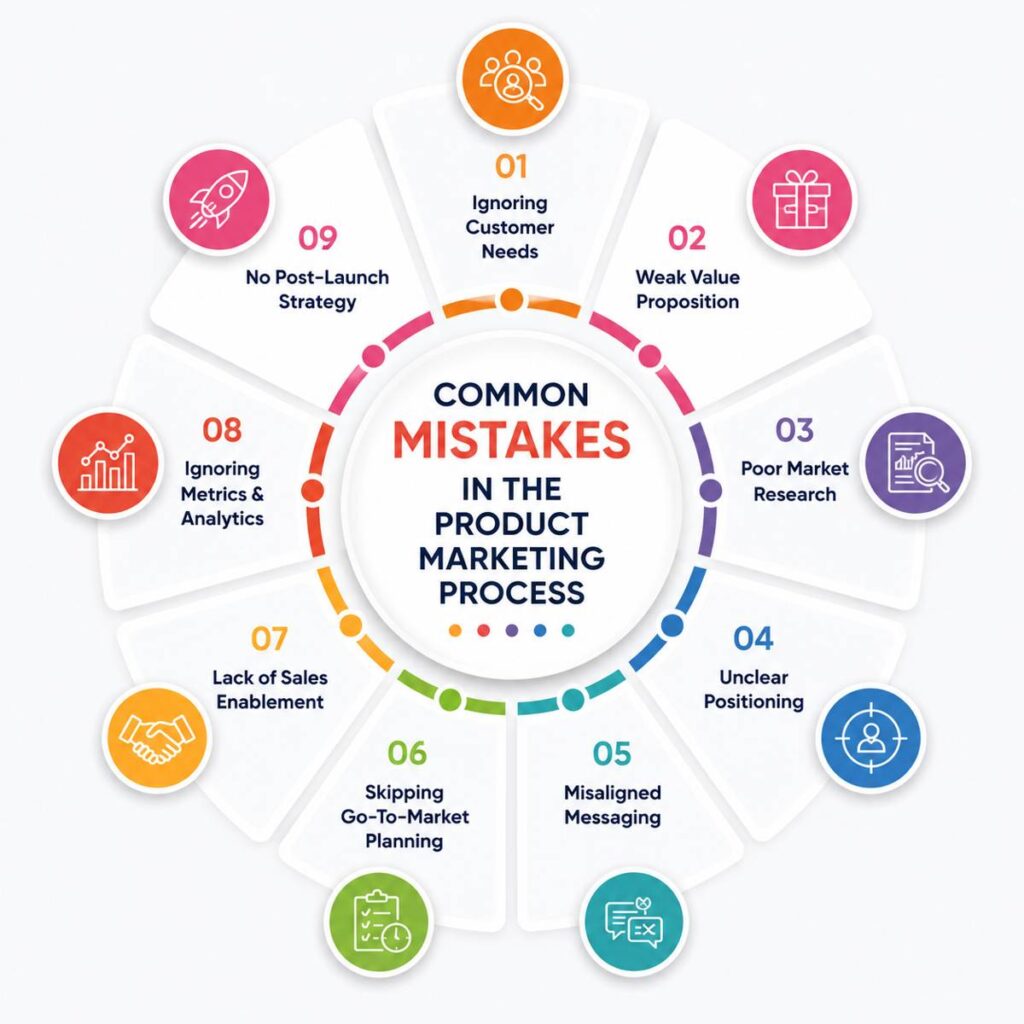
Avoid these common issues that undermine the Product Marketing Process:
Skipping Research
Assumptions create weak decisions. Companies that skip the research stage of the Product Marketing Process often build products for imaginary customers.
Consequences:
- Products that miss the mark
- Wasted development resources
- Poor launch performance
- Ineffective marketing campaigns
Solution: Commit to thorough research before proceeding in the Product Marketing Process.
Weak Positioning
When positioning is unclear, customers don’t understand your value. This is one of the most common failures in the Product Marketing Process.
Consequences:
- Confused customers
- Commoditization and price competition
- Ineffective messaging
- Poor differentiation
Solution: Invest in developing clear, differentiated positioning early in the Product Marketing Process.
Generic Messaging
Broad messaging reduces conversion. The Product Marketing Process requires specific, relevant messaging that speaks to identified personas.
Consequences:
- Low response rates
- Poor targeting
- Wasted marketing spend
- Unclear value propositions
Solution: Develop persona-specific messaging that addresses specific pains and outcomes.
Poor Launch Planning
Without proper planning, products lose momentum. A rushed or uncoordinated launch undermines the entire Product Marketing Process.
Consequences:
- Weak initial traction
- Missed opportunities
- Confused customers
- Poor internal alignment
Solution: Create detailed launch plans that cover all aspects of the Product Marketing Process.
Ignoring Performance Metrics
When you don’t measure, optimization becomes impossible. The Product Marketing Process requires continuous measurement.
Consequences:
- Inability to improve
- Wasted resources
- Poor ROI demonstration
- Lack of accountability
Solution: Define and track KPIs throughout the Product Marketing Process.
Best Practices for an Effective Product Marketing Process
To improve results from your Product Marketing Process:
Start with Customer Insights
Every successful Product Marketing Process begins with understanding customers. Invest in research before making decisions.
Build Clear Positioning
Don’t rush positioning. The Product Marketing Process requires thoughtful positioning before anything else.
Test Messaging Early
Test messages with customers before full launch. The Product Marketing Process should include message validation.
Align Product and Sales Teams
Break down silos. The Product Marketing Process works best when teams collaborate closely.
Track Metrics Consistently
Define your KPIs early and track them throughout the Product Marketing Process.
Treat Launches as Ongoing Processes
Launch isn’t an event; it’s a phase. The Product Marketing Process continues post-launch with optimization.
Product Marketing Process Example
Challenge
A SaaS company struggled with low adoption after launch. Despite significant marketing spend, customers weren’t engaging with the product or converting to paid plans.
Strategy
The company re-engaged the Product Marketing Process systematically:
Research:
- Conducted customer interviews with existing users
- Analyzed why customers weren’t adopting
- Identified gaps between product capabilities and customer needs
- Studied competitors’ approach to similar problems
- Discovered confusion around product value
Persona Refinement:
- Created detailed personas for different user segments
- Identified the most valuable customer segment
- Understood specific goals and challenges of each segment
- Mapped the decision-making process
Positioning Overhaul:
- Repositioned product around customer outcomes
- Emphasized differentiation from competitors
- Created clear value proposition
- Simplified how the product was described
Messaging Improvement:
- Translated features into customer benefits
- Used customer language in all communications
- Created tiered messaging for different personas
- Developed clear proof points
GTM Strategy Redesign:
- Shifted channels to reach target personas
- Created targeted campaigns for each segment
- Refined pricing based on value perceptions
- Developed sales enablement materials
Execution:
- Updated all marketing materials
- Trained sales teams on new positioning
- Redesigned website and content
- Launched targeted campaigns
Results
After implementing the improved Product Marketing Process:
- Qualified Leads: Increased by 180%
- Conversion Rates: Improved from 2% to 7%
- Product Adoption: Grew 130% in 90 days
- Customer Retention: Improved by 45%
- Revenue Growth: 67% year-over-year increase
Product Marketing Process Checklist
Use this checklist before proceeding with your Product Marketing Process:
Market Research Stage
☐ Customer problems identified and documented
☐ Competitor analysis completed
☐ Market demand validated
☐ Opportunity assessment finalized
☐ Research findings shared with team
Persona Development Stage
☐ Primary buyer persona created
☐ Secondary personas developed
☐ Personas validated with real customer data
☐ Personas shared with sales and product teams
☐ Personas integrated into marketing strategy
Positioning Stage
☐ Target audience clearly defined
☐ Problem statement developed
☐ Solution value articulated
☐ Differentiator identified
☐ Positioning statement finalized
☐ Positioning validated with customers
Messaging Stage
☐ Core message developed
☐ Supporting messages created
☐ Proof points identified
☐ Features translated to benefits
☐ Messaging tested with target audience
☐ Messaging guide documented
GTM Strategy Stage
☐ Target channels selected
☐ Pricing strategy defined
☐ Demand generation plan created
☐ Sales plan developed
☐ Timeline established
☐ Resources allocated
Launch Preparation Stage
☐ Product launch checklist created
☐ All launch assets prepared
☐ Internal teams trained
☐ Campaigns built and scheduled
☐ Launch day activities planned
☐ Post-launch plan developed
Sales Enablement Stage
☐ Product deck created
☐ Battlecards developed
☐ Objection handling documents prepared
☐ Sales training completed
☐ Sales playbook finalized
☐ Ongoing enablement planned
Measurement and Optimization Stage
☐ KPIs defined
☐ Analytics set up
☐ Baseline metrics established
☐ Feedback loop created
☐ Optimization process defined
☐ Regular reporting scheduled
Frequently Asked Questions
What are the stages of the product marketing process?
The Product Marketing Process consists of eight stages: market research and opportunity analysis, define buyer personas, build product positioning, develop product messaging, create a go-to-market strategy, prepare the product launch strategy, enable sales teams, and measure performance and optimize.
What is the difference between product marketing and product management?
Product management builds the product, focusing on features, development, and technical execution. Product marketing brings the product to market and drives adoption, focusing on customers, positioning, and commercial success. Both are essential in the Product Marketing Process.
How long does product marketing take?
The timeline depends on product complexity, market conditions, and organizational readiness. Most structured launches require several weeks to months. The Product Marketing Process should be tailored to your specific situation.
What should a product marketing strategy include?
A comprehensive strategy in the Product Marketing Process includes research insights, buyer personas, positioning, messaging, GTM planning, launch execution, sales enablement, and performance measurement.
How do you measure product marketing success?
Measure success through customer acquisition cost, conversion rates, product adoption rates, retention rates, and revenue growth. These metrics indicate whether your Product Marketing Process is delivering results.
How is product marketing different from brand marketing?
Product marketing focuses on driving adoption and usage of specific products. Brand marketing focuses on overall brand awareness and perception. Product marketing supports brand marketing and vice versa.
What skills are needed for product marketing?
Successful product marketers need customer empathy, strategic thinking, messaging skills, analytical ability, cross-functional collaboration, project management, and adaptability. The Product Marketing Process requires all these skills.
Final Thoughts
A successful product launch doesn’t happen by chance. The right Product Marketing Process helps businesses understand customers, position products effectively, execute launches confidently, and continuously improve results.
When research, positioning, messaging, and go-to-market execution work together through a structured Product Marketing Process, products gain stronger market traction and sustainable growth. Companies that invest in this process consistently outperform those that don’t.
The Product Marketing Process is not a one-time effort but a continuous cycle of learning, execution, and optimization. Products evolve, markets change, and customer needs shift. The best organizations treat the Product Marketing Process as an ongoing commitment rather than a one-and-done project.
By following the comprehensive framework outlined in this guide and avoiding common mistakes, you can build a Product Marketing Process that consistently delivers results. Start with customer insights, build clear positioning, develop compelling messaging, execute with precision, measure what matters, and continuously optimize. That’s the formula for product marketing success.
Your products deserve an effective Product Marketing Process. Your customers deserve to understand your value. Your business deserves the revenue that follows. Now it’s time to make it happen with a structured, strategic approach to product marketing.
By implementing this comprehensive Product Marketing Process, organizations can transform how they bring products to market, ensuring every launch achieves its full potential and drives sustainable growth.