
Building a great product is no longer enough.
Many businesses spend months developing products only to discover that customers do not understand the value, adoption remains low, and growth becomes difficult. In most cases, the issue is not product quality—it is the absence of a clear product marketing framework.
A product marketing framework helps businesses understand customers, position products effectively, communicate value, launch strategically, and continuously improve performance.
Whether you are a startup founder, marketer, product manager, or business owner, this guide will show you how to create a repeatable system that turns products into successful market offerings.
What Is a Product Marketing Framework?
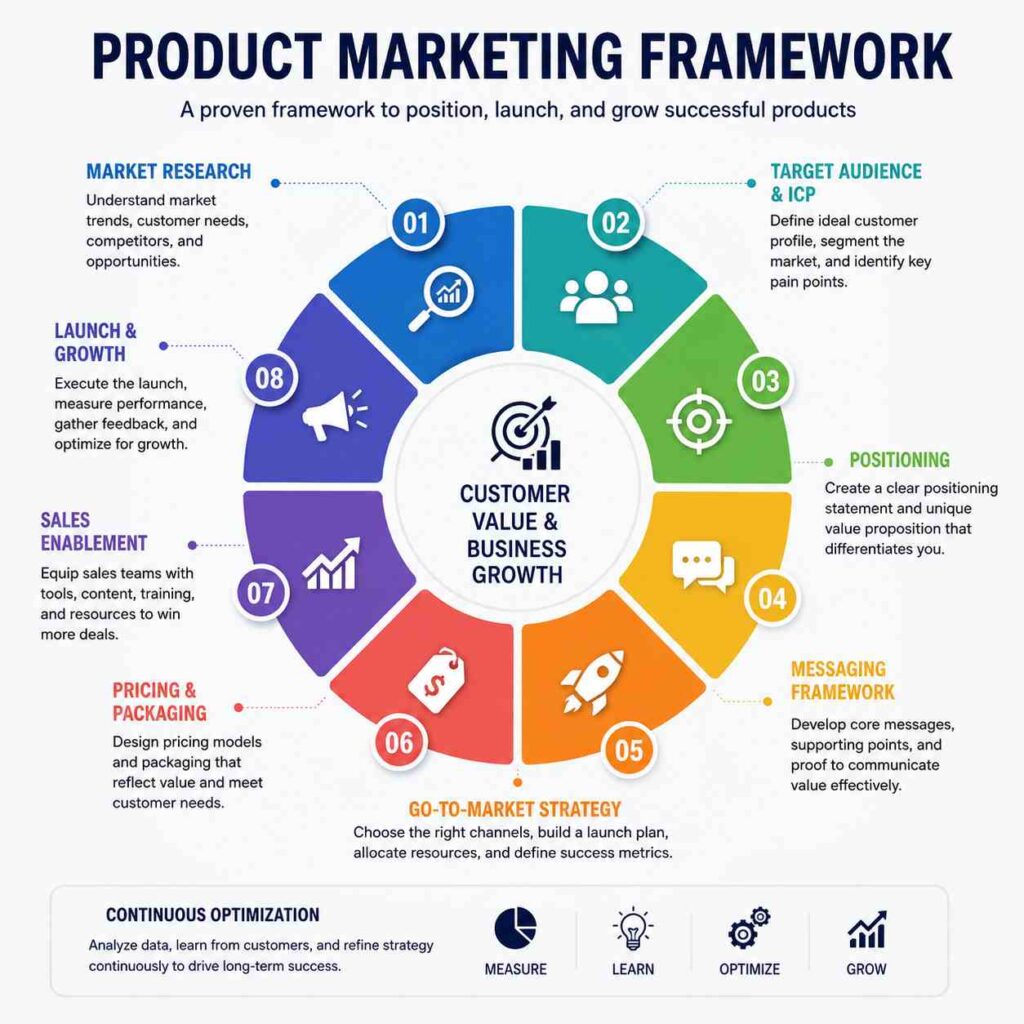
A product marketing framework is a structured approach used to bring a product to market and drive adoption.
It combines:
- Market research
- Customer understanding
- Positioning
- Messaging
- Go-to-market planning
- Sales enablement
- Performance measurement
The goal is simple:
Deliver the right product to the right audience with the right message at the right time.
Instead of relying on assumptions, a framework creates consistency across product, marketing, and sales teams.
Why a Product Marketing Framework Matters
Without a framework, businesses often face:
- Unclear market positioning
- Weak customer engagement
- Low conversion rates
- Misaligned teams
- Inefficient marketing spend
- Slow product adoption
A strong framework creates measurable benefits.
Key Advantages
Better Customer Understanding
You stop marketing to everyone and focus on ideal buyers.
Stronger Positioning
Customers understand immediately why your product matters.
Faster Product Adoption
Clear messaging reduces buying friction.
Improved Revenue Growth
Better alignment creates more predictable outcomes.
Efficient Decision Making
Teams work toward shared objectives.
Core Components of a Product Marketing Framework
1. Market Research
Every successful framework begins with Market research.
Before creating campaigns or messaging, understand the market environment.
Areas to Research
Industry Trends
Study:
- Market growth
- Customer behavior shifts
- Emerging opportunities
Competitor Analysis
Identify:
- Positioning strategies
- Pricing structures
- Feature gaps
Customer Research
Methods include:
- Surveys
- Interviews
- Support conversations
- Community insights
Questions to Ask
- Who is the target customer?
- What problem exists?
- How urgent is the need?
- What alternatives are customers using?
Research removes assumptions and improves decisions.
2. Customer Segmentation and Ideal Customer Profile (ICP)
Not every customer delivers equal value.
Segmentation allows businesses to focus on audiences with the highest growth potential.
Types of Segmentation
Demographic
Examples:
- Age
- Industry
- Company size
Behavioral
Examples:
- Purchase patterns
- Product usage
- Engagement level
Psychographic
Examples:
- Motivations
- Values
- Preferences
Example ICP
Company Type: SaaS Startup
Role: Marketing Manager
Challenge: Generating qualified leads
Goal: Increase customer acquisition efficiently
A defined ICP improves messaging accuracy.
3. Product Positioning
Positioning determines how customers perceive your product.
Strong positioning answers:
Why should someone choose your product instead of alternatives?
Elements of Positioning
Target Audience
Who benefits most?
Market Category
What category do you compete in?
Differentiator
What makes your solution unique?
Outcome
What result does the customer receive?
Positioning Statement Template
For [Audience], our [Product] helps achieve [Desired Outcome] unlike [Alternative Solution].
Example
For growing businesses, our analytics platform provides faster insights without requiring technical expertise.
Positioning creates clarity across every marketing channel.
4. Build a Messaging Framework
Positioning explains who you are.
Messaging explains why people should care.
Effective messaging includes:
Core Message
Primary value proposition.
Example:
“Reduce campaign setup time by 50%.”
Supporting Messages
Explain:
- Features
- Benefits
- Use cases
Proof Elements
Support claims using:
- Case studies
- Testimonials
- Metrics
- Demonstrations
Emotional Drivers
People often buy emotionally and justify logically.
Examples:
- Save time
- Reduce stress
- Increase confidence
- Gain competitive advantage
5. Create a Go-To-Market (GTM) Strategy
A product marketing framework becomes effective through execution.
A Go-To-Market strategy defines how customers discover and purchase.
Audience Acquisition Channels
Examples:
Organic
- SEO
- Content marketing
- Social media
Paid
- Search ads
- Social ads
- Display campaigns
Partnerships
- Affiliates
- Strategic collaborations
Direct Sales
- Outbound outreach
- Account-based marketing
GTM Checklist
✓ Define target audience
✓ Build messaging
✓ Select channels
✓ Create content assets
✓ Train sales team
✓ Set launch KPIs
6. Pricing and Packaging Strategy
Pricing communicates value.
Poor pricing can damage adoption—even with excellent products.
Common Pricing Models
Value-Based Pricing
Price based on customer outcomes.
Competitive Pricing
Price relative to competitors.
Penetration Pricing
Lower entry price for growth.
Tiered Pricing
Multiple plans for different users.
Packaging Best Practices
Offer clear distinctions:
Basic → Growth → Premium
Reduce complexity and make decisions easier.
7. Sales Enablement
Marketing creates demand.
Sales converts demand.
Sales enablement ensures consistency.
Essential Sales Assets
Product Decks
Explain positioning and benefits.
Battle Cards
Help address competitor objections.
Demo Scripts
Improve product demonstrations.
Objection Handling Guides
Increase conversion confidence.
Example Objection
Customer:
“Your product is expensive.”
Response:
“Our customers typically recover the investment through efficiency improvements.”
8. Product Launch Strategy
Launching is not a single-day event.
Successful launches happen in phases.
Pre-Launch
Focus on awareness.
Activities:
- Audience building
- Landing pages
- Beta programs
- Email waitlists
Launch Phase
Focus on visibility.
Activities:
- Campaign rollout
- Product announcements
- Social engagement
- Influencer outreach
Post-Launch
Focus on optimization.
Track:
- Conversion rate
- Activation
- Customer feedback
- Retention
9. Product Marketing Framework Models
Several established models improve execution.
STP Framework
Segmentation
Identify audience groups.
Targeting
Select ideal segments.
Positioning
Create differentiation.
AARRR Framework
Measure growth through:
- Acquisition
- Activation
- Retention
- Revenue
- Referral
Jobs-To-Be-Done (JTBD)
Customers hire products to accomplish outcomes.
Example:
People do not buy project management software.
They buy organization and visibility.
4Ps Framework
- Product
- Price
- Place
- Promotion
These remain foundational for strategy development.
10. Step-by-Step Process to Build a Product Marketing Framework
Step 1: Conduct Research
Gather customer and market data.
Step 2: Define ICP
Prioritize highest-value audiences.
Step 3: Build Positioning
Clarify differentiation.
Step 4: Create Messaging
Develop persuasive communication.
Step 5: Design GTM Strategy
Choose channels and execution plans.
Step 6: Enable Sales
Provide tools and training.
Step 7: Measure and Optimize
Improve continuously.
11. Metrics to Measure Product Marketing Success
Measurement turns marketing into a growth engine.
Awareness Metrics
- Traffic
- Reach
- Share of voice
Acquisition Metrics
- Customer Acquisition Cost (CAC)
- Conversion Rate
Activation Metrics
- Trial-to-paid conversion
- Time-to-value
Retention Metrics
- Churn Rate
- Repeat usage
Revenue Metrics
- Monthly Recurring Revenue
- Customer Lifetime Value
12. Common Product Marketing Mistakes to Avoid
Selling Features Instead of Outcomes
Customers buy results.
Ignoring Customer Feedback
Market signals matter.
Weak Differentiation
Avoid generic messaging.
Measuring Vanity Metrics
Focus on business outcomes.
Launching Without Validation
Test before scaling.
Example of a Product Marketing Framework in Action
Imagine a software company launching a collaboration tool.
Research
Teams struggle with scattered communication.
ICP
Remote teams with 20–200 employees.
Positioning
Simple collaboration without complexity.
Messaging
“Work together faster.”
GTM
SEO + demos + email campaigns.
Results
Higher adoption and improved retention.
This demonstrates how each framework component connects.
Future Trends in Product Marketing
Product marketing continues evolving.
Watch these trends:
- AI-powered personalization
- Product-led growth
- Community-driven acquisition
- Predictive analytics
- First-party data strategies
Companies that adapt early create stronger competitive advantages.
Final Thoughts
A product marketing framework transforms marketing from isolated campaigns into a repeatable growth system.
When businesses understand customers, position clearly, communicate effectively, and measure outcomes, product adoption becomes more predictable.
Start simple.
Research your audience.
Build messaging.
Launch intentionally.
Optimize continuously.
The strongest product marketing frameworks are never finished—they evolve with the market.
Frequently Asked Questions (FAQ)
What is a product marketing framework?
A structured process used to position, launch, promote, and grow a product.
Why is product marketing important?
It connects customer needs with product value to improve adoption and revenue.
What are the key elements of a product marketing framework?
Research, segmentation, positioning, messaging, GTM strategy, sales enablement, and analytics.
How do startups use product marketing frameworks?
Startups use frameworks to launch efficiently, reduce wasted spend, and accelerate growth.
Want to improve product adoption and growth? Start building your product marketing framework and turn marketing into a repeatable growth engine.
Add a Comment