
Table of Contents
A SaaS product can have excellent technology, useful features, and a strong development team yet still struggle to stand out. The problem is often not the product itself. It is the lack of a clear reason for customers to choose it over competing products, familiar tools, internal processes, or simply doing nothing.
When several SaaS products offer similar features, differentiation becomes the deciding factor.
SaaS product differentiation is about identifying what makes your product meaningfully different and valuable to a specific audience—and then communicating that difference consistently across your website, product, sales process, advertising, content, and customer experience.
The goal is not to claim that your SaaS is “better” at everything. The goal is to make the right customers understand why your product is the right choice for their particular problem.
This guide explains how to differentiate a SaaS product, the different types of SaaS differentiation, a practical differentiation framework, real-world examples, common mistakes, measurement methods, and a ready-to-use SaaS differentiation template.
What Is SaaS Product Differentiation?
SaaS product differentiation is the process of making a software-as-a-service product meaningfully distinct from competing products and alternatives in ways that matter to its target customers.
A differentiator can come from many areas, including:
- A specialized target audience
- A specific customer problem
- Product capabilities
- User experience
- Pricing
- Performance
- Customer service
- Implementation
- Integrations
- Data
- Brand
- Business model
- Expertise
- Community
- Distribution
For example, saying:
https://xperiatech.com/positioning-messaging-services/ “Our platform is an easy-to-use CRM.”
does not provide much differentiation.
Thousands of SaaS products can make a similar claim.
A stronger positioning might be:
“A CRM built for small sales teams that need to manage inbound leads without complicated enterprise software.”
The second statement gives the customer more information about who the product is for, what problem it addresses, and why it may be preferable to alternatives.
A simple definition
You can think of SaaS differentiation as:
Customer need + meaningful difference + customer value + credible proof = strong differentiation
The important word is meaningful.
A difference that customers do not care about is not a strong differentiator.
Why SaaS Product Differentiation Matters
SaaS markets often become crowded quickly. A new product can enter a category where established companies already provide similar functionality.
If your messaging sounds like everyone else, customers have little reason to investigate further.
Strong SaaS product differentiation can help you:
1. Reduce price-based competition
When customers cannot see meaningful differences between products, price often becomes a major deciding factor.
Clear differentiation gives customers another reason to buy.
Instead of:
“We are cheaper.”
you can communicate:
“We eliminate the manual reporting process that takes your team several hours every week.”
That changes the conversation from cost to value.
2. Improve conversion rates
A clear value proposition helps visitors quickly understand:
- What the product does
- Who it is for
- What problem it solves
- What makes it different
- Why they should take the next step
That clarity can improve website engagement, demos, trials, and conversions.
3. Make sales conversations easier
Sales representatives need a simple answer to:
“Why should we choose you instead of your competitor?”
A strong differentiation strategy gives them a consistent answer.
4. Attract better-fit customers
Trying to appeal to everyone often creates generic messaging.
A differentiated SaaS product can intentionally attract a specific customer segment.
5. Strengthen brand recall
Customers are more likely to remember a product associated with a specific problem, audience, experience, or outcome.
6. Support premium pricing
If customers perceive your SaaS as uniquely valuable, you may have more pricing flexibility than a company competing primarily through discounts.
7. Create a stronger competitive advantage
A feature can be copied.
A deeply integrated workflow, proprietary data, strong community, specialized expertise, or trusted brand can be significantly harder to replicate.
SaaS Differentiation vs Positioning vs USP vs Value Proposition
These terms are related, but they are not interchangeable.
| Concept | Main Question |
|---|---|
| SaaS Differentiation | What makes us meaningfully different? |
| SaaS Positioning | How should customers perceive us compared with alternatives? |
| Value Proposition | Why should customers choose us? |
| USP | What distinctive promise do we make? |
| Competitive Advantage | What can we do better or sustain more effectively? |
| Messaging | How do we communicate these ideas? |
Think of differentiation as the strategic difference, positioning as the market perception you want to create, and messaging as the way you communicate it.
For example:
Differentiation:
Specialized workflow for ecommerce inventory teams.
Positioning:
Inventory management software designed specifically for growing ecommerce brands.
Value proposition:
Help ecommerce teams reduce stockouts and overstock without relying on spreadsheets.
Messaging:
“Know what to reorder before you run out.”
These pieces work together.
7 Types of SaaS Product Differentiation
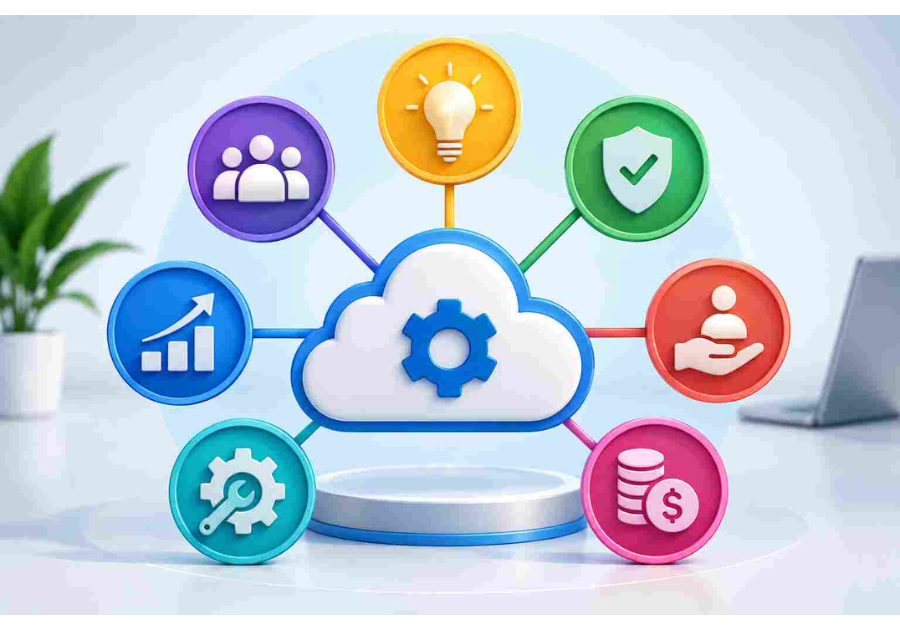
There is no single way to differentiate a SaaS product. The strongest strategy often combines several types while emphasizing one primary differentiator.
1. Customer-Segment Differentiation
One of the most effective SaaS differentiation strategies is to specialize.
Instead of trying to serve:
“Businesses of all sizes.”
you might serve:
“Accounting firms with 10–100 employees.”
Or:
“Marketing agencies managing multiple client campaigns.”
This creates a sharper connection between your product and a particular audience.
Why it works
A specialized SaaS product can design:
- Features
- Workflows
- Templates
- Integrations
- Content
- Pricing
- Onboarding
- Support
around the needs of one customer segment.
Example
Generic:
Project management software for teams.
Differentiated:
Project management software built for creative agencies managing client approvals, deadlines, and revisions.
The second product immediately communicates specialization.
2. Problem-Based Differentiation
Instead of positioning your SaaS around a category, position it around a specific problem.
For example:
Generic:
Customer communication platform.
Problem-focused:
Help support teams reduce repetitive customer questions with automated knowledge workflows.
The second message focuses on a problem rather than simply describing a software category.
How to find a problem worth owning
Ask:
- What frustrates customers most?
- What consumes the most time?
- What costs them money?
- What creates operational risk?
- What do competitors solve poorly?
- What workarounds do customers currently use?
The more painful and specific the problem, the stronger the opportunity for differentiation.
3. Product or Feature Differentiation
A SaaS product can differentiate through a capability that customers genuinely value.
Examples include:
- Advanced automation
- Specialized reporting
- Unique integrations
- Workflow customization
- Faster processing
- Specialized analytics
- Collaboration capabilities
- Security controls
- Industry-specific functionality
However, there is an important distinction:
A feature is not automatically a differentiator.
If every competitor offers the same feature, it is simply a category expectation.
For example, if every modern CRM offers contact management, contact management cannot be your primary differentiator.
Instead, ask:
What can our product do that competitors cannot easily do, or cannot do as effectively?
4. User Experience Differentiation
Sometimes the product itself is not radically different, but the experience is.
You can differentiate through:
- Simpler onboarding
- Faster setup
- Easier navigation
- Better interface design
- Fewer steps
- Better documentation
- More intuitive workflows
- Faster customer support
This can be particularly powerful in categories where competitors are complicated.
Example
Imagine two analytics platforms.
Platform A:
Requires technical configuration and several training sessions.
Platform B:
Connect your data and create your first report in minutes.
The underlying technology may be comparable, but the customer experience creates a meaningful distinction.
5. Performance Differentiation
Performance can become a strong differentiator when customers care about measurable outcomes.
Potential performance dimensions include:
- Speed
- Accuracy
- Reliability
- Uptime
- Scalability
- Processing capacity
- Response time
- Automation rate
Instead of saying:
“Our software is powerful.”
show evidence.
For example:
“Process thousands of transactions without manually reviewing each record.”
Specific performance claims are stronger than generic adjectives.
6. Pricing and Business-Model Differentiation
Pricing can also distinguish a SaaS product.
Potential approaches include:
- Freemium
- Usage-based pricing
- Seat-based pricing
- Flat-rate pricing
- Modular pricing
- Tiered pricing
- Outcome-oriented pricing
- Transparent pricing
However, competing only on being cheaper can create a difficult business model.
A stronger strategy is to connect pricing to customer value.
For example:
“Pay based on usage, not the number of employees.”
This can appeal to companies whose usage varies significantly.
7. Service and Implementation Differentiation
The product is only one part of the SaaS customer experience.
You can differentiate through:
- White-glove onboarding
- Migration services
- Dedicated customer success
- Training
- Consulting
- Industry-specific implementation
- Faster support
- Strategic guidance
This is particularly valuable for products with complex implementation.
A competitor may sell software.
You may sell:
Software + implementation + expertise + ongoing support.
That broader experience can become part of your differentiation.
How to Differentiate a SaaS Product From Competitors
Now we reach the core of the SaaS differentiation process.
Finding a unique idea in a meeting room is rarely enough. Strong differentiation usually comes from researching customers, competitors, alternatives, market gaps, and your own capabilities.
Use the following process.
Step 1: Define Your Ideal Customer Profile
Before deciding how to differentiate your SaaS product, determine exactly who you want to attract.
Your ideal customer profile, or ICP, should answer:
- Who is the customer?
- What industry are they in?
- How large is the company?
- What role buys the product?
- What role uses it?
- What problem are they experiencing?
- How urgent is the problem?
- What solution are they currently using?
- What causes them to start looking for alternatives?
- What factors influence the purchase?
Example
Instead of:
Small businesses
define:
B2B SaaS companies with 10–50 employees that need a simple system for managing inbound sales leads.
That level of specificity creates opportunities for stronger differentiation.
Step 2: Identify Your Real Competitive Alternatives
A common SaaS marketing mistake is looking only at direct competitors.
Your customer has more alternatives than competing software.
They might use:
- Another SaaS product
- Excel
- Google Sheets
- Internal software
- A freelancer
- A consultant
- A manual process
- An existing employee
- An agency
- Doing nothing
Suppose you sell expense-management software.
Your competitor might not be another expense-management platform.
It could be:
Employees submit receipts by email and the finance team manually enters everything into spreadsheets.
Your differentiation opportunity may therefore be about eliminating manual work rather than defeating another software vendor.
Ask this question
“What would our ideal customer do if our product did not exist?”
The answer reveals your real competitive landscape.
Step 3: Conduct a SaaS Competitor Analysis
Build a competitor matrix before choosing your positioning.
Analyze competitors across:
| Factor | Your SaaS | Competitor A | Competitor B |
|---|---|---|---|
| Target customer | |||
| Core problem | |||
| Main promise | |||
| Key features | |||
| Pricing | |||
| User experience | |||
| Integrations | |||
| Customer support | |||
| Strength | |||
| Weakness | |||
| Proof | |||
| Positioning |
Look beyond competitor websites.
Study:
- Customer reviews
- Product comparison pages
- Demo videos
- Support documentation
- Pricing pages
- Social media comments
- Community discussions
- Sales messaging
- Product announcements
- Customer complaints
Your goal isn’t to copy competitors.
Your goal is to discover what they repeatedly promise and where customer expectations remain unsatisfied.
Step 4: Mine Customer Pain Points
Your customers can reveal your best differentiators.
Interview:
- Existing customers
- New customers
- Lost prospects
- Churned customers
- Sales leads
- Customer support teams
Ask questions such as:
Before using our product, what were you doing?
This reveals alternatives.
What was the biggest problem with your previous solution?
This reveals pain.
Why did you choose us?
This reveals perceived differentiation.
What almost stopped you from buying?
This reveals objections.
What feature or benefit do you value most?
This reveals buying priorities.
What would make you switch away?
This reveals retention risks.
The answers can be more valuable than internal brainstorming.
Step 5: Find the Differentiation Gap
Now compare three things:
Customer pain + competitor weakness + your capability
This intersection is where valuable differentiation can emerge.
For example:
Competitor weakness
Competitors offer powerful analytics but require technical expertise.
Customer pain
Marketing teams want analytics without depending on data specialists.
Your capability
Your platform provides pre-built reports and guided analysis.
Potential differentiation
“Advanced marketing analytics without the technical complexity.”
Notice that the differentiator is not simply:
“We have dashboards.”
The meaningful difference is the combination of capability, customer need, and competitor weakness.
Step 6: Turn Features Into Customer Outcomes
Feature-based messaging is one of the biggest obstacles to effective SaaS differentiation.
Consider:
Automated lead routing.
That’s a feature.
Now translate it:
Feature: Automated lead routing
↓
Capability: Leads are assigned automatically
↓
Benefit: Sales representatives receive leads faster
↓
Outcome: Teams can respond quickly and reduce missed opportunities
The final outcome is usually much more compelling than the technical feature.
Use this formula:
Feature → Capability → Benefit → Business Outcome
Another example
Feature: Automated invoice reminders
Capability: The system sends payment reminders automatically.
Benefit: Finance teams spend less time following up.
Business outcome: Faster collections and less administrative work.
This approach makes SaaS messaging more commercially meaningful.
Step 7: Choose Your Primary Differentiator
Many SaaS companies make the mistake of trying to differentiate on everything.
Their homepage says they are:
- Fast
- Affordable
- Easy
- Secure
- Powerful
- Flexible
- Innovative
- Scalable
- AI-powered
- Customizable
The result is often a message that says nothing memorable.
Instead, identify one primary differentiator and a small number of supporting advantages.
Use the “Why You?” test
Ask:
If a customer had to remember only one reason to choose us, what should it be?
That answer should influence your headline, value proposition, sales pitch, and campaign messaging.
Step 8: Validate Your Differentiator
Before building your entire marketing strategy around a differentiator, test it.
Score your proposed differentiator from 1–5 against these questions:
| Validation Question | Score |
|---|---|
| Is it genuinely different? | /5 |
| Does the target customer care? | /5 |
| Does it solve a meaningful problem? | /5 |
| Can competitors easily copy it? | /5 |
| Can we prove it? | /5 |
| Does it influence purchase decisions? | /5 |
| Does it align with our capabilities? | /5 |
A strong differentiator should perform well across most categories.
If customers don’t care about the difference, it doesn’t matter how technically impressive it is.
The 6D SaaS Differentiation Framework
To make the process easier, use this six-stage framework:
1. Define
Define your ideal customer and their most important needs.
2. Discover
Discover their current solutions, alternatives, frustrations, and expectations.
3. Diagnose
Analyze competitor strengths, weaknesses, positioning, pricing, messaging, and customer complaints.
4. Differentiate
Select a meaningful difference that your target audience values.
5. Demonstrate
Support your differentiation with proof, data, testimonials, case studies, demonstrations, or measurable outcomes.
6. Deploy
Apply your differentiation consistently across your website, sales materials, advertising, content, product experience, and customer communication.
This creates a complete system rather than treating differentiation as a slogan.
How to Turn SaaS Differentiation Into Positioning
Finding your differentiator is only half the work.
You must turn that difference into clear SaaS positioning.
A useful positioning structure is:
For [target customer] who [problem], [product] is the [category] that [key outcome/difference], unlike [alternative] that [limitation].
Example
For growing ecommerce brands struggling with inventory uncertainty, our platform is an inventory intelligence solution that helps teams make faster purchasing decisions without relying on complicated spreadsheets.
The positioning statement helps internal teams understand what the product should stand for.
It does not necessarily have to appear word-for-word on the website.
How to Create a SaaS Value Proposition From Your Differentiator
Your value proposition should connect:
Customer → Problem → Solution → Benefit → Difference
For example:
Weak
Powerful CRM for modern businesses.
Better
Manage leads, automate follow-ups, and give your sales team one place to track customer relationships.
More differentiated
A lightweight CRM for growing sales teams that need faster lead follow-up without the complexity of enterprise CRM software.
The third version provides a clearer reason for the target customer to consider the product.
How to Communicate SaaS Differentiation
A strong differentiation strategy should appear throughout the customer journey.
Homepage
Your homepage should quickly answer:
- Who is this for?
- What problem does it solve?
- What outcome does it provide?
- Why is it different?
- What should I do next?
A simple structure is:
Headline → Supporting message → Differentiator → Benefits → Proof → CTA
Pricing Page
Your pricing page should reinforce your value.
Don’t simply list:
Basic / Pro / Enterprise
Explain why the pricing model makes sense.
If your differentiation is transparency, show transparent pricing.
If your differentiation is flexibility, show flexible plans.
If your product is designed for smaller teams, avoid making the pricing structure unnecessarily complicated.
Product Pages
Don’t write pages that only list features.
Instead:
Feature → Customer problem → Benefit → Outcome → Proof
For example:
Automated reporting
becomes:
Stop spending hours building weekly reports. Automatically generate performance summaries your team can review and share.
Sales Deck
Your sales team should be able to explain differentiation in a few sentences.
Create a simple competitive messaging framework:
Customer problem → Alternative → Limitation → Your difference → Outcome → Proof
This prevents salespeople from giving inconsistent explanations.
Paid Advertising
Advertising requires a sharper version of your differentiation.
Instead of:
“Powerful project management software.”
Try:
“Project management for agencies that need client approvals without endless email threads.”
The second message targets a specific pain point and audience.
Content Marketing
Your content strategy should reinforce the territory you want to own.
If your SaaS differentiates around helping agencies manage client workflows, publish content around:
- Agency project management
- Client approvals
- Agency workflow automation
- Managing revisions
- Agency productivity
- Client communication
- Project profitability
This builds topical relevance around the problem you want to be known for solving.
SaaS Product Differentiation Examples
Let’s look at how generic SaaS messaging can become more differentiated.
Example 1: Project Management SaaS
Generic
All-in-one project management software.
Differentiated
Project management built for creative agencies managing client projects, approvals, and revisions.
Why it works
The second statement identifies:
- A specific audience
- A specific workflow
- Specific problems
Example 2: CRM SaaS
Generic
Powerful CRM for growing businesses.
Differentiated
A lightweight CRM for small sales teams that want faster lead follow-up without enterprise-level complexity.
Differentiation type
- Audience
- Experience
- Problem
- Complexity
Example 3: HR SaaS
Generic
Modern HR software.
Differentiated
HR management software designed for multi-location businesses managing hourly employees.
Differentiation type
- Customer segment
- Industry/workforce specialization
Example 4: Analytics SaaS
Generic
AI-powered analytics platform.
Differentiated
Ecommerce analytics that turns sales and inventory data into daily purchasing decisions.
The second message focuses on an actual business outcome instead of using technology terminology as the primary differentiator.
Example 5: Customer Support SaaS
Generic
Improve customer support with automation.
Differentiated
Help support teams resolve repetitive questions automatically while keeping complex conversations with human agents.
Here, the differentiation is about the workflow and customer experience.
SaaS Differentiation Examples From Successful Companies
Successful SaaS companies demonstrate an important lesson: differentiation does not always mean inventing an entirely new software category.
Slack
Slack became strongly associated with workplace communication and team collaboration rather than presenting itself simply as another messaging application.
The lesson:
Category + specific experience + recognizable use case can create strong differentiation.
Canva
Canva built strong differentiation around making design accessible to people who were not professional designers.
The lesson:
Ease of use can become a strategic differentiator when it addresses a major barrier in the category.
Shopify
Shopify’s positioning has historically focused heavily on enabling businesses to create and operate online stores without having to build ecommerce infrastructure from scratch.
The lesson:
Simplifying a complex process can itself be a powerful form of differentiation.
HubSpot
HubSpot became strongly associated with inbound marketing and a broader connected customer platform.
The lesson:
A company can differentiate through a combination of methodology, product ecosystem, content, education, and category ownership.
Figma
Figma differentiated strongly around browser-based collaborative design workflows.
The lesson:
A product experience can become the differentiator when it changes how teams work together.
The important takeaway is not to copy these companies.
Instead, examine how their products connect a particular audience, problem, experience, and value proposition.
Common SaaS Differentiation Mistakes
Mistake 1: Saying “We’re the Best”
Statements such as:
“The world’s best CRM.”
are difficult to believe without evidence.
Replace unsupported superiority claims with specific advantages.
Mistake 2: Competing Only on Features
Feature lists do not automatically communicate value.
A competitor can often match feature counts.
Explain what those features enable customers to accomplish.
Mistake 3: Copying Competitor Positioning
If every competitor says:
- Easy
- Powerful
- Flexible
- Affordable
- Innovative
using the same language makes your product blend into the category.
Study competitor messaging to identify opportunities for differentiation—not phrases to copy.
Mistake 4: Trying to Serve Everyone
“Built for businesses of all sizes” may sound attractive, but it can weaken your positioning.
Specificity often creates stronger relevance.
Mistake 5: Using Vague Claims
Words such as:
- Innovative
- Revolutionary
- Powerful
- Next-generation
- Smart
- Advanced
need context.
Explain what makes the product innovative or powerful and why the customer should care.
Mistake 6: Differentiating on Something Customers Don’t Value
Your engineering team may be proud of a technical feature.
Customers may not care.
The differentiator needs to matter to the buyer.
Mistake 7: Having Differentiation Without Proof
If you claim:
“The fastest platform.”
customers may ask:
“According to what?”
Support important claims with:
- Case studies
- Customer testimonials
- Benchmarks
- Product demonstrations
- Usage data
- Reviews
- Certifications
- Before-and-after results
Mistake 8: Changing Positioning Too Frequently
SaaS companies sometimes change messaging every few months because of new features or trends.
Constant changes can prevent customers from associating the brand with a specific value.
Refine your positioning based on evidence, but maintain a consistent strategic direction.
How to Make SaaS Differentiation Defensible
A differentiator becomes more valuable when competitors cannot easily copy it.
There is a major difference between:
Different
and
Defensible.
A competitor can copy a button, feature, color, pricing plan, or marketing phrase.
Defensible advantages can come from:
Proprietary Data
Unique data accumulated through product usage can become increasingly valuable.
Network Effects
A product can become more valuable as more customers or participants use it.
Workflow Integration
When your SaaS becomes deeply integrated into business processes, replacing it becomes more difficult.
Switching Costs
Migration, retraining, integrations, historical data, and established workflows can create customer stickiness.
Community
A strong user community can provide value that competitors cannot reproduce immediately.
Specialized Expertise
Deep knowledge of a particular industry can support stronger products and positioning.
Brand
Trust and recognition can become competitive assets.
Ecosystem
Integrations, partners, developers, templates, and complementary services can create a broader moat.
Distribution
A strong distribution advantage can be as valuable as product functionality.
The strongest SaaS companies often combine several of these advantages.
How to Measure SaaS Differentiation
You cannot improve differentiation effectively if you never measure its impact.
Track metrics that indicate whether your positioning is influencing customer behavior.
| KPI | What It Can Tell You |
|---|---|
| Website conversion rate | Whether messaging resonates |
| Demo conversion | Whether prospects see enough value |
| Trial-to-paid conversion | Whether value survives product evaluation |
| Win rate | Competitive effectiveness |
| Sales cycle | Buyer clarity and confidence |
| CAC | Acquisition efficiency |
| Churn | Long-term product value |
| Customer retention | Strength of customer-product fit |
| Brand searches | Awareness and recall |
| Customer interviews | Qualitative differentiation |
| Win/loss analysis | Why buyers choose or reject you |
Win/loss analysis
One of the most useful techniques is asking prospects why they chose or rejected your product.
Look for patterns.
If customers repeatedly say:
“We chose you because your implementation was much easier.”
you may have discovered a valuable differentiator.
If customers repeatedly say:
“Your product looked similar to the alternatives, but your price was lower.”
you may have a weaker strategic differentiation.
A Practical SaaS Differentiation Scorecard
Use this scorecard when evaluating your positioning.
Score each factor from 1 to 5.
Customer relevance
Does the target customer care?
Uniqueness
Is the benefit meaningfully different?
Credibility
Can you prove the claim?
Defensibility
Can competitors easily copy it?
Business value
Does it solve an expensive or important problem?
Clarity
Can customers understand it quickly?
Consistency
Can you communicate it across channels?
Scalability
Can the differentiator remain valuable as the company grows?
The goal isn’t necessarily to score 5 everywhere immediately.
The scorecard helps identify weaknesses before investing heavily in marketing.
SaaS Product Differentiation Checklist
Use this checklist before finalizing your SaaS positioning.
Customer
- Have we defined our ideal customer?
- Do we understand their most important problems?
- Do we know what triggers them to search for a solution?
- Do we understand who makes the buying decision?
Competition
- Have we identified direct competitors?
- Have we identified indirect competitors?
- Have we identified non-software alternatives?
- Do we understand competitor positioning?
- Do we know what customers dislike about existing solutions?
Differentiation
- Is our difference meaningful?
- Does the target customer care about it?
- Is it specific?
- Can we prove it?
- Is it difficult to copy?
- Does it connect to a valuable outcome?
Messaging
- Is our homepage clear?
- Does our headline communicate value?
- Does our website explain why we are different?
- Does sales use consistent messaging?
- Do our ads reinforce the same differentiation?
- Does our content support our positioning?
Measurement
- Are we tracking conversion rates?
- Are we measuring win rates?
- Are we conducting win/loss interviews?
- Are we monitoring churn reasons?
- Are we testing messaging?
SaaS Product Differentiation Template
Use this template to develop your own SaaS differentiation strategy.
1. Ideal Customer
Our ideal customer is:
2. Main Problem
The biggest problem they experience is:
3. Current Alternative
They currently solve this problem by:
4. Competitors
The main competitors they consider are:
5. Competitor Weakness
Existing solutions are limited because:
6. Our Capability
Our product can:
7. Customer Benefit
This helps customers:
8. Business Outcome
The resulting business outcome is:
9. Proof
We can prove this through:
10. Primary Differentiator
The strongest reason to choose us is:
11. Positioning Statement
For [target customer] who [problem], [product] is the [category] that [unique outcome/difference], unlike [alternative] that [limitation].
12. Core Message
We help [audience] achieve [outcome] without [major pain point].
This template can be used by SaaS founders, product marketers, growth teams, brand strategists, and marketing agencies.
How to Build a SaaS Differentiation Strategy Step by Step
For teams that want a practical implementation process, use this 30-day approach.
Week 1: Customer Research
Collect:
- Customer interviews
- Sales-call insights
- Support questions
- Review data
- Churn reasons
- Feature requests
Identify the problems customers repeatedly mention.
Week 2: Competitive Research
Create a competitor matrix.
Analyze:
- Positioning
- Website headlines
- Product features
- Pricing
- Customer reviews
- Content strategy
- Strengths
- Weaknesses
- Customer complaints
Look for gaps.
Week 3: Differentiation Development
Create several potential differentiators.
For each one, ask:
Does the customer care?
Is it different?
Can we prove it?
Can competitors copy it?
Does it support our business strategy?
Select the strongest option.
Week 4: Positioning and Messaging
Translate your differentiation into:
- Homepage messaging
- Product messaging
- Sales pitch
- Ad copy
- Email messaging
- Content themes
- Product descriptions
- Sales deck
- Case studies
Then test the messaging with real customers.
How SaaS Companies Can Use Differentiation Across the Funnel
SaaS differentiation should not exist only on the homepage.
Awareness
Use your differentiator to attract the right audience.
Example:
“Project management for creative agencies.”
Consideration
Explain why your approach is different.
Example:
“Manage approvals, revisions, and client feedback in one workflow.”
Decision
Provide proof.
Example:
Customer case study showing reduced project delays.
Conversion
Give the customer a low-friction next step.
Example:
Start a free trial.
Retention
Deliver the experience that supports your differentiation.
If you promise simplicity, onboarding should be simple.
If you promise speed, the product should feel fast.
If you promise expertise, customer success should demonstrate that expertise.
This creates alignment between marketing promise and product experience.
The Difference Between a Feature and a True Differentiator
This distinction deserves special attention.
Suppose your SaaS has:
100 integrations.
That’s a product attribute.
But if your target customer is a growing ecommerce business and those integrations eliminate hours of manual data entry, the meaningful differentiator could be:
“Connect your entire ecommerce workflow without rebuilding your data systems.”
The feature supports the differentiator.
The customer outcome creates the value.
A useful test
Ask:
“If our competitor copied this feature tomorrow, would customers still have a reason to choose us?”
If the answer is no, the feature alone is probably not a defensible differentiator.
Can Pricing Be a SaaS Differentiator?
Yes, but pricing should be handled strategically.
A SaaS company can differentiate through:
- Transparent pricing
- Simple pricing
- Flexible plans
- Usage-based pricing
- No long-term contracts
- Pricing designed for small teams
- Enterprise customization
However, being cheap is rarely a sustainable differentiation strategy by itself.
If your entire position is:
“We cost less.”
a competitor can lower its price.
A stronger approach is:
“We provide a simpler product for small teams without requiring expensive enterprise contracts.”
Now price supports a broader customer and experience strategy.
Can a Small SaaS Startup Compete With Large SaaS Companies?
Yes.
A startup does not necessarily need to match a large competitor feature-for-feature.
Instead, it can specialize.
For example, a large CRM may serve thousands of industries.
A startup could focus specifically on:
CRM for independent financial advisors.
The startup can then build:
- Industry-specific workflows
- Relevant templates
- Specialized onboarding
- Targeted integrations
- Industry-specific reporting
- Specialized content
- Customer support
This can create a stronger fit for a narrow segment.
The lesson is:
A smaller product can compete by being more relevant rather than simply being bigger.
How to Know if Your SaaS Differentiation Is Working
Your differentiation is working when customers begin repeating the message back to you.
Listen for statements such as:
“We chose you because…”
“You were the only platform that…”
“We liked that your product…”
“The biggest difference was…”
These customer statements are valuable because they show how the market actually perceives your product.
Your internal positioning statement may say one thing.
Your customers may perceive something completely different.
The best SaaS differentiation strategies align:
What you want to be known for + what customers actually value + what your product can consistently deliver.
Frequently Asked Questions About SaaS Product Differentiation
What is SaaS product differentiation?
SaaS product differentiation is the process of making a software product meaningfully distinct from competing products and alternatives based on factors customers value, such as specialization, user experience, product capabilities, pricing, service, performance, or business outcomes.
How do you differentiate a SaaS product?
Start by defining your ideal customer, identifying direct and indirect alternatives, analyzing competitors, researching customer pain points, finding gaps in existing solutions, selecting a meaningful differentiator, validating it, and turning it into consistent positioning and messaging.
What are the best SaaS differentiation strategies?
Common strategies include niche specialization, solving a specific problem, creating a superior user experience, offering unique capabilities, improving performance, developing a differentiated pricing model, providing specialized implementation, and building defensible advantages such as data, community, integrations, or expertise.
How can a SaaS startup differentiate itself?
A SaaS startup can differentiate by focusing on a specific customer segment or problem rather than trying to compete with larger companies across every feature. Specialized workflows, simpler experiences, better onboarding, industry expertise, and highly relevant messaging can create a strong competitive position.
What is the difference between SaaS differentiation and positioning?
Differentiation focuses on what makes a SaaS product meaningfully different. Positioning determines how that difference should be perceived in the minds of the target customers compared with alternatives. Differentiation provides the strategic substance; positioning communicates where the product belongs in the customer’s decision framework.
Can SaaS pricing be a differentiator?
Yes. SaaS products can differentiate through transparent, flexible, usage-based, flat-rate, or segment-specific pricing. However, competing only on low price can be difficult to sustain, so pricing is generally stronger when connected to a broader customer value proposition.
What makes a SaaS product unique?
A SaaS product becomes unique when it provides a meaningful combination of capabilities, experience, specialization, customer outcomes, brand, service, data, ecosystem, or business model that customers value and competing alternatives cannot easily replicate.
How do you find a SaaS product’s competitive advantage?
Analyze customer needs, competitor weaknesses, your unique capabilities, and the alternatives customers use. Then identify advantages that create measurable customer value and are difficult for competitors to copy.
How do you measure SaaS differentiation?
Measure conversion rates, win rates, sales-cycle length, trial-to-paid conversion, customer retention, churn reasons, customer feedback, brand searches, and win/loss patterns. Qualitative customer interviews are especially useful for understanding why customers perceive your product as different.
Should a SaaS product have multiple differentiators?
A SaaS product can have several competitive advantages, but it should usually communicate one primary differentiator supported by a few secondary benefits. Too many competing messages can make the product difficult to understand and remember.
How important is customer research for SaaS differentiation?
Customer research is critical because differentiation only works when the target audience values the difference. Interviews, reviews, sales conversations, support tickets, churn interviews, and win/loss analysis can reveal customer priorities that internal teams may overlook.
Final Takeaway: Differentiate Where Customers Care
The strongest SaaS differentiation strategy does not begin with the question:
“What features do we have that competitors don’t?”
It begins with:
“Why would the right customer choose us instead of every realistic alternative?”
That question changes the entire approach.
Start with your customer.
Understand their problem.
Identify what they currently use.
Analyze competitors.
Find the gaps.
Connect those gaps with your product’s strengths.
Choose a meaningful differentiator.
Prove it.
Then turn that difference into clear positioning and consistent messaging.
The goal is not to make your SaaS look different for the sake of being different. The goal is to make your product more relevant, more valuable, and more memorable to the customers you want to win.
A strong SaaS differentiation strategy can ultimately be summarized as:
Define the customer → understand the alternatives → identify the gap → create meaningful differentiation → prove the value → position the product → communicate consistently → measure and improve.
When customers can quickly answer “Why this SaaS product instead of the alternatives?”, your differentiation strategy is doing its job.