
Table of Contents
A great product can still struggle to sell when its message is unclear.
A prospect visits your website and sees a long list of features. Your sales team describes the product differently. Your advertising focuses on another benefit. Your landing page uses broad phrases such as “powerful,” “innovative,” or “easy to use.” Meanwhile, competitors with similar products communicate their value more clearly.
The problem may not be the product.
It may be the product messaging.
A product messaging framework gives your company a structured way to explain what your product does, who it is for, what problem it solves, why customers should care, and why they should choose it over alternatives.
More importantly, a good framework turns those answers into messages that can be used across your website, landing pages, sales presentations, advertising campaigns, email marketing, social media, product launches, and sales conversations.
This guide explains how to create a product messaging framework step by step, including the essential components, a practical template, an example, common mistakes, testing methods, and ways to turn your framework into conversion-focused marketing.
What Is a Product Messaging Framework?
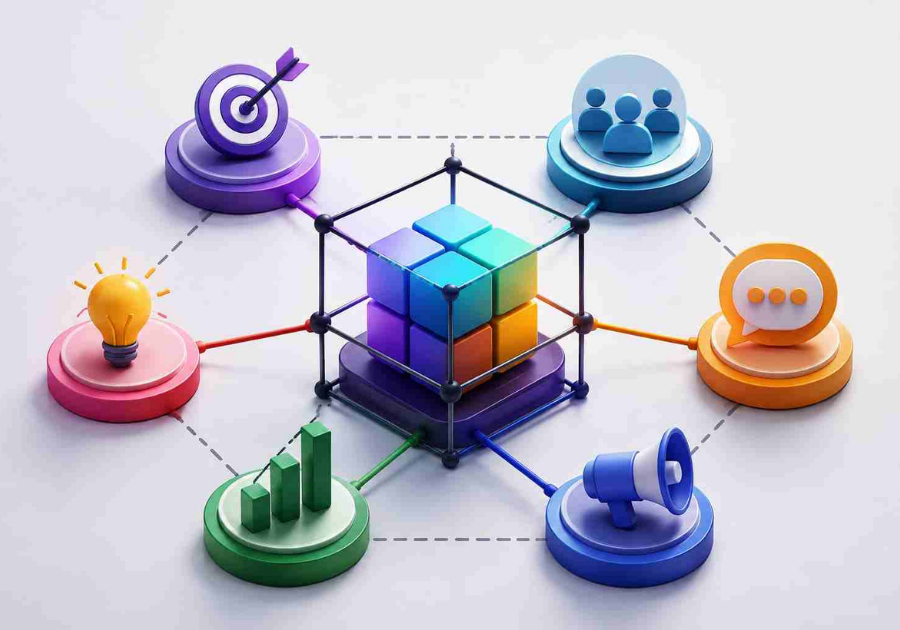
A product messaging framework is a structured system that defines the key messages a company should communicate about a product to a specific audience.
It connects:
Target audience → Customer problem → Desired outcome → Value proposition → Messaging pillars → Benefits → Differentiators → Proof → CTA
Instead of allowing every department to create its own description of the product, the framework creates a shared messaging foundation.
A product messaging framework typically answers questions such as:
- Who is the product designed for?
- What problem does the customer have?
- What does the customer want to achieve?
- What value does the product provide?
- What makes the product different?
- Which benefits matter most to the buyer?
- What evidence supports your claims?
- What objections might stop someone from buying?
- What action should the customer take?
The framework is not necessarily the final copy for your website or advertisements. It is the strategic foundation behind that copy.
Think of it as a blueprint.
Your website, advertisements, emails, sales decks, and social posts are the finished structures built from that blueprint.
Why Is a Product Messaging Framework Important?
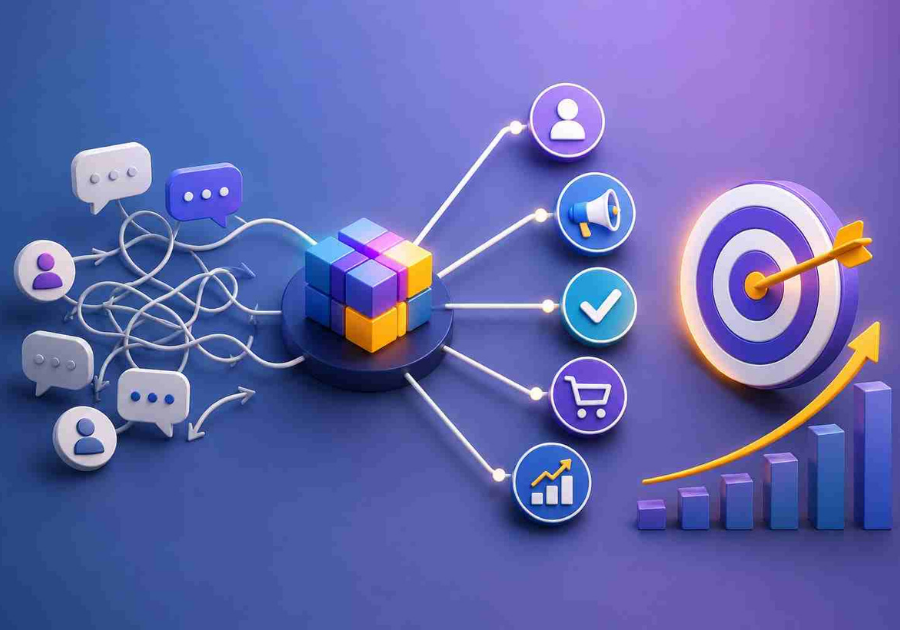
Without a clear framework, product communication can become inconsistent.
Marketing may say one thing. Sales may emphasize another. Product teams may focus on features while customers are more interested in outcomes.
A strong product messaging framework solves this problem by giving everyone a common language.
1. It makes your product easier to understand
Customers should not have to study your website to figure out what your product does.
https://xperiatech.com/positioning-messaging-services/ Clear messaging quickly communicates:
Who it is for + what problem it solves + what outcome it creates.
When prospects understand your value quickly, they can decide whether your product is relevant to them.
2. It improves differentiation
Many companies describe their products using similar language.
For example:
- Easy to use
- Powerful
- Flexible
- Affordable
- Innovative
- All-in-one
- Customer-focused
These statements may sound positive, but they rarely create strong differentiation.
A messaging framework forces you to identify the specific reason a customer should choose your product.
3. It creates consistency
Your homepage, sales deck, ads, emails, social media, and product pages should not sound like they belong to completely different companies.
A framework creates consistency without requiring every channel to use identical wording.
4. It helps sales teams communicate value
Salespeople need more than a list of product features.
They need to understand:
- Which problem to lead with
- Which benefit matters to each persona
- How to explain differentiation
- Which proof points to use
- How to respond to objections
A product messaging framework can become an important sales enablement resource.
5. It supports better conversion rates
Clearer messaging can reduce confusion and help prospects understand why they should take the next step.
Depending on the business, that next step could be:
- Requesting a demo
- Starting a free trial
- Booking a consultation
- Making a purchase
- Downloading a resource
- Contacting sales
Product Messaging vs. Product Positioning vs. Value Proposition
These concepts are related, but they are not identical.
| Concept | Main Question | Primary Purpose |
|---|---|---|
| Product Positioning | Where should we compete and how should customers perceive us? | Strategic differentiation |
| Value Proposition | Why should the customer choose us? | Communicate core value |
| Product Messaging | What should we communicate to customers? | Customer communication |
| Messaging Framework | How should all our messages connect? | Consistency and execution |
| Brand Voice | How should we sound? | Tone and personality |
Product positioning
Positioning establishes your product’s place in the market.
It considers:
- Target customer
- Market category
- Competitive alternatives
- Unique value
- Differentiation
Value proposition
The value proposition communicates why the customer should care.
It focuses on the value your product creates.
Product messaging
Product messaging turns your positioning and value proposition into customer-facing communication.
Product messaging framework
The framework organizes all of those messages into a repeatable structure.
The relationship can be simplified as:
Positioning → Value Proposition → Messaging Framework → Marketing Copy
What Should a Product Messaging Framework Include?
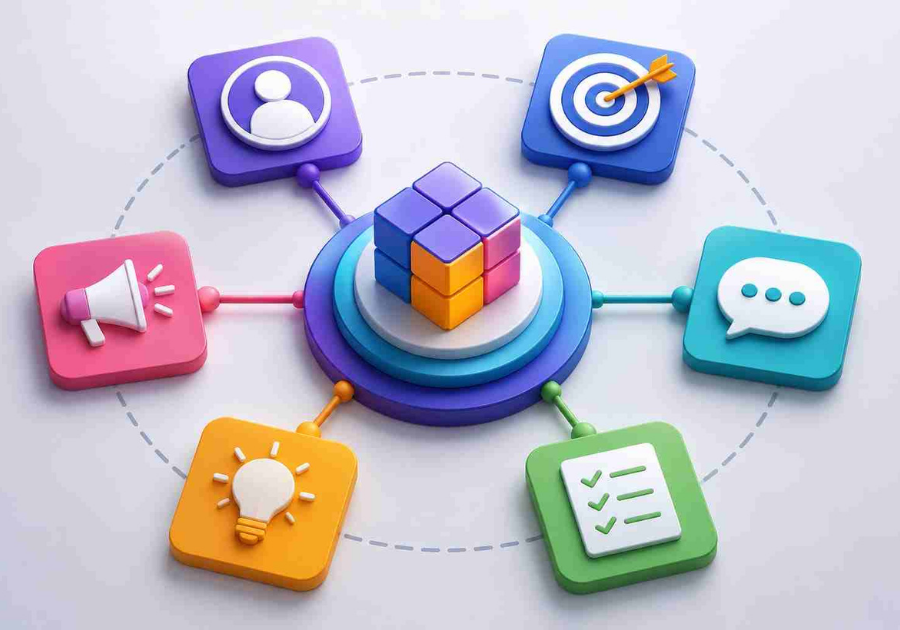
A comprehensive product messaging framework can contain several layers.
1. Target audience
Define exactly who you are trying to reach.
2. Customer problem
Identify the important problem your product solves.
3. Customer goals
Understand what customers ultimately want to accomplish.
4. Product category
Explain what the product is and how customers should understand it.
5. Core value proposition
Summarize the most important value your product provides.
6. Messaging pillars
Create the major themes that support the core message.
7. Benefits
Explain what customers gain.
8. Features
Connect product capabilities to customer benefits.
9. Differentiators
Explain why your product is different from alternatives.
10. Proof points
Provide evidence supporting your claims.
11. Objection handling
Prepare responses to common customer concerns.
12. Calls to action
Define what customers should do next.
A strong framework doesn’t simply describe your product.
It explains the customer transformation your product enables.
How to Create a Product Messaging Framework: 10-Step Process
Now let’s build a product messaging framework from the ground up.
Step 1: Define Your Ideal Customer
The first mistake many companies make is trying to create messaging for everyone.
When a message targets everyone, it often becomes too generic to strongly connect with anyone.
Start by defining your ideal customer.
Consider:
- Industry
- Company size
- Job role
- Responsibilities
- Buying authority
- Goals
- Pain points
- Current solutions
- Budget
- Buying triggers
- Common objections
For B2B products, remember that the person using your product may not be the same person purchasing it.
For example:
User: Marketing manager
Buyer: Head of Marketing
Decision influencer: Finance
Executive stakeholder: CEO
Each person may care about a different aspect of the product.
Customer profile template
Use this structure:
Our ideal customer is:
[Describe the customer]
Their role is:
[Job title or responsibility]
Their biggest problem is:
[Specific problem]
They currently solve it by:
[Existing solution]
They want to achieve:
[Desired outcome]
Their biggest buying concern is:
[Objection]
This creates the foundation for the rest of your product messaging framework.
Step 2: Research Your Customer’s Real Language
Your customers already have a vocabulary for describing their problems.
Your job is to discover it.
Don’t rely only on internal assumptions.
Look at:
- Customer interviews
- Sales calls
- Support conversations
- Customer reviews
- Surveys
- Testimonials
- Community discussions
- Search queries
- Product feedback
- Competitor reviews
- Demo questions
- Lost-deal interviews
Pay attention to repeated phrases.
Suppose you sell project management software.
Your team might say:
“Centralized workflow management platform.”
Customers might say:
“I waste half my day chasing people for project updates.”
The second statement may be much more useful for messaging.
Why?
Because it reflects the customer’s actual experience.
Build a customer language bank
Create categories such as:
Pain language
- “I spend too much time…”
- “It’s difficult to…”
- “We keep losing track of…”
Desired outcome language
- “I want to…”
- “We need a way to…”
- “It would be easier if…”
Objection language
- “I’m worried that…”
- “It seems expensive because…”
- “We already use…”
Use this language when developing your messaging.
Step 3: Identify the Problem Your Product Solves
A product can solve several problems, but not every problem deserves equal attention.
Separate the problem into different levels.
Functional problem
What practical problem does the customer experience?
Business problem
What impact does that problem have on the organization?
Emotional problem
How does the situation make the customer feel?
For example:
Product: Reporting automation software
Feature: Automated reports
Functional benefit: Reduces manual reporting work
Business outcome: Saves employee time and improves reporting efficiency
Emotional benefit: Gives managers more confidence in their data
This creates a useful chain:
Feature → Benefit → Business outcome → Customer value
Your product messaging should spend more time communicating the value and outcome than simply listing the feature.
Step 4: Define the Desired Customer Outcome
Customers rarely buy a product simply because they want the product.
They buy the result they believe the product will help them achieve.
Someone doesn’t necessarily want accounting software.
They may want:
- Fewer manual tasks
- Better financial visibility
- Faster reporting
- Fewer errors
- More control over cash flow
Someone doesn’t necessarily want project management software.
They may want:
- Fewer missed deadlines
- Better collaboration
- Less administrative work
- More predictable delivery
This is why your messaging should answer:
What changes for the customer after they use our product?
Create a simple before-and-after model.
Before
- Manual processes
- Poor visibility
- Delays
- Confusion
- Repetitive work
After
- Automated workflows
- Better visibility
- Faster execution
- Clear ownership
- More productive teams
The stronger the transformation, the stronger the messaging opportunity.
Step 5: Define Your Core Value Proposition
Your core value proposition is the central promise around which the rest of your messaging can be organized.
A useful formula is:
For [target customer] who [problem], [product] helps them [desired outcome] by [unique approach]. Unlike [alternative], we [key differentiator].
For example:
For growing agencies struggling with scattered project updates, our platform helps teams manage deadlines, workloads, and client projects in one workspace, unlike disconnected spreadsheets and communication tools.
A strong value proposition should be:
- Specific
- Customer-focused
- Relevant
- Differentiated
- Easy to understand
- Supported by evidence
Avoid stuffing your value proposition with every feature.
The goal is clarity, not completeness.
Step 6: Create Your Messaging Pillars
Messaging pillars are the major themes that support your core product message.
Most products don’t need dozens of pillars.
Three to five strong pillars are usually easier to remember and activate.
For example:
Core message
Manage agency projects with less coordination and more visibility.
Messaging Pillar 1: Project visibility
Give teams one place to understand project status, deadlines, and responsibilities.
Messaging Pillar 2: Workflow efficiency
Reduce repetitive coordination and manual updates.
Messaging Pillar 3: Team capacity
Understand workload and resource availability.
Messaging Pillar 4: Client confidence
Deliver projects more predictably and communicate progress clearly.
Each pillar can then be expanded into:
Message → Benefit → Feature → Proof → CTA
This creates a scalable messaging system.
Step 7: Connect Features to Benefits and Outcomes
One of the most common product messaging mistakes is treating features as the message.
A feature tells customers what the product has.
A benefit explains what the customer gains.
An outcome explains why that gain matters.
Consider:
“Our platform has automated reporting.”
That’s a feature.
A better message might be:
“Generate recurring reports automatically instead of building them manually every week.”
That’s a benefit.
A stronger business-oriented version might be:
“Reduce weekly reporting work so your team can spend more time analyzing performance.”
That’s an outcome.
Use the following framework:
| Feature | Benefit | Outcome |
|---|---|---|
| Automated reporting | Less manual work | Save team time |
| Real-time dashboard | Faster visibility | Make decisions sooner |
| Workflow automation | Fewer repetitive tasks | Improve productivity |
| Collaboration tools | Better communication | Reduce project delays |
This is one of the simplest ways to make product messaging more customer-centric.
Step 8: Identify Your Competitive Differentiators
Differentiation is not the same as being different.
Your product may have dozens of unique characteristics that customers don’t care about.
A useful differentiator should answer:
Why should this customer choose us instead of their most realistic alternative?
Your alternatives might include:
Direct competitors
Companies selling similar products.
Indirect competitors
Different products solving a similar problem.
DIY solutions
Spreadsheets, documents, internal systems, or manual processes.
Status quo
The customer continues doing nothing.
The last two are particularly important.
Sometimes your biggest competitor isn’t another software company.
It’s:
“We’ve always done it this way.”
Differentiation questions
Ask:
- What do customers choose us for?
- Why do customers leave competitors for us?
- What do customers mention in reviews?
- Which features are genuinely difficult to replicate?
- What can we prove?
- Which customer segment values our difference most?
- Which alternatives are customers comparing us against?
Avoid claiming:
“We’re the best.”
Explain what makes you meaningfully different and provide evidence.
Step 9: Add Proof Points
A message becomes more credible when you can prove it.
Proof points may include:
- Customer testimonials
- Case studies
- Quantifiable results
- Product demonstrations
- Customer reviews
- Certifications
- Industry recognition
- Usage statistics
- Research
- Before-and-after results
- Customer logos
For example:
Claim
“Reduce manual reporting work.”
Better
“Automate recurring reports and reduce the amount of manual reporting work your team handles each week.”
Stronger with proof
“Customers use automated reporting to reduce repetitive weekly reporting work.”
The exact claim should always match the evidence you actually have.
Avoid inventing statistics simply to make marketing copy sound impressive.
Step 10: Build Your Messaging Hierarchy
Now bring everything together.
A useful product messaging hierarchy looks like this:
Core Message
↓
Messaging Pillars
↓
Customer Benefits
↓
Features
↓
Proof Points
↓
Objection Handling
↓
CTA
For example:
Core message
Help growing businesses manage projects more efficiently.
Pillar 1
Improve project visibility.
Benefit: Everyone knows what needs to happen next.
Feature: Real-time project dashboard.
Proof: Customer case study.
Pillar 2
Reduce manual coordination.
Benefit: Spend less time chasing updates.
Feature: Automated notifications.
Proof: Customer testimonial.
Pillar 3
Improve resource planning.
Benefit: Identify capacity issues earlier.
Feature: Workload planning.
Proof: Product demonstration.
This hierarchy keeps the message organized.
Product Messaging Framework Template
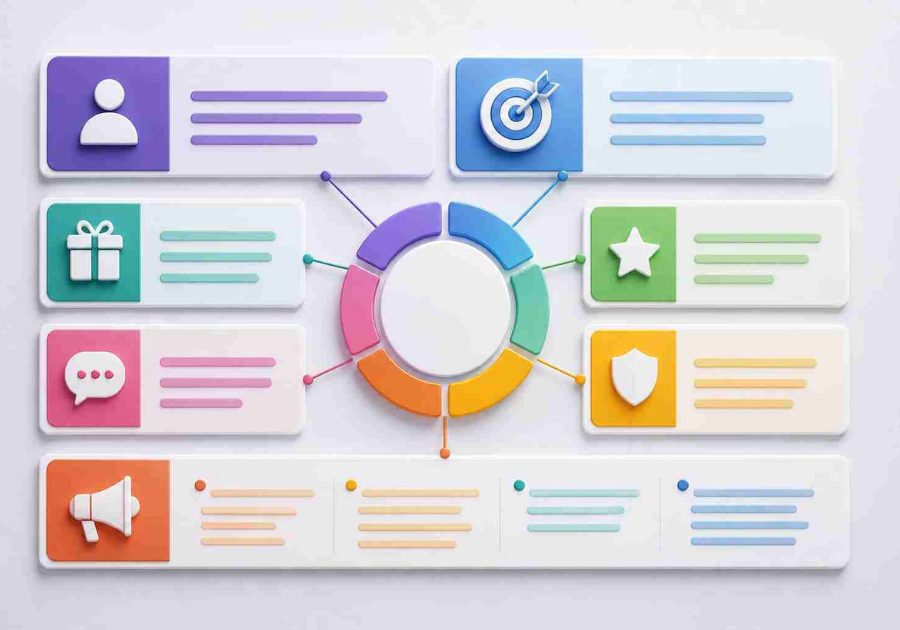
You can use the following template to build your own framework.
1. Target Customer
Who are we targeting?
[Answer]
2. Customer Problem
What important problem do they experience?
[Answer]
3. Customer Goal
What outcome do they want?
[Answer]
4. Product Category
What is the product?
[Answer]
5. Core Value Proposition
Why should the customer care?
[Answer]
6. Messaging Pillars
Pillar 1:
[Message]
Pillar 2:
[Message]
Pillar 3:
[Message]
7. Key Benefits
- [Benefit]
- [Benefit]
- [Benefit]
8. Key Features
- [Feature]
- [Feature]
- [Feature]
9. Differentiators
We are different because:
[Answer]
10. Competitive Alternatives
Customers may compare us with:
- [Competitor]
- [Alternative]
- [DIY solution]
- [Status quo]
11. Proof Points
- [Testimonial]
- [Case study]
- [Statistic]
- [Demonstration]
12. Common Objections
- [Objection]
- [Objection]
- [Objection]
13. CTA
What should the customer do next?
[CTA]
Product Messaging Framework Example
Let’s make the process more practical with a fictional SaaS product.
Imagine a company called FlowDesk, a project management platform for growing creative agencies.
Target customer
Agency owners, project managers, and operations teams.
Customer problem
Projects are managed across spreadsheets, email, messaging apps, and disconnected tools.
Business impact
- Missed deadlines
- Poor project visibility
- Excessive coordination
- Unclear workloads
- Client communication problems
Desired outcome
Agencies want to deliver projects on time while reducing administrative work.
Core value proposition
FlowDesk helps growing creative agencies organize projects, deadlines, workloads, and client updates in one connected workspace.
Messaging pillars
Pillar 1: Project visibility
Know what is happening across every active project.
Pillar 2: Workflow efficiency
Reduce repetitive coordination and manual updates.
Pillar 3: Resource planning
Understand workloads before projects become overloaded.
Pillar 4: Client confidence
Make project progress easier to communicate.
Turning the Framework Into Actual Marketing Copy
The same framework can now produce different messages for different channels.
Homepage
Headline:
Keep every agency project on track.
Supporting copy:
Manage deadlines, workloads, workflows, and client updates from one connected workspace.
CTA:
Start a Free Trial
Landing Page
The landing page can expand each messaging pillar.
Headline
Less project chasing. More project delivery.
Supporting message
Give your team one place to manage projects, deadlines, workloads, and updates without relying on disconnected spreadsheets and conversations.
Then introduce:
- Visibility
- Workflow efficiency
- Resource planning
- Client communication
Google Ads
A search advertisement needs to be much shorter.
Possible message:
Project Management for Agencies
Manage deadlines, workloads, and client projects in one workspace. Start your free trial.
The framework stays the same.
The format changes.
Sales Pitch
A salesperson might say:
“FlowDesk helps agencies reduce the coordination work that happens between project teams. Instead of tracking deadlines and updates across multiple tools, teams can manage project status, workload, and client communication from one workspace.”
Again, the strategic message remains consistent.
Social Media
A social post could focus on one pillar:
Still asking your team for project updates manually?
A centralized project dashboard can give your team visibility without another round of messages.
Less chasing. More doing.
The framework makes this content easier to create.
Adapt Your Product Messaging to the Buyer’s Journey
Different stages of the customer journey require different messages.
Your framework should account for this.
Awareness Stage
The customer may not fully understand the solution yet.
Focus on:
Problem + consequences
Example:
Spending hours every week chasing project updates?
Consideration Stage
The customer understands the problem and is evaluating solutions.
Focus on:
Solution + benefits + differentiation
Example:
Manage projects, workloads, and deadlines from one connected workspace.
Decision Stage
The customer is close to purchasing.
Focus on:
Proof + ROI + objections + risk reduction
Example:
See how growing agencies use centralized project management to reduce coordination and improve delivery visibility.
Retention Stage
The customer already bought the product.
Focus on:
Value realization + adoption + expansion
Example:
Discover three workflows that can help your team get more value from the platform.
This buyer-journey approach prevents companies from using the same message everywhere.
Create Persona-Specific Product Messaging
A single product can have several audiences.
Suppose you sell a business analytics platform.
CEO
Primary concern:
Business growth and decision-making
Message:
Get the visibility you need to make faster growth decisions.
Marketing Manager
Primary concern:
Campaign performance
Message:
See which campaigns are generating meaningful business results.
Finance Manager
Primary concern:
Accuracy and financial control
Message:
Connect performance data to the numbers that matter to finance.
Operations Manager
Primary concern:
Efficiency
Message:
Identify operational bottlenecks before they become expensive problems.
The underlying product remains the same.
The emphasis changes based on what matters to the persona.
How to Use Your Product Messaging Framework Across Marketing Channels
A strong framework should be flexible enough to support multiple channels.
Website
Use:
- Core value proposition
- Primary differentiator
- Messaging pillars
- Proof points
- CTA
Landing pages
Use:
- Persona-specific problem
- Relevant benefit
- Supporting features
- Proof
- Conversion-focused CTA
Paid advertising
Use:
- Pain point
- Desired outcome
- Differentiator
- Strong CTA
Email marketing
Use:
- Problem
- Insight
- Benefit
- Proof
- Action
Social media
Use:
- Customer pain
- Educational insight
- Product benefit
- Proof
- CTA
Sales decks
Use:
- Market problem
- Customer impact
- Solution
- Differentiation
- Evidence
- Business value
Product launches
Use:
- Problem
- New capability
- Customer benefit
- Differentiation
- Proof
- Adoption CTA
The framework remains the strategic foundation while the final wording changes by channel.
Common Product Messaging Mistakes to Avoid
1. Talking about features too early
Customers don’t necessarily care that your software has 25 features.
They care about what those features help them accomplish.
Start with the problem and outcome.
2. Trying to appeal to everyone
A message such as:
“Our platform helps businesses of all sizes improve productivity.”
is broad.
A more focused message might be:
“Project management software designed for growing creative agencies.”
Specificity creates relevance.
3. Using vague marketing language
Words like:
- Revolutionary
- Innovative
- Powerful
- Cutting-edge
- Next-generation
- Best-in-class
don’t communicate much unless supported by a meaningful explanation.
Replace vague claims with specific customer value.
Instead of:
“A powerful analytics platform.”
Try:
“Track campaign performance, customer acquisition, and revenue from one dashboard.”
4. Copying competitor messaging
Competitor research is useful for understanding the market.
It should not become an excuse to reproduce competitor language.
Ask:
“What position can we own?”
rather than:
“How can we sound like them?”
5. Creating too many messaging pillars
If everything is a priority, nothing is a priority.
Three to five clear pillars are usually easier to manage than 12 disconnected themes.
6. Ignoring customer language
Internal teams often use industry terminology that customers don’t naturally use.
Your messaging should prioritize language customers understand.
7. Making claims without proof
A differentiation claim is stronger when customers can verify it.
Whenever possible, connect important claims to evidence.
8. Never updating the framework
Your market changes.
Your product changes.
Your customers change.
Competitors change.
Your product messaging framework should evolve as you learn more.
How to Test Your Product Messaging
Creating a framework is not the final step.
You need to determine whether customers actually understand and respond to the message.
Qualitative testing
Customer interviews
Ask:
- What do you think this product does?
- Who do you think it is for?
- What problem does it solve?
- What part of the message is most important?
- What feels unclear?
- What would make you trust the claim?
Sales feedback
Ask sales teams:
- Which messages get prospects interested?
- Which objections appear repeatedly?
- Which benefits close deals?
- Which claims create confusion?
User testing
Show people your headline or value proposition and ask what they think it means.
You are looking for comprehension, not compliments.
Quantitative Product Messaging Tests
You can also test messages using measurable outcomes.
Depending on your funnel, monitor:
- Click-through rate
- Landing-page conversion rate
- Demo requests
- Trial registrations
- Lead quality
- Sales-qualified leads
- Opportunity rate
- Win rate
- Customer acquisition cost
- Revenue generated
For example, suppose you test two homepage headlines.
Version A
Powerful software for modern businesses.
Version B
Automate weekly reporting and give your team real-time performance visibility.
If Version B produces stronger engagement and conversions, you have evidence that specific outcome-focused messaging is more effective for that audience.
The goal isn’t to find the message that sounds best internally.
The goal is to find the message that helps customers understand and act.
How to Measure Product Messaging Performance
Create a simple measurement funnel.
Message exposure
↓
Engagement
↓
Consideration
↓
Conversion
↓
Sales
↓
Revenue
Then connect metrics to each stage.
| Funnel Stage | Possible Metrics |
|---|---|
| Awareness | Impressions, reach |
| Engagement | CTR, page engagement |
| Consideration | Product-page engagement, demo interest |
| Conversion | Trial/demo/signup rate |
| Sales | Opportunity rate, win rate |
| Revenue | Pipeline, revenue, retention |
Don’t judge product messaging using one metric alone.
A message can generate a high click-through rate but poor-quality leads.
The best messaging attracts the right customers, not simply more visitors.
Product Messaging Framework for SaaS Companies
SaaS companies often face a particular messaging challenge.
Features can quickly become complex.
A SaaS product might offer:
- Automation
- Integrations
- Analytics
- AI capabilities
- Collaboration
- Reporting
- Security
- Customization
Listing everything can overwhelm prospects.
Instead, organize your SaaS product messaging around customer outcomes.
SaaS messaging structure
Who it’s for
↓
Problem
↓
Outcome
↓
How the product achieves it
↓
Why it’s different
↓
Proof
↓
CTA
For example:
For growing sales teams struggling with inconsistent follow-up, our platform automates repetitive outreach workflows so representatives can spend more time having meaningful conversations.
This is much more useful than:
“Our platform includes automation, CRM integrations, analytics, workflows, dashboards, and reporting.”
The second describes a product.
The first communicates value.
Product Messaging Framework for B2B Products
B2B buying decisions often involve several stakeholders.
Your messaging should account for different priorities.
Executive buyer
Focus on:
- Revenue
- Growth
- Efficiency
- Risk
- ROI
Functional buyer
Focus on:
- Performance
- Productivity
- Workflow
- Results
Technical buyer
Focus on:
- Integration
- Security
- Reliability
- Scalability
End user
Focus on:
- Ease of use
- Time savings
- Productivity
- User experience
A good B2B product messaging framework doesn’t create four completely different product stories.
It creates one strategic message with persona-specific emphasis.
When Should You Update Your Product Messaging Framework?
Your messaging should be reviewed whenever important conditions change.
Update it when:
- You launch a new product
- You enter a new market
- Your target audience changes
- Your pricing changes significantly
- A major competitor changes position
- Your product gains new capabilities
- Customer objections change
- Your conversion rate declines
- Your sales team reports message confusion
- Customer research reveals new priorities
- Your company changes its positioning
You should also review performance regularly.
A messaging framework is not a document that gets created once and forgotten in a company folder.
It should become a working strategic asset.
Product Messaging Framework Checklist
Before launching your messaging, ask:
Audience
- Is the target customer clearly defined?
- Do we understand their priorities?
- Do we know who influences the purchase?
Problem
- Is the main customer problem specific?
- Do we understand the business impact?
- Do we understand the customer’s desired outcome?
Value
- Is our value proposition clear?
- Does it focus on customer value rather than company claims?
- Can someone understand it quickly?
Differentiation
- Do we know the customer’s alternatives?
- Is our differentiation meaningful?
- Can we prove our claims?
Messaging
- Do we have a clear core message?
- Do we have three to five messaging pillars?
- Are benefits connected to features?
- Do we have persona-specific variations?
Conversion
- Are objections addressed?
- Does each channel have an appropriate CTA?
- Are we testing our messages?
- Are we measuring business outcomes?
If several boxes remain unchecked, your messaging framework probably needs more work.
Frequently Asked Questions About Product Messaging Frameworks
What is a product messaging framework?
A product messaging framework is a structured system that defines how a company communicates a product’s value to its target audience. It typically includes the target customer, problem, desired outcome, value proposition, messaging pillars, benefits, differentiators, proof points, objections, and calls to action.
Why is a product messaging framework important?
A product messaging framework creates consistency, improves clarity, strengthens differentiation, supports sales teams, and provides a foundation for conversion-focused marketing across websites, advertising, email, social media, and sales materials.
What are the main components of a product messaging framework?
The main components include target audience, customer problem, desired outcome, value proposition, messaging pillars, product benefits, features, differentiators, proof points, objection handling, and CTA.
How do you create a product messaging framework?
Start by researching your ideal customer and their problems. Define the desired customer outcome, create a value proposition, identify messaging pillars, connect features to benefits, establish differentiation, add proof points, address objections, and adapt the messages to different buyer personas and channels.
What is the difference between product positioning and product messaging?
Product positioning defines how you want the product to be perceived relative to alternatives in the market. Product messaging translates that positioning into customer-facing communication.
How many messaging pillars should a product have?
There is no universal number, but three to five focused messaging pillars are often easier to understand, remember, manage, and apply across marketing and sales channels.
Should product messaging focus on features or benefits?
Product messaging should prioritize customer benefits and outcomes while using features as supporting evidence. A feature explains what the product does; a benefit explains what the customer gains from it.
How often should product messaging be updated?
Review your product messaging regularly and update it whenever your audience, product, market, competitors, customer needs, or business strategy changes. Performance data and customer feedback should also influence updates.
Can the same product messaging framework be used across all channels?
Yes. The strategic framework can remain consistent while the execution changes. Your website may use detailed messaging, while an advertisement may use one benefit and a short CTA.
How does product messaging improve conversions?
Clear product messaging helps prospects quickly understand the product, recognize its relevance, see its value, understand its differentiation, and decide what action to take next.
Final Thoughts: Build a Messaging System, Not Just a Tagline
A product messaging framework is much more than a catchy headline.
It is the system behind your product communication.
The strongest frameworks connect customer research with business value:
Customer → Problem → Outcome → Value → Differentiation → Proof → Action
Start by understanding the customer.
Then identify the problem they are trying to solve.
Define the outcome they want.
Turn that insight into a clear value proposition.
Build a small number of messaging pillars.
Connect features to benefits.
Establish meaningful differentiation.
Support important claims with proof.
Then turn the framework into channel-specific messaging for your website, landing pages, advertisements, sales materials, email campaigns, social media, and product launches.
Most importantly, test the message against real customer behavior.
If prospects don’t understand what your product does, why it matters, or why they should choose it, adding more features to your website won’t necessarily solve the problem.
Better product messaging starts with better customer understanding.
And a well-built product messaging framework gives your entire organization a repeatable way to turn that understanding into clearer communication and stronger conversions.
Quick Product Messaging Framework
For a simple reference, remember this:
1. Define your audience
2. Research their language
3. Identify their problem
4. Define the desired outcome
5. Create your value proposition
6. Build messaging pillars
7. Connect features to benefits
8. Identify differentiators
9. Add proof points
10. Test, measure, and optimize
That is the foundation of a product messaging strategy that can support both marketing performance and sales conversations.
SEO Elements
SEO Title: How to Create a Product Messaging Framework That Converts
Meta Description: Learn how to create a product messaging framework with a step-by-step process, template, examples, messaging pillars, proof points, and conversion strategies.
Suggested URL Slug: /product-messaging-framework/
Primary Keyword: product messaging framework
Secondary Keywords: product messaging, product messaging strategy, product messaging template, product messaging examples, product positioning framework, product value proposition, messaging pillars, B2B product messaging, SaaS product messaging, product differentiation, product marketing strategy.