

Table of Contents
A company can have a great product and still struggle to communicate its value clearly. The problem is often not the product itself—it is the absence of a consistent messaging structure.
One team may focus on features. Sales may emphasize price. Marketing may talk about benefits. Leadership may describe a bigger vision. Customers, meanwhile, may be left wondering what the company actually stands for and why they should choose it.
A messaging house solves this problem by giving everyone a shared structure for communicating the most important ideas about a brand, product, or organization.
A messaging house organizes communication around one central message, several supporting messages, and credible proof points. Think of it as the architectural blueprint for your brand messaging: the roof represents the main message, the pillars support that message, and the foundation provides evidence.
This guide explains how to create a messaging house from scratch, including research, positioning, messaging pillars, proof points, audience variations, examples, testing methods, and a practical messaging house template.
What Is a Messaging House?

A messaging house is a strategic framework that organizes a company’s most important messages into a clear hierarchy.
The structure normally contains three core parts:
- Roof: The central or overarching message
- Pillars: The key supporting messages that reinforce the central message
- Foundation: Proof points that demonstrate why the messages are credible
A simple messaging house looks like this:
                    ┌─────────────────────────┐
                    │          ROOF           │
                    │      Core Message       │
                    └─────────────────────────┘
                         /       |       \
                        /        |        \
               ┌──────────┐ ┌──────────┐ ┌──────────┐
               │ PILLAR 1 │ │ PILLAR 2 │ │ PILLAR 3 │
               └──────────┘ └──────────┘ └──────────┘
                    |             |             |
                 Proof         Proof         Proof
                 Points        Points        Points
               ─────────────────────────────────────
                         FOUNDATION
The purpose is simple: every important message should connect back to the central idea.
https://xperiatech.com/positioning-messaging-services/ For example, a SaaS company might have:
Roof:
Simplify project management for growing teams.
Pillar 1: Centralized collaboration
Pillar 2: Automated workflows
Pillar 3: Better project visibility
Each pillar would then have evidence such as customer results, product capabilities, testimonials, research, or performance data.
Is a Messaging House the Same as a Message House?
Yes, in most marketing and communications contexts, messaging house and message house refer to essentially the same concept.
You may also see terms such as:
- Message house framework
- Messaging framework
- Brand messaging framework
- Messaging architecture
- Brand message house
The terminology can vary, but the fundamental idea remains similar: create one coherent hierarchy of messages that guides communication across channels and audiences.
Why Is a Messaging House Important?

Without a messaging house, organizations often create individual pieces of content without a consistent strategic foundation.
A website might claim one benefit, while a sales presentation focuses on another. A social media campaign may introduce a completely different positioning angle.
This creates message fragmentation.
A well-developed messaging house provides a central source of truth.
1. It Creates Consistent Communication
Consistency does not mean repeating exactly the same sentence everywhere.
It means that your website, sales team, advertisements, social media posts, presentations, emails, and public communications all reinforce the same fundamental idea.
Your wording can change by channel while your strategic message stays consistent.
2. It Aligns Marketing and Sales
Marketing teams often create campaigns based on audience research, while sales teams hear customer objections directly.
A messaging house gives both teams a common foundation.
Marketing can communicate the major benefits, while sales can expand on those benefits during conversations.
This reduces conflicting claims and makes customer-facing communication more coherent.
3. It Makes Complex Products Easier to Explain
Complex products often have dozens of features.
Customers don’t necessarily need to understand every feature immediately.
They need to understand:
What is this?
Why does it matter to me?
What problem does it solve?
Why should I believe you?
A messaging house turns a large collection of product information into a smaller number of meaningful messages.
4. It Makes Content Creation Easier
Once your messaging pillars are established, they can become content categories.
For example:
Pillar: Productivity
Possible content:
- Productivity tips
- Customer stories
- Product tutorials
- Industry statistics
- How-to articles
- Expert insights
- Product demonstrations
One messaging pillar can therefore generate dozens of content ideas.
5. It Strengthens Brand Positioning
Your messaging house helps reinforce what you want customers to associate with your company.
If your brand wants to be known for simplicity, for example, that idea should appear consistently throughout the messaging architecture.
Over time, repeated and supported messages can help strengthen your position in the market.
The Three Main Components of a Messaging House

Before learning how to create a messaging house, you need to understand its basic architecture.
1. The Roof: Your Core Message
The roof is the most important message in the entire framework.
It represents the central idea you want your audience to remember.
A strong roof should answer:
What is the most important thing customers should understand about your brand or product?
It should be:
- Clear
- Relevant
- Customer-focused
- Differentiated
- Easy to remember
- Broad enough to support your pillars
- Specific enough to mean something
Weak Core Message
We provide innovative solutions for modern businesses.
The problem is that almost any company could say this.
Stronger Core Message
We help growing SaaS teams automate customer onboarding without adding operational complexity.
The second statement tells the reader:
- Who it serves
- What it helps them accomplish
- What problem it addresses
Your roof does not necessarily need to be your website headline word for word. It is the strategic message behind your external communication.
2. The Pillars: Your Supporting Messages
The pillars support the roof.
They explain why your core message is believable and valuable.
Most messaging houses work well with approximately three to four major pillars. The exact number depends on the complexity of the organization, audience, and communication objectives.
For example:
Roof
Make customer onboarding faster and easier for growing SaaS teams.
Pillar 1
Reduce manual onboarding work
Pillar 2
Create a smoother customer experience
Pillar 3
Increase onboarding visibility
Each pillar addresses a different dimension of the core promise.
What Makes a Good Messaging Pillar?
A good pillar should:
- Matter to the target audience
- Support the core message
- Communicate a meaningful benefit
- Be distinct from the other pillars
- Have evidence behind it
- Be useful across multiple channels
Avoid turning every product feature into a pillar.
For example:
Feature: Automated emails
Benefit: Customers receive timely onboarding information
Outcome: Customers can move through onboarding with less manual assistance
The outcome is generally more valuable as a message than the raw feature.
3. The Foundation: Proof Points
The foundation is what makes the messaging house credible.
A company can claim:
Our platform saves businesses time.
But the audience may immediately wonder:
How much time?
That is where proof comes in.
Examples of Proof Points
Your foundation can include:
- Customer testimonials
- Case studies
- Research
- Product data
- Customer statistics
- Reviews
- Demonstrations
- Certifications
- Awards
- Independent studies
- Before-and-after results
- Customer retention data
- Usage statistics
- Expert endorsements
- Implementation results
For example:
Pillar: Reduce manual reporting.
Claim: Teams spend less time preparing reports.
Proof: Customers report saving several hours per reporting cycle.
The exact evidence should always be accurate and verifiable.
A Useful Rule
Think of your messaging hierarchy as:
Claim → Benefit → Evidence
The claim tells people what you stand for.
The benefit tells them why they should care.
The evidence tells them why they should believe you.
How to Create a Messaging House Step by Step
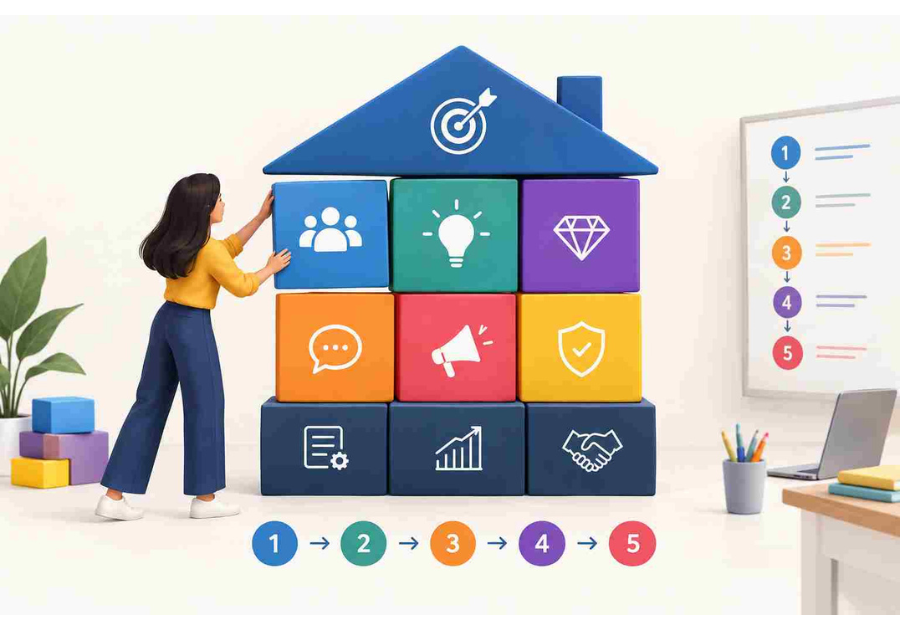
Now let’s move from theory to implementation.
Creating a strong messaging house isn’t simply a matter of writing a catchy headline. The strongest frameworks are built from research, customer insights, positioning, differentiation, and evidence.
Here is a practical 12-step process.
Step 1: Define Your Target Audience
Start with the audience—not the product.
Before writing your core message, identify exactly who you want to reach.
Ask:
- Who is the primary audience?
- Who uses the product?
- Who makes the purchasing decision?
- Who influences the decision?
- What industry are they in?
- What role do they have?
- What challenges are they experiencing?
- What outcomes do they want?
- What alternatives are they considering?
For a B2B SaaS product, for example, the buyer may be a marketing director while the daily user may be a marketing specialist.
Both people may care about the product for different reasons.
Create an Audience Profile
| Category | Example |
|---|---|
| Audience | Growing SaaS companies |
| Buyer | Marketing leader |
| User | Marketing team |
| Main problem | Manual campaign management |
| Desired outcome | Faster campaign execution |
| Concern | Implementation complexity |
| Alternative | Spreadsheets and disconnected tools |
This information will influence every layer of your messaging house.
Step 2: Identify Customer Problems
Your messaging should reflect real customer problems rather than assumptions.
Ask customers:
- What is the biggest challenge you face?
- What takes too much time?
- What is difficult about your current process?
- What happens if the problem isn’t solved?
- What have you already tried?
- Why didn’t those solutions work?
- What would an ideal solution look like?
Look for recurring patterns.
For example, customers might repeatedly say:
“We spend too much time manually updating reports.”
That language can become a valuable input for your messaging.
Organize Problems Into Categories
Functional problems
What isn’t working?
Financial problems
What is costing money?
Time problems
What takes too long?
Operational problems
Where is the process inefficient?
Emotional problems
What causes frustration, uncertainty, or risk?
Understanding all five can help you develop stronger supporting messages.
Step 3: Identify Desired Customer Outcomes
Don’t stop at the problem.
Determine what customers actually want to achieve.
For example:
Problem: Reporting takes too long.
Desired outcome: Get reports ready faster.
Business outcome: Make decisions sooner.
Emotional outcome: Feel more confident about performance.
This progression helps move your messaging from features to meaningful value.
Feature vs Benefit vs Outcome
| Level | Example |
|---|---|
| Feature | Automated reporting |
| Benefit | Reduces manual work |
| Outcome | Teams get performance insights faster |
| Business value | Faster, better-informed decisions |
A strong messaging house generally prioritizes the customer outcome rather than simply listing product capabilities.
Step 4: Research Your Competitors
Your messaging should not exist in isolation.
Study how competitors describe:
- Their category
- Their value proposition
- Their key benefits
- Their differentiators
- Their target audience
- Their proof
- Their tone
- Their recurring phrases
Create a simple competitor messaging matrix.
| Competitor | Main Message | Pillar | Proof | Potential Gap |
|---|---|---|---|---|
| Company A | Save time | Automation | Customer data | Limited customization |
| Company B | Easy collaboration | Collaboration | Reviews | Weak reporting |
| Company C | Enterprise control | Security | Certifications | Complex setup |
The goal isn’t to copy competitor messaging.
The goal is to identify where the market sounds repetitive.
If every competitor says:
Simple, powerful, flexible, innovative
those words may have little differentiation.
Look for a message your brand can credibly own.
Step 5: Define Your Positioning
Before finalizing your messaging house, clarify your position.
A useful positioning structure is:
For [target audience] who [problem or need], [brand] is a [category] that [key value], because [reason to believe].
For example:
For growing ecommerce teams struggling with fragmented customer data, Brand X is a customer analytics platform that brings purchase and behavior data into one workspace, helping teams make faster retention decisions.
This positioning statement doesn’t necessarily become your public-facing copy.
Instead, it gives your messaging house strategic direction.
Step 6: Write the Roof
Now develop your core message.
Start with several alternatives instead of trying to create the perfect statement immediately.
Formula 1: Audience + Outcome
We help [audience] achieve [outcome].
Formula 2: Problem + Solution
Help [audience] overcome [problem] through [solution].
Formula 3: Outcome + Differentiation
[Brand] helps [audience] achieve [outcome] without [common limitation].
Formula 4: Customer Value
[Brand] gives [audience] a better way to [important job].
Then evaluate each version.
Core Message Evaluation Checklist
Ask:
- Is it clear?
- Is it customer-focused?
- Is it specific?
- Is it differentiated?
- Is it believable?
- Does it support the pillars?
- Could a competitor say the same thing?
- Can the message be explained in one sentence?
If the answer to several questions is no, keep refining.
Step 7: Develop Your Messaging Pillars
Once the roof is clear, identify the three or four ideas that best support it.
Suppose your roof is:
Help growing teams manage projects with less complexity.
Possible pillars could be:
Pillar 1: Simple Collaboration
Everyone can access the information they need in one place.
Pillar 2: Automated Workflows
Teams can reduce repetitive project administration.
Pillar 3: Real-Time Visibility
Managers can understand project progress without chasing updates.
Notice how each pillar contributes to the same overall promise.
They are also distinct.
A common mistake is creating pillars that overlap.
For example:
- Easy to use
- Simple
- User-friendly
These are essentially the same message expressed three ways.
Instead, create pillars that represent different reasons customers should believe your core promise.
Step 8: Add Proof to Every Pillar
Now build the foundation.
For each pillar, ask:
What evidence proves this?
Create a proof-point database.
| Pillar | Message | Proof |
|---|---|---|
| Simplicity | Easy to implement | Customer onboarding results |
| Efficiency | Reduces repetitive work | Time-saving data |
| Visibility | Improves project tracking | Customer case study |
You can categorize proof into three levels.
Level 1: Direct Evidence
Strongest evidence includes:
- Measured results
- Customer data
- Case studies
- Product analytics
Level 2: Credibility Evidence
Examples include:
- Reviews
- Testimonials
- Certifications
- Awards
Level 3: Demonstrative Evidence
Examples include:
- Product demonstrations
- Screenshots
- Tutorials
- Interactive examples
Use the strongest available proof for your most important claims.
Step 9: Adapt the Messaging House for Different Audiences
A messaging house should provide consistency without forcing every audience to hear exactly the same language.
Imagine a SaaS company sells to:
- CEOs
- Marketing managers
- Sales leaders
- Operations teams
The core message can remain consistent.
But the emphasis changes.
CEO
Focus on:
- Business efficiency
- Revenue impact
- Strategic visibility
Marketing Manager
Focus on:
- Campaign execution
- Productivity
- Performance
Sales Leader
Focus on:
- Pipeline visibility
- Team productivity
- Revenue opportunities
Operations Leader
Focus on:
- Process efficiency
- Automation
- Workflow management
This creates message consistency with audience relevance.
Step 10: Add Objection Handling
This is one of the most useful additions to a modern messaging house.
Customers rarely evaluate only the positive claims.
They also ask:
- Is it expensive?
- Is implementation difficult?
- Will it integrate with our tools?
- Can our team learn it quickly?
- Is it secure?
- Will it work at our scale?
- What happens if we need support?
For each major pillar, document common objections.
Example
Pillar: Easy implementation
Claim: Teams can launch quickly.
Proof: Customer implementation data.
Objection: “Will we need a technical team?”
Response: Explain onboarding support, integrations, documentation, or implementation resources.
This turns your messaging house into a useful sales enablement tool, not just a marketing document.
Step 11: Turn the Framework Into a One-Page Messaging House
Once your research is complete, simplify it.
Your final one-page framework might look like:
                         ROOF
              Core Brand Message
                         │
          ┌──────────────┼──────────────┐
          │              │              │
       PILLAR 1       PILLAR 2       PILLAR 3
          │              │              │
       Proof 1        Proof 1        Proof 1
       Proof 2        Proof 2        Proof 2
       Proof 3        Proof 3        Proof 3

              AUDIENCE VARIATIONS
                       │
                OBJECTION HANDLING
                       │
                    CTAs
The document should be simple enough that a marketer, salesperson, executive, designer, or content writer can understand it quickly.
Step 12: Test and Refine Your Messaging House
Creating the document is not the final step.
You need to determine whether the messaging actually works.
Test it with:
- Existing customers
- Prospects
- Sales representatives
- Marketing teams
- Customer support teams
- Product teams
- Leadership
Ask:
What do you think this company does best?
Then compare their answers with your intended core message.
If customers consistently describe you differently, that is useful information.
Your messaging may need refinement.
A Complete Messaging House Example
Let’s create a fictional example for a SaaS project management platform called FlowTask.
Roof: Core Message
FlowTask helps growing teams manage projects from planning to completion without scattered tools or constant manual updates.
Now we build the pillars.
Pillar 1: Centralized Collaboration
Message
Teams can organize tasks, conversations, files, and project information in one workspace.
Proof
- Shared project dashboards
- Centralized task management
- Team collaboration features
- Customer testimonials
Customer Outcome
Teams spend less time searching for project information.
Pillar 2: Automated Workflows
Message
Teams can automate repetitive project processes and reduce administrative work.
Proof
- Workflow automation
- Automated task assignments
- Recurring processes
- Custom workflow rules
Customer Outcome
Teams spend more time completing meaningful work and less time managing repetitive tasks.
Pillar 3: Real-Time Visibility
Message
Managers can quickly understand project progress, deadlines, and potential bottlenecks.
Proof
- Reporting dashboards
- Project status views
- Progress tracking
- Performance reporting
Customer Outcome
Leaders can make decisions using current project information.
Complete Structure
ROOF
FlowTask helps growing teams manage projects without scattered tools or constant manual updates.
PILLAR 1
Centralize collaboration.
Proof: Shared workspaces, task management, customer feedback.
PILLAR 2
Automate repetitive workflows.
Proof: Workflow automation, recurring tasks, process templates.
PILLAR 3
Improve project visibility.
Proof: Dashboards, reports, progress tracking.
The important point is that every pillar reinforces the roof.
Messaging House Template
You can use the following template to build your own messaging house.
1. Roof: Core Message
We help:
[Target audience]
Achieve:
[Desired outcome]
By:
[Your unique value]
Without:
[Common frustration or limitation]
Final Core Message
[Write one concise customer-focused statement.]
2. Pillar One
Supporting Message
[What is the first major reason customers should believe the core message?]
Customer Benefit
[Why does it matter?]
Proof
- [Evidence]
- [Customer result]
- [Data]
- [Testimonial]
3. Pillar Two
Supporting Message
[Second supporting idea]
Customer Benefit
[Benefit]
Proof
- [Evidence]
- [Customer result]
- [Data]
- [Testimonial]
4. Pillar Three
Supporting Message
[Third supporting idea]
Customer Benefit
[Benefit]
Proof
- [Evidence]
- [Customer result]
- [Data]
- [Testimonial]
5. Audience Adaptations
Audience 1
Primary concern:
[Concern]
Relevant message:
[Adapted message]
Audience 2
Primary concern:
[Concern]
Relevant message:
[Adapted message]
Audience 3
Primary concern:
[Concern]
Relevant message:
[Adapted message]
6. Objections
Objection 1:
[Customer concern]
Response:
[Evidence-backed response]
Objection 2:
[Customer concern]
Response:
[Evidence-backed response]
Common Messaging House Mistakes
Even a well-designed framework can fail if the underlying messages are weak.
Here are the most common mistakes to avoid.
1. Making the Core Message Too Generic
Statements such as:
We deliver innovative solutions.
or:
We help businesses grow.
are difficult to own because almost every company can say them.
Specificity creates meaning.
Instead of:
We help businesses improve productivity.
Try:
We help distributed teams reduce repetitive project administration.
The second statement provides a clearer direction.
2. Making the Pillars Product Features
A feature isn’t automatically a strategic message.
For example:
AI dashboard
is a feature.
The customer-facing message could be:
Give managers faster visibility into performance.
Then the dashboard becomes evidence supporting the benefit.
3. Creating Too Many Pillars
More isn’t necessarily better.
If you have ten pillars, your audience may struggle to remember any of them.
Prioritize the few ideas that have the greatest impact on your positioning.
4. Using Unsupported Claims
Avoid claims such as:
We are the world’s leading platform.
unless you have credible evidence to support them.
Instead, use specific proof:
Used by X organizations.
or:
Customers reduced reporting time by X%.
Only use figures and claims that can be substantiated.
5. Making Every Pillar Sound the Same
Consider:
- Easy
- Simple
- Effortless
- User-friendly
These may represent one concept rather than four pillars.
Your pillars should add different dimensions to your core message.
6. Writing From the Company’s Perspective
Weak messaging:
We provide advanced analytics technology.
Customer-focused messaging:
Help teams identify performance trends faster.
The second statement focuses on what the audience gets rather than what the company sells.
7. Ignoring Customer Language
Your customers may not use the terminology your internal team uses.
If customers consistently say:
“I spend hours copying data between tools.”
don’t automatically replace it with:
“Cross-platform data synchronization creates operational inefficiencies.”
The second version may sound professional, but the first communicates the problem more naturally.
8. Creating the Messaging House and Forgetting About It
A messaging house should not become a document that sits in a folder.
Use it actively.
It should influence:
- Website copy
- Landing pages
- Sales presentations
- Email campaigns
- Social media
- Advertising
- PR
- Content
- Product marketing
- Sales conversations
How to Use a Messaging House Across Marketing Channels
One of the biggest advantages of a messaging house is its versatility.
The same strategic architecture can power different forms of communication.
Website
Roof: Homepage positioning
Pillars: Benefit sections
Proof: Testimonials, statistics, case studies
CTA: Primary conversion action
Content Marketing
Turn each pillar into a content category.
For example:
Pillar: Productivity
Content ideas:
- Productivity guides
- Industry research
- How-to articles
- Customer stories
- Tutorials
- Checklists
This makes your content strategy more consistent.
Social Media
One messaging pillar can generate multiple social posts.
For example:
Pillar: Automation
Content:
- Automation tips
- Workflow mistakes
- Customer story
- Product demonstration
- Before-and-after example
- Industry statistic
The social content can vary while reinforcing the same strategic message.
Paid Advertising
Each pillar can become a different advertising angle.
Ad Angle 1
Reduce repetitive work.
Ad Angle 2
Give your team one place to manage projects.
Ad Angle 3
See project performance without chasing updates.
Testing multiple pillar-based angles can help identify which message resonates most strongly.
Sales Presentations
A sales deck can follow the same structure:
Opening: Core message
Middle: Messaging pillars
Evidence: Case studies and results
Objections: Addressed near the relevant pillar
Closing: CTA
This prevents the sales presentation from becoming a random collection of product features.
Messaging House vs. Other Messaging Frameworks
Several marketing concepts sound similar, but they serve different purposes.
| Framework | Main Purpose |
|---|---|
| Messaging House | Organizes core messages and supporting proof |
| Value Proposition | Explains the value delivered to customers |
| USP | Highlights a distinctive reason to choose a brand |
| Positioning Statement | Defines how a brand should be perceived relative to alternatives |
| Brand Messaging Framework | Broader system for communicating brand ideas |
| Brand Voice | Defines how the brand communicates |
| Elevator Pitch | Communicates the essential idea quickly |
These frameworks can work together.
For example:
Positioning determines where you want to compete.
↓
Value proposition explains the value you provide.
↓
Messaging house organizes the messages used to communicate that value.
↓
Brand voice determines how those messages sound.
↓
Content and campaigns distribute the messages.
Messaging House vs. Value Proposition
A value proposition and messaging house are related but not identical.
A value proposition generally communicates why a customer should choose a product or service.
A messaging house creates a broader hierarchy around that value proposition.
For example:
Value Proposition
Automate your customer onboarding and reduce manual work.
Messaging House
Roof:
Simplify customer onboarding.
Pillar 1:
Automate repetitive tasks.
Pillar 2:
Improve customer experience.
Pillar 3:
Increase onboarding visibility.
Foundation:
Customer results, product capabilities, case studies, and data.
The messaging house therefore gives the value proposition more structure.
How to Test Whether Your Messaging House Works
A messaging house isn’t successful because it looks good on a slide.
It succeeds when it improves communication.
Use these tests.
The 10-Second Clarity Test
Show someone your core message briefly.
Ask:
What does this company/product do?
If they cannot explain it, simplify the message.
The Differentiation Test
Ask:
Could our closest competitor use this exact message?
If yes, find a more distinctive angle.
The Proof Test
For every major claim, ask:
Can we prove this?
If not, either find evidence or soften the claim.
The Customer-Language Test
Compare your messaging against:
- Customer interviews
- Reviews
- Support tickets
- Sales calls
- Surveys
- Search queries
- Community discussions
Your language should reflect real customer concerns.
The Sales Test
Give the messaging house to sales representatives.
Ask:
Can you naturally use these messages in a customer conversation?
If the framework feels too theoretical, simplify it.
The Content Test
Give the framework to a content writer.
Ask them to create:
- A blog post
- A landing page
- A social post
- An email
- A sales paragraph
If the framework makes content creation easier, it is doing its job.
How Often Should You Update a Messaging House?
There is no universal update schedule.
Review your messaging when something significant changes, such as:
- A new product launch
- A new target audience
- A major repositioning
- A website redesign
- A new competitor
- A change in customer needs
- A new market
- A merger or acquisition
- Major customer research
- New proof or performance data
Even when there is no major change, periodically review whether your messaging still reflects how customers describe your business.
The framework should be stable enough to create consistency but flexible enough to evolve.
Can a Company Have More Than One Messaging House?
Yes, but be careful.
A company may need different messaging architecture for:
- Different products
- Different customer segments
- Different markets
- Different industries
However, those variations should not contradict the broader brand positioning.
For example, an enterprise software company could have:
Corporate Brand Roof
Simplify complex business operations.
Then individual products can have their own supporting messaging systems.
The goal is to create hierarchy, not chaos.
Messaging House Checklist
Before finalizing your framework, review this checklist.
Strategy
- Have we clearly defined our target audience?
- Do we understand their problems?
- Do we know their desired outcomes?
- Have we analyzed competing messages?
- Is our positioning clear?
Roof
- Is our core message easy to understand?
- Is it customer-focused?
- Is it specific?
- Is it differentiated?
- Can we support it with evidence?
Pillars
- Do we have three or four strong supporting messages?
- Does each pillar support the roof?
- Are the pillars distinct?
- Are they based on customer needs?
- Do they communicate outcomes rather than just features?
Foundation
- Does every major claim have proof?
- Is the evidence credible?
- Are customer results documented?
- Can sales and marketing access the proof?
Implementation
- Have we created audience variations?
- Have we documented objections?
- Can the framework guide website copy?
- Can it guide content?
- Can it guide advertising?
- Can sales use it?
- Do we have a process for testing and updating it?
If you can check most of these boxes, your messaging house is ready to become a practical communication tool.
Frequently Asked Questions About Messaging Houses
What is a messaging house?
A messaging house is a communication framework that organizes a company’s core message, supporting messages, and proof points. The roof represents the central message, the pillars represent supporting messages, and the foundation contains evidence that supports those claims.
What are the three main parts of a messaging house?
The three traditional components are the roof, pillars, and foundation. The roof contains the core message, the pillars contain supporting messages, and the foundation contains proof points.
What goes on the roof of a messaging house?
The roof contains the central message you want your audience to remember. It should be clear, relevant, differentiated, customer-focused, and broad enough to connect all the supporting pillars.
How many pillars should a messaging house have?
There is no fixed number, but three to four strong pillars are often easier to communicate and remember than a long list of supporting messages. The ideal number depends on the brand, audience, and complexity of the offering.
What are proof points in a messaging house?
Proof points are pieces of evidence that support your messaging claims. They can include customer testimonials, case studies, research, statistics, product data, reviews, certifications, demonstrations, and measurable customer outcomes.
What is the difference between a messaging house and a message house?
The terms are commonly used interchangeably. Both describe a framework that organizes a central message, supporting messages, and evidence into a structured hierarchy.
What is the difference between a messaging house and a messaging framework?
A messaging framework is a broader term that can include positioning, value propositions, audience-specific messages, brand messages, objections, proof, and communication guidelines. A messaging house is one structured approach to organizing these messages.
Can a messaging house be used for B2B SaaS?
Yes. A messaging house is particularly useful for B2B SaaS companies because SaaS products often have multiple features, audiences, use cases, and benefits that need to be organized into a clear story.
Who should create a messaging house?
Ideally, the process should involve marketing, product marketing, sales, leadership, customer-facing teams, and—where possible—customer research. One person can manage the framework, but input from multiple teams makes the final messaging stronger.
How do I know if my messaging house is effective?
Test whether customers understand your core message, whether employees communicate it consistently, whether every major claim has evidence, whether the pillars are differentiated, and whether the messaging improves engagement or conversion across relevant channels.
Final Thoughts: Build a Messaging House That People Can Actually Use
A messaging house is more than a diagram with a roof, pillars, and foundation.
It is a strategic system for turning complex brand information into clear, consistent, evidence-backed communication.
The most effective process starts with your audience. Understand their problems, desired outcomes, concerns, alternatives, and language before writing your core message.
Then build the architecture:
Roof → What should people remember?
Pillars → What are the major reasons to believe it?
Foundation → What proves those messages are true?
From there, adapt the framework for different audiences, address objections, and translate the messages into your website, content, sales materials, advertising, social media, email, and other communication channels.
Most importantly, don’t treat the messaging house as a one-time branding exercise.
Use it as a living source of truth.
When a content writer needs to develop a new article, the messaging house should tell them which ideas to reinforce. When a salesperson prepares for a customer conversation, it should provide the core narrative and supporting evidence. When a marketing team launches an advertising campaign, it should provide tested message angles. When leadership communicates publicly, it should help keep the story consistent.
The result is not simply better copy.
It is a brand that becomes easier to understand, easier to remember, easier to differentiate, and easier to trust.
A strong messaging house ultimately answers one critical question:
What should our audience believe about us, why should they care, and what evidence gives them a reason to believe it?
Once those answers are clear, your entire communication strategy becomes easier to build.