
Table of Contents
That is why a go-to-market strategy matters.
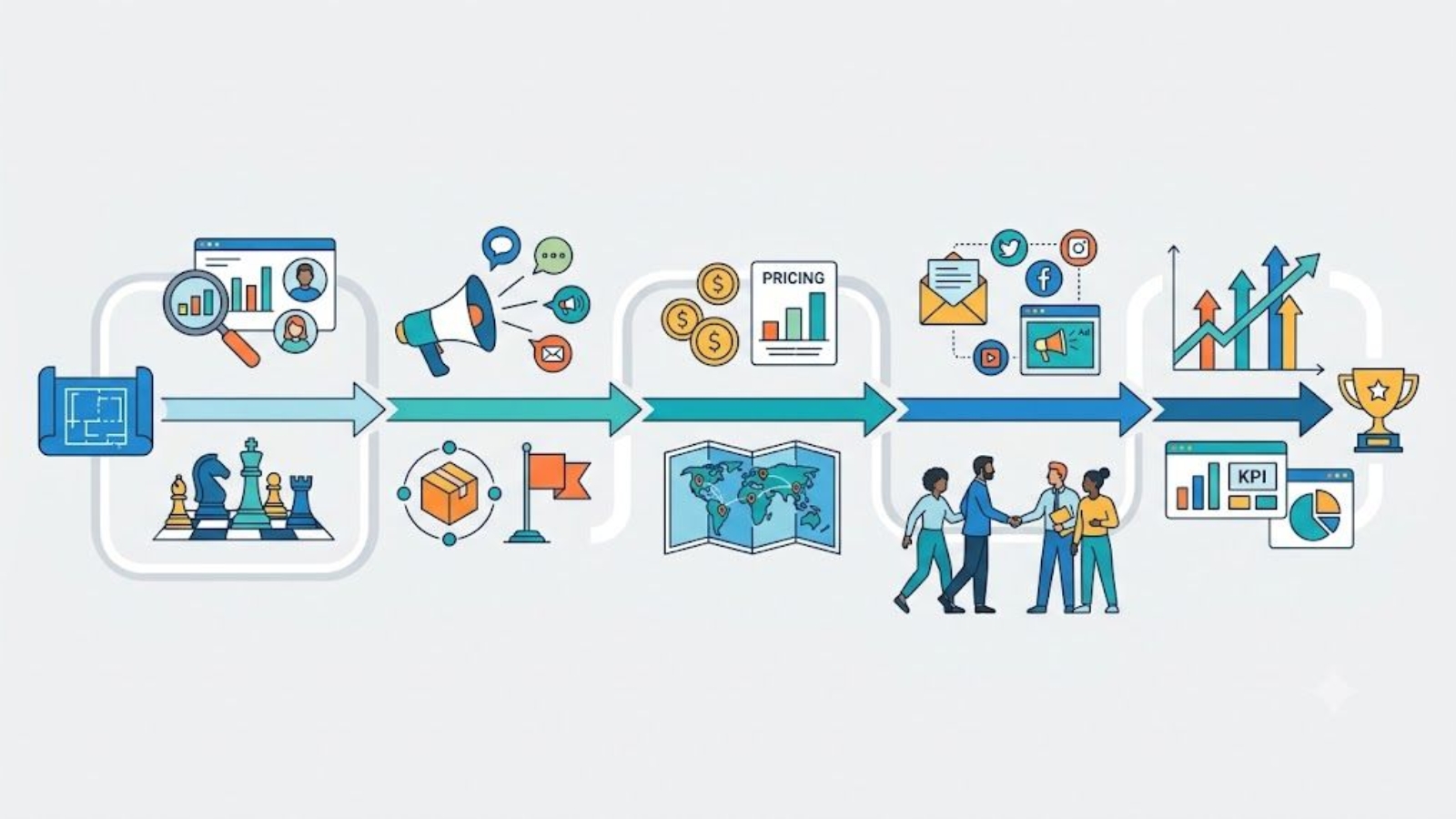
A go-to-market (GTM) strategy is a structured plan for introducing a product, service, or offer to a specific market and turning potential buyers into customers. It connects market research, ideal customer profiles, positioning, messaging, pricing, sales, marketing, distribution, launch activities, and measurement into one coordinated approach.
To create a go-to-market strategy, define your business goal, identify your ideal customer profile, research the market, clarify the customer problem, develop positioning and messaging, choose your GTM motion and channels, establish pricing, plan the launch, and measure the results.
This guide explains each step in detail and provides a practical Go-To-Market Strategy template, example, checklist, and framework you can adapt to a startup, SaaS company, B2B business, service company, or established brand.
What Is a Go-To-Market Strategy?
A go-to-market strategy is a plan that explains how a company will bring a product or service to a defined target market, communicate its value, reach potential customers, generate demand, convert buyers, and achieve measurable business results.
It answers several fundamental questions:
- Who is the product for?
- What problem does it solve?
- Why should customers choose it?
- How will the company position the product?
- What price should customers pay?
- How will prospects discover the offer?
- How will customers purchase it?
- Which sales and marketing channels should be used?
- What should happen before, during, and after launch?
- Which metrics will determine whether the strategy is working?
A GTM strategy therefore goes beyond a promotional campaign or product announcement. It connects the entire path from market opportunity to customer acquisition and retention.
Go-To-Market Strategy vs. Go-To-Market Plan
The terms “Go-To-Market Strategy ” and “GTM plan” are sometimes used interchangeably, but they are not exactly the same.
A GTM strategy defines the overall approach. It determines the target market, ICP, positioning, pricing model, sales motion, channels, and competitive advantage.
A GTM plan translates that strategy into specific actions, timelines, owners, budgets, campaigns, and launch activities.
For example:
Strategy: Sell a scheduling platform to small and midsize salons using a free-trial and sales-assisted model.
Plan: Launch a landing page, publish educational content, run search and social campaigns, contact qualified leads, offer product demonstrations, and follow up with trial users over 90 days.
The strategy establishes the direction. The plan explains how the team will execute it.
What Are the Key Components of a Go-To-Market Strategy?
A complete GTM strategy usually includes the following components:
| Component | Key Question |
|---|---|
| Business objective | What do we want to achieve? |
| Target market | Which market should we enter? |
| Ideal customer profile | Which customers are the best fit? |
| Customer problem | What urgent problem are we solving? |
| Value proposition | What outcome do we provide? |
| Positioning | How should customers perceive us? |
| Messaging | What should we communicate? |
| Pricing | How should we charge? |
| GTM motion | How will customers discover and buy? |
| Channels | Where will we reach them? |
| Launch strategy | How will we introduce the offer? |
| Sales enablement | What does the sales team need? |
| KPIs | How will we measure success? |
| Optimization | How will we improve after launch? |
These components should not be treated as isolated decisions. Each one should inform the next.
For example, your ICP influences your messaging. Your messaging influences your channels. Your sales motion influences your pricing. Your pricing and conversion rates influence your customer acquisition economics.
That interconnected structure is what makes a Go-To-Market Strategy effective.
When Should You Create a Go-To-Market Strategy?
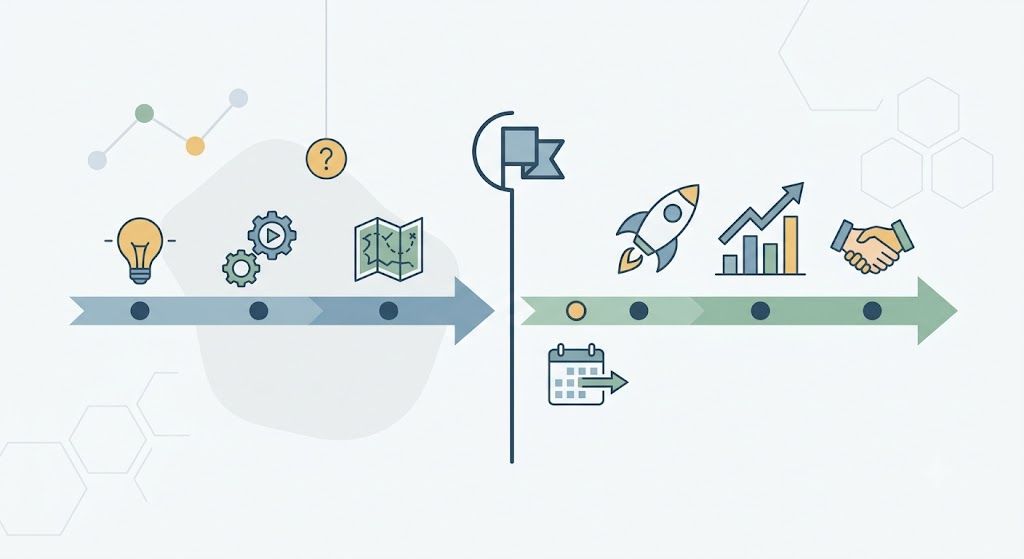
A go-to-market strategy is useful whenever there is a meaningful change in what you sell, who you sell to, or where you sell it.
You may need a GTM strategy when:
- Launching a new product
- Introducing a new service
- Entering a new geographic market
- Targeting a new customer segment
- Launching a SaaS product
- Expanding an existing product into enterprise accounts
- Repositioning an existing product
- Introducing a major product update
- Entering a highly competitive category
- Changing your pricing model
- Moving from founder-led sales to a sales team
- Expanding from one acquisition channel to multiple channels
A GTM strategy is not limited to startups.
An established company entering a new market can face many of the same questions as a startup: Who are the new customers? What do they value? Which competitors already serve them? Which channels influence their buying decisions? What price will they accept?
The scale may be different, but the strategic questions remain similar.
How to Create a Go-To-Market Strategy in 10 Steps
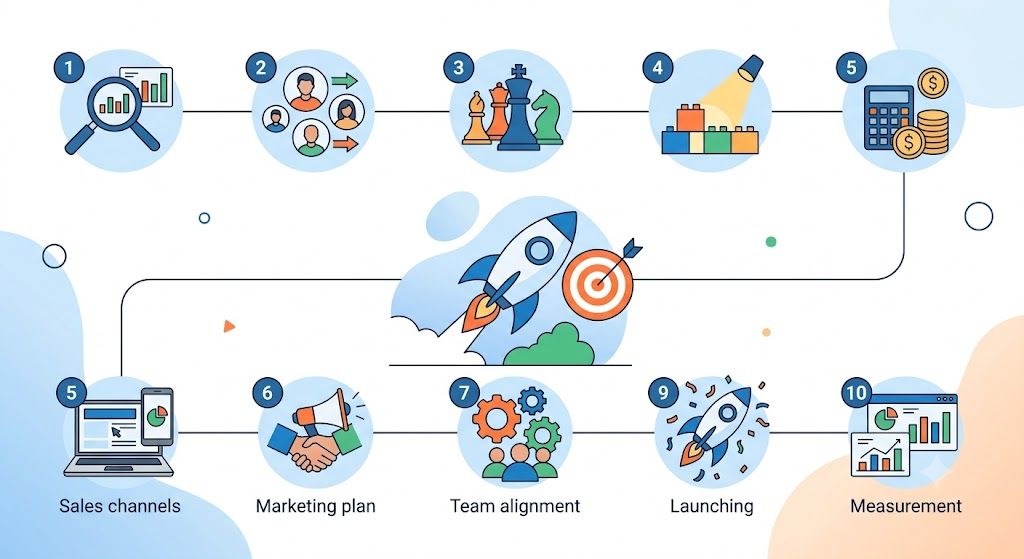
The following framework takes you from initial business objectives to post-launch optimization.
Step 1: Define Your GTM Goal and Launch Objectives
Before choosing marketing channels or creating promotional campaigns, decide what the Go-To-Market Strategy needs to accomplish.
A vague objective such as “increase awareness” is difficult to manage because it does not establish a clear outcome.
Instead, define a measurable objective.
For example:
Acquire 100 qualified customers within the first 90 days.
Other GTM objectives might include:
- Generate 1,000 qualified leads
- Reach $100,000 in new revenue
- Generate $500,000 in sales pipeline
- Achieve 20% trial-to-paid conversion
- Enter three new geographic markets
- Acquire 500 new users
- Reach a specific product adoption rate
- Reduce customer acquisition cost
- Increase market share within a defined segment
Use the SMART framework
Your GTM objective should ideally be:
- Specific
- Measurable
- Achievable
- Relevant
- Time-bound
Instead of:
“Get more customers.”
Use:
“Acquire 150 paying customers from small retail businesses within six months while maintaining a customer acquisition cost below $200.”
This objective gives marketing, sales, and leadership a common target.
Define launch success before launch
One of the most useful GTM practices is deciding what success means before execution begins.
Ask:
- What result would make this launch successful?
- What result would indicate that the strategy needs adjustment?
- Which metrics will we review weekly?
- Which metrics will we evaluate after 30, 60, and 90 days?
Your answers create the measurement foundation for the entire strategy.
Step 2: Define Your Ideal Customer Profile
One of the most important parts of a successful go-to-market strategy is identifying exactly who you want to reach.
A broad target audience is not the same as an ideal customer profile.
For example:
“Small businesses” is a broad market.
An ICP could be:
“Local beauty salons with 5–25 employees that manage more than 100 appointments per month and currently rely on manual scheduling or basic booking tools.”
The second description gives your team much more useful information.
What is an Ideal Customer Profile?
An Ideal Customer Profile (ICP) describes the type of organization or customer that is most likely to gain significant value from your product and become a profitable, sustainable customer.
Depending on your business model, an ICP can include:
- Industry
- Company size
- Revenue
- Geographic location
- Business model
- Number of employees
- Technology stack
- Existing solutions
- Pain points
- Buying triggers
- Budget
- Decision-making structure
- Urgency
- Customer maturity
For B2C businesses, you may focus more on consumer characteristics and buyer behavior.
ICP vs. Buyer Persona
An ICP describes the best-fit customer or organization.
A buyer persona describes the individual decision-maker or user within that customer group.
For example:
ICP: SaaS companies with 20–100 employees.
Buyer persona: Head of Marketing responsible for generating qualified leads.
You can have multiple buyer personas within one ICP.
A simple ICP formula
Use this framework:
Our ideal customers are [customer type] who have [specific characteristics], experience [problem], and are motivated to buy when [trigger occurs].
This forces you to be specific.
Why ICP matters
A clearly defined ICP helps you:
- Create relevant content
- Improve advertising targeting
- Prioritize sales leads
- Personalize messaging
- Choose better channels
- Reduce wasted marketing spend
- Improve conversion rates
- Align sales and marketing
If everyone is your customer, your message usually becomes too generic to be compelling.
Step 3: Research the Market, Customers, and Competitors
Once your ICP is defined, research the environment in which you will compete.
Market research should answer three questions:
Is there demand?
What do customers care about?
How are competitors currently solving the problem?
Research your customers
Useful sources include:
- Customer interviews
- Surveys
- Sales conversations
- Customer support questions
- Product reviews
- Online communities
- Search behavior
- CRM data
- Website analytics
- Social media comments
- Testimonials
- Competitor reviews
Pay particular attention to the language customers use to describe their problems.
If customers repeatedly say:
“I spend hours every week creating reports.”
That language may be more useful for your messaging than an internal statement such as:
“Our platform improves reporting efficiency.”
Customer language often produces stronger marketing copy because it reflects the actual buying problem.
Analyze competitors
Build a competitor comparison covering:
- Product features
- Pricing
- Positioning
- Target audience
- Messaging
- Website
- Content
- Advertising
- Sales process
- Reviews
- Customer complaints
- Distribution channels
- Strengths
- Weaknesses
Don’t only ask:
“What are our competitors doing?”
Also ask:
“What are customers still unhappy about?”
That second question can reveal a market gap.
Look for positioning gaps
Suppose every competitor emphasizes:
- More features
- More integrations
- More automation
- Lower price
You may discover that customers actually want:
- Easier implementation
- Better support
- Faster onboarding
- Industry-specific workflows
That difference can become your positioning opportunity.
Step 4: Define the Customer Problem and Value Proposition
Your product may have dozens of features, but customers usually purchase because they want a particular outcome.
This is why your Go-To-Market Strategy should distinguish between features, benefits, and outcomes.
Feature
What the product does.
Automated reporting.
Benefit
Why that feature is useful.
Reduces manual reporting work.
Outcome
What the customer ultimately gains.
The marketing team gets faster insights and spends less time preparing reports.
The outcome is often more persuasive than the feature.
Identify the core customer problem
Ask:
- What is the customer struggling with?
- How frequently does the problem occur?
- What does the problem cost them?
- What happens if they do nothing?
- What solutions are they currently using?
- Why are existing solutions inadequate?
- What outcome do they want instead?
The strongest GTM opportunities often exist where the problem is both important and urgent.
Create a value proposition
A value proposition should clearly communicate:
- Who you serve
- What problem you solve
- What outcome you provide
- Why your approach is different
A simple formula is:
We help [target customer] achieve [desired outcome] by solving [specific problem] through [solution or differentiator].
For example:
We help growing salons reduce missed appointments by providing simple online scheduling, automated reminders, and customer follow-up in one platform.
That is more meaningful than:
“An advanced appointment management platform.”
The second statement describes the product category. The first explains the value.
Step 5: Create Your Positioning and Messaging
Once you know your customer and their problem, decide how you want the market to understand your product.
What is positioning?
Positioning is the place your product occupies in the customer’s mind compared with alternatives.
Your product could be positioned around:
- Price
- Simplicity
- Performance
- Convenience
- Premium quality
- Speed
- Specialization
- Reliability
- Innovation
- Customer experience
- Industry expertise
The important question is:
Why should the target customer choose this product instead of doing nothing or choosing an alternative?
Positioning statement
Use this framework:
For [target customer] who [problem], [product] is a [category] that [primary benefit]. Unlike [alternative], it [key differentiator].
Example:
For independent retailers that struggle with inventory visibility, our platform is a lightweight inventory management solution that provides real-time stock tracking. Unlike complex enterprise systems, it can be configured without a dedicated IT team.
Build messaging pillars
Your messaging should not depend on one slogan.
Create three to five messaging pillars.
For example:
Pillar 1: Simplicity
Easy setup and straightforward workflows.
Pillar 2: Efficiency
Reduce repetitive manual tasks.
Pillar 3: Visibility
Understand performance through clear reporting.
Pillar 4: Support
Get help from specialists when needed.
These pillars can then inform:
- Website copy
- Ads
- Sales presentations
- Emails
- Social content
- Product demonstrations
- Case studies
- Landing pages
Consistent messaging helps customers understand the same value regardless of where they encounter your brand.
Step 6: Choose Your Go-To-Market Motion
Your GTM motion describes how customers move from discovering your offer to becoming paying customers.
There is no universally best GTM motion. The right approach depends on product complexity, price, customer behavior, sales cycle, and resources.
Product-led growth
With a product-led approach, the product itself plays a major role in acquisition and conversion.
Common tactics include:
- Free trials
- Freemium plans
- Self-service signup
- Product demos
- In-product onboarding
- Usage-based upgrades
This approach can work well for products that customers can understand and experience without extensive sales assistance.
Sales-led growth
Sales representatives guide prospects through the buying journey.
This is often appropriate for:
- High-ticket products
- Enterprise software
- Complex solutions
- Customized services
- Long buying cycles
Typical activities include:
- Prospecting
- Discovery calls
- Demonstrations
- Consultations
- Proposals
- Negotiation
- Account management
Marketing-led or inbound GTM
Marketing generates demand through channels such as:
- SEO
- Content marketing
- Social media
- Webinars
- Paid advertising
- Educational resources
This can be effective when customers actively research the problem before contacting a company.
Partner-led GTM
Partners help distribute or sell your product.
Examples include:
- Resellers
- Agencies
- Affiliates
- Distributors
- Technology partners
- Consultants
- Strategic alliances
Partner-led strategies can help companies access audiences they would otherwise struggle to reach.
Community-led GTM
Some products grow through communities, referrals, events, creators, and customer advocacy.
Community-led growth can be particularly useful when customers benefit from sharing knowledge and experiences with other users.
Hybrid GTM motions
Many companies combine approaches.
For example:
SEO + free trial + sales assistance
or:
Paid advertising + demo + sales team + customer success
Choose the combination that matches how your customers actually buy.
Step 7: Choose the Right Marketing, Sales, and Distribution Channels
Choosing channels should come after understanding your customer.
Don’t choose Instagram, LinkedIn, Google Ads, SEO, or email simply because they are popular.
Choose channels based on where your ICP spends time and how they make buying decisions.
Evaluate channels using five questions
For every potential channel, ask:
- Does our target customer use it?
- Can we communicate our value effectively there?
- Can we measure results?
- Can we execute consistently?
- Can the channel scale profitably?
Common GTM channels
Search engine optimization
SEO can attract customers who are actively searching for solutions.
It is especially useful for informational and problem-aware searches.
For example:
- How to reduce missed appointments
- Best inventory software for small retailers
- How to automate financial reporting
Paid search
Paid search can capture high-intent demand quickly.
It may be effective when people already know what type of solution they need.
Social media
Social platforms can help with:
- Awareness
- Education
- Community
- Retargeting
- Product demonstrations
- Customer stories
Choose platforms based on audience fit rather than posting everywhere.
Email marketing
Email can support:
- Lead nurturing
- Trial onboarding
- Product education
- Promotions
- Customer retention
- Cross-selling
Sales outreach
Outbound sales can be useful for high-value B2B products where the potential revenue per customer justifies personalized outreach.
Partnerships
Partnerships can create distribution leverage by connecting you with established audiences.
Build a channel scorecard
| Channel | Audience Fit | Speed | Cost | Scalability | Priority |
|---|---|---|---|---|---|
| SEO | High | Slow | Medium | High | High |
| Paid Search | High | Fast | High | High | High |
| High | Medium | Medium | Medium | Medium | |
| High | Fast | Low | High | High | |
| Partnerships | Medium–High | Medium | Medium | High | Medium |
| Events | Medium | Slow | High | Medium | Test |
Your goal is not to use every channel.
Your goal is to identify the few channels most likely to produce meaningful results.
Step 8: Set Pricing and Packaging
Pricing is not just a finance decision. It is an important part of your go-to-market strategy.
Your pricing communicates value, influences conversion, affects customer acquisition economics, and determines which segments you can serve profitably.
Common pricing approaches
Cost-plus pricing
Calculate your costs and add a margin.
This is simple but may fail to reflect customer-perceived value.
Competitor-based pricing
Set prices relative to competing products.
This helps establish a market reference point but can lead to undifferentiated pricing.
Value-based pricing
Price according to the value customers receive.
This can be particularly powerful when your product produces measurable financial or operational benefits.
Common packaging models
Depending on the business, you might offer:
- Free plan
- Free trial
- Basic plan
- Professional plan
- Enterprise plan
- Per-user pricing
- Usage-based pricing
- Subscription pricing
- One-time purchase
- Custom pricing
Avoid unnecessary complexity
Too many pricing options can make the purchase decision harder.
Your packaging should help customers quickly answer:
“Which option is right for me?”
A simple three-tier structure can often be easier to understand than a complicated collection of plans.
Pricing should also align with your ICP.
A small business may prioritize affordability and simplicity, while an enterprise customer may prioritize security, integrations, service levels, customization, and support.
Step 9: Build Your Go-To-Market Launch Plan
After defining your strategy, convert it into an execution timeline.
A useful launch structure has three phases:
Pre-launch
The objective is to prepare the market, product, team, and distribution system.
Activities may include:
- Validate customer demand
- Test messaging
- Build landing pages
- Prepare product documentation
- Recruit beta users
- Create sales materials
- Train sales teams
- Build email sequences
- Prepare advertising campaigns
- Develop launch content
- Contact partners
- Establish analytics
- Create customer support processes
Launch
The launch is the coordinated release period.
Possible activities include:
- Product announcement
- Website update
- Email campaign
- Social media campaign
- Paid advertising
- Sales outreach
- Webinar
- Product demonstration
- PR
- Partner promotion
- Customer stories
- Influencer or creator collaborations
The launch should not depend on one channel.
If an email campaign generates interest, for example, the sales team should be ready to respond. If paid traffic increases, the landing page should be optimized for conversion. If customers encounter problems, support should be prepared.
Post-launch
The work does not end when the product goes live.
Post-launch activities include:
- Follow-up campaigns
- Retargeting
- Customer onboarding
- Trial conversion
- Sales follow-up
- Customer interviews
- Review collection
- Case study development
- Product feedback
- Conversion optimization
- Churn analysis
The post-launch phase is where your original assumptions meet actual market behavior.
A Practical 30/60/90-Day GTM Framework
Days 1–30: Validate and Launch
Focus on:
- ICP validation
- Messaging tests
- Initial campaigns
- Early customers
- Conversion tracking
- Sales feedback
The goal is learning as much as possible.
Days 31–60: Improve
Analyze:
- Best-performing channels
- Conversion rates
- Customer objections
- Sales cycle
- CAC
- Landing page performance
- Trial behavior
Remove weak tactics and improve the channels showing promise.
Days 61–90: Scale
Invest more heavily in proven activities.
This could mean:
- Increasing advertising budget
- Expanding content
- Adding sales capacity
- Developing partnerships
- Creating case studies
- Improving onboarding
- Expanding into adjacent segments
A 90-day plan should not be treated as a rigid schedule. It should evolve based on evidence.
Step 10: Measure, Learn, and Optimize Your GTM Strategy
A GTM strategy is not complete without a measurement system.
However, tracking dozens of metrics does not automatically produce better decisions.
Choose metrics that correspond to each stage of the customer journey.
Awareness metrics
Track:
- Impressions
- Reach
- Website traffic
- Branded searches
- Content engagement
- Video views
These metrics help indicate whether people are discovering your offer.
Acquisition metrics
Track:
- Leads
- Qualified leads
- Cost per lead
- Marketing-qualified leads
- Sales-qualified leads
- Demo requests
- Trial signups
Conversion metrics
Track:
- Lead-to-customer conversion
- Demo-to-customer conversion
- Trial-to-paid conversion
- Win rate
- Landing-page conversion
- Sales cycle length
Revenue metrics
Track:
- New revenue
- Monthly recurring revenue
- Annual recurring revenue
- Average contract value
- Revenue per customer
- Customer acquisition cost
- Customer lifetime value
Retention metrics
Track:
- Churn
- Retention rate
- Expansion revenue
- Repeat purchases
- Product adoption
- Customer satisfaction
Use metrics to make decisions
The purpose of measurement is not to create a dashboard full of numbers.
It is to answer questions such as:
- Which customers convert best?
- Which channel produces the highest-quality leads?
- Where are prospects dropping out?
- Which messaging generates more qualified demand?
- Which customer segment has the highest lifetime value?
- Is CAC sustainable?
- Should we invest more in a specific channel?
- Should the product or offer be changed?
That turns analytics into a decision-making system.
Go-To-Market Strategy Template
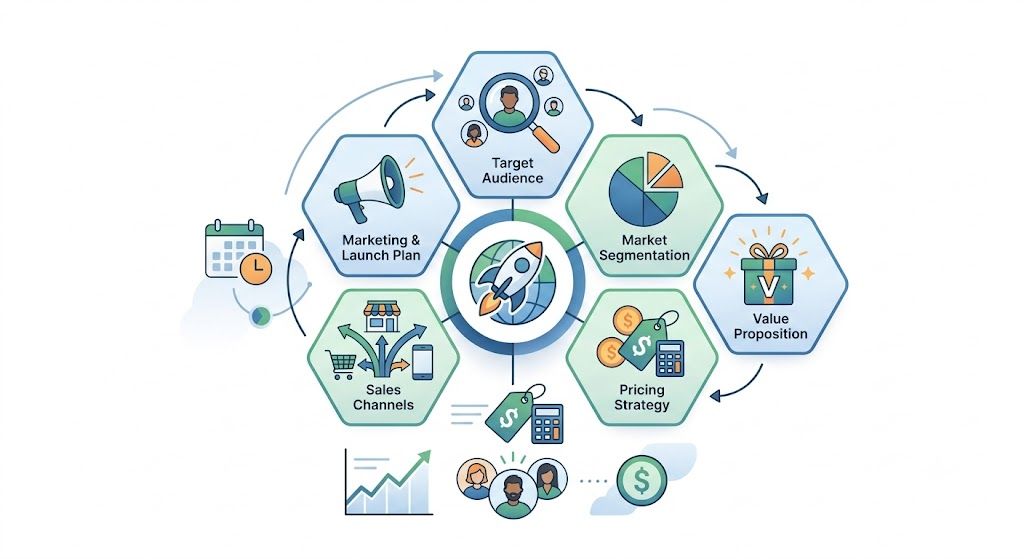
Use the following template to create your own GTM strategy.
1. Product or Offer
What are you launching?
Describe the product, service, feature, or offer in one or two sentences.
2. Target Market
Which market are you entering?
Define the broader customer segment.
3. Ideal Customer Profile
Who is the best-fit customer?
Describe the characteristics that indicate strong fit.
4. Customer Problem
What problem does this customer have?
Identify the pain point and its consequences.
5. Value Proposition
What valuable outcome do you provide?
Explain the result customers can expect.
6. Positioning
Why should customers choose you instead of alternatives?
Define your differentiation.
7. Messaging
What are the three to five ideas customers should remember?
Create your messaging pillars.
8. Pricing
How will customers pay?
Define your pricing and packaging.
9. GTM Motion
How will customers discover, evaluate, and purchase the product?
Choose a product-led, sales-led, marketing-led, partner-led, community-led, or hybrid approach.
10. Channels
Where will you reach customers?
Select your highest-potential marketing, sales, and distribution channels.
11. Launch Timeline
What happens before, during, and after launch?
Create a timeline with clear responsibilities.
12. KPIs
How will you determine success?
Choose metrics for acquisition, conversion, revenue, and retention.
13. Budget
What resources are available?
Include:
- Advertising
- Content
- Technology
- Sales
- Partnerships
- Events
- Creative production
14. Ownership
Who is responsible for each activity?
Assign clear owners rather than leaving tasks to “the marketing team” or “sales.”
15. Optimization Plan
How will you respond to market feedback?
Define when the strategy will be reviewed and which signals will trigger changes.
Go-To-Market Strategy Example
Consider a fictional SaaS company launching an appointment management platform for small salons.
Product
An online scheduling and customer management platform that helps salons manage appointments, reminders, customer records, and follow-ups.
Target market
Independent and growing beauty salons.
ICP
Salons with:
- 5–25 employees
- High appointment volume
- Multiple staff members
- Manual scheduling problems
- Frequent cancellations
- Limited administrative resources
Core problem
Salon owners lose time managing appointments and revenue because customers miss bookings, staff schedules are difficult to coordinate, and follow-up is inconsistent.
Value proposition
Help salons reduce scheduling friction, minimize missed appointments, and manage customer bookings from one simple platform.
Positioning
Instead of competing as a generic enterprise scheduling platform, the company positions itself as a straightforward appointment management system designed specifically for growing salons.
GTM motion
A hybrid model:
Free trial + educational content + sales assistance
Prospects can experience the product themselves while sales representatives assist businesses that need additional guidance.
Channels
The initial channel mix might include:
- SEO
- Google Search Ads
- Partnerships with salon consultants
- Direct sales outreach
Pricing
Three plans:
Starter: For small salons
Growth: For growing teams
Pro: For larger locations with advanced needs
Launch
During the first 30 days, the company focuses on beta users and messaging validation.
During days 31–60, it identifies the strongest acquisition channels.
During days 61–90, it increases investment in channels that generate qualified customers.
KPIs
The company tracks:
- Website visitors
- Trial signups
- Cost per trial
- Trial-to-paid conversion
- CAC
- Monthly recurring revenue
- Churn
- Customer retention
This example demonstrates how the individual elements of a GTM strategy connect.
The ICP influences the messaging. The messaging influences the channels. The product complexity influences the sales motion. Pricing influences conversion and acquisition economics. Customer feedback influences future positioning.
How to Choose the Right GTM Strategy for Your Business
Different businesses require different approaches.
| Business Situation | Potential GTM Approach |
|---|---|
| Low-cost SaaS | Product-led |
| High-ticket B2B | Sales-led |
| Complex enterprise product | Sales + marketing |
| Strong search demand | Inbound |
| Large partner ecosystem | Partner-led |
| Community-focused product | Community-led |
| SMB product | Self-service + inbound |
| Highly customized service | Sales-led |
| Consumer subscription | Marketing + product-led |
| New category | Education + marketing + sales |
These are starting points rather than universal rules.
A company selling expensive enterprise software may require sales representatives because buyers need demonstrations, security reviews, procurement approvals, and customized proposals.
A low-cost SaaS product may not justify that level of human involvement.
The correct question is not:
“Which GTM strategy is most popular?”
It is:
“Which buying process best matches how our customers evaluate and purchase this type of solution?”
Common Go-To-Market Strategy Mistakes
Even a detailed GTM framework can fail when execution is based on incorrect assumptions.
1. Trying to Sell to Everyone
A broad audience creates vague messaging and inefficient targeting.
Start with a clearly defined segment.
2. Choosing Channels Before Defining the ICP
A company may launch on five social platforms without knowing whether its target customers use them.
Define the customer first.
Then choose channels.
3. Focusing on Features Instead of Outcomes
Customers rarely buy a feature for the feature itself.
Explain what the feature enables them to achieve.
4. Copying Competitors
Competitive research should reveal opportunities, not encourage imitation.
Find a meaningful reason to choose your product.
5. Launching Without Validation
A polished launch cannot compensate for weak demand.
Test your assumptions with customers before investing heavily.
6. Using Too Many Channels
More channels do not automatically mean more growth.
Start with a manageable number of high-potential channels.
7. Ignoring Pricing
Pricing affects positioning, conversion, customer quality, and profitability.
Treat it as a strategic decision.
8. Misaligning Sales and Marketing
Marketing may define one target customer while sales pursues another.
Both teams should work from the same ICP, positioning, qualification criteria, and revenue goals.
9. Measuring Vanity Metrics
Large impressions or follower counts may look impressive but do not necessarily indicate commercial success.
Connect marketing activity to qualified demand, conversions, revenue, and retention.
10. Treating GTM as a One-Time Project
Markets change.
Customers provide new feedback.
Competitors change their positioning.
Channels become more or less effective.
Your GTM strategy should therefore be reviewed and improved continuously.
Go-To-Market Strategy vs. Marketing Strategy vs. Product Launch
These concepts overlap, but they are not identical.
| Factor | GTM Strategy | Marketing Strategy | Product Launch |
|---|---|---|---|
| Primary purpose | Bring an offer to market | Generate and capture demand | Introduce a product |
| Scope | Broad | Marketing-focused | Launch-focused |
| Target audience | Defined ICP | Target audience | Launch audience |
| Positioning | Core component | Usually included | Usually included |
| Pricing | Usually included | Sometimes limited | May be included |
| Sales | Included | May be included | Often involved |
| Distribution | Included | Channel-focused | Launch channels |
| Timeline | Launch + ongoing | Ongoing | Specific launch period |
| Metrics | Business + funnel | Marketing performance | Launch performance |
A product launch is an event or coordinated period.
A marketing strategy focuses primarily on demand generation and customer communication.
A GTM strategy connects the wider system of market selection, positioning, pricing, sales, marketing, distribution, launch, and measurement.
How Long Does It Take to Create a Go-To-Market Strategy?
There is no universal timeline.
A straightforward SMB or service launch may require only a few weeks of focused planning.
A complex B2B, enterprise, SaaS, or international launch can require several weeks or months because it may involve extensive research, pricing decisions, sales enablement, legal considerations, partnerships, product readiness, and market validation.
The timeline depends on:
- Product complexity
- Market size
- Number of customer segments
- Geographic expansion
- Sales cycle
- Regulatory requirements
- Existing customer research
- Team size
- Available resources
- Product readiness
Speed matters, but validation matters more than rushing to launch.
Frequently Asked Questions About Go-To-Market Strategy
What are the steps of a go-to-market strategy?
The main steps are to define your objectives, identify your target market and ICP, research customers and competitors, define the problem and value proposition, establish positioning and messaging, choose a GTM motion, select channels, determine pricing, build the launch plan, and measure and optimize performance.
What is a GTM strategy?
A GTM strategy is a plan for bringing a product or service to a specific market. It explains who the company will serve, what value it provides, how it will reach customers, how customers will buy, and how success will be measured.
How do you create a GTM strategy?
Start with the business objective and work through the customer, problem, positioning, pricing, sales motion, channels, launch plan, and KPIs. The most effective GTM strategies connect these decisions rather than treating them as separate marketing activities.
What are the best go-to-market strategies?
There is no single best Go-To-Market Strategy for every business. Common approaches include product-led, sales-led, marketing-led, partner-led, community-led, and hybrid models. The best choice depends on customer behavior, product complexity, price, sales cycle, and available resources.
What are the key components of a GTM strategy?
Key components include the target market, ICP, customer problem, value proposition, positioning, messaging, pricing, sales motion, distribution channels, launch plan, sales enablement, KPIs, and optimization process.
What are the 4 Ps of a go-to-market strategy?
The traditional 4 Ps are Product, Price, Place, and Promotion. They provide a useful foundation, but a modern Go-To-Market Strategy usually expands beyond the 4 Ps to include ICP, positioning, customer journey, sales motion, competitive differentiation, and measurable business outcomes.
What is an example of a GTM strategy?
A SaaS company targeting small businesses might use a free trial, SEO, paid search, email marketing, and sales assistance to acquire customers. Its GTM strategy would define the ICP, customer problem, positioning, pricing, channels, launch timeline, and KPIs before execution.
Is a go-to-market strategy only for new products?
No. A GTM strategy can also be used when entering a new market, targeting a new segment, launching a new service, changing pricing, repositioning a product, or expanding an existing offering into a new geographic or customer market.
What KPIs should a GTM strategy track?
Useful GTM KPIs include qualified leads, conversion rate, customer acquisition cost, sales cycle length, win rate, new revenue, recurring revenue, customer lifetime value, retention, churn, and channel-level performance. The exact metrics should match the business model and GTM objective.
What is the difference between a GTM strategy and a marketing strategy?
A marketing strategy focuses primarily on creating demand, communicating value, and attracting customers. A GTM strategy is broader and can include market selection, ICP, positioning, pricing, sales, distribution, marketing, launch execution, and customer retention.
How often should a GTM strategy be updated?
Review it regularly, especially after launch. Early-stage companies may review performance weekly or monthly because they are still validating assumptions. More established businesses can use monthly, quarterly, or milestone-based reviews.
Go-To-Market Strategy Checklist
Before launching, make sure your strategy answers each of these questions:
- Is the GTM objective specific and measurable?
- Is the target market clearly defined?
- Is the ICP specific enough for sales and marketing teams to use?
- Have you researched customer pain points?
- Have you analyzed competitors?
- Do you understand the alternatives customers currently use?
- Is the core customer problem clearly defined?
- Is the value proposition easy to understand?
- Is your positioning differentiated?
- Have you developed clear messaging pillars?
- Have you selected an appropriate GTM motion?
- Have you identified the channels your ICP actually uses?
- Have you determined pricing and packaging?
- Is your website or landing page ready?
- Is your sales team prepared?
- Are sales and marketing aligned?
- Is the launch timeline documented?
- Are responsibilities assigned?
- Is the launch budget defined?
- Are analytics and conversion tracking configured?
- Are your KPIs clearly defined?
- Do you have a customer feedback process?
- Do you have a post-launch optimization plan?
Final Thoughts: Build a GTM Strategy That Can Learn
Creating a go-to-market strategy is not about producing a long document filled with marketing activities.
The real objective is to create a repeatable system for understanding a market, reaching the right customers, communicating relevant value, converting demand, and learning from results.
Start with the customer rather than the channel.
Define the ICP before creating campaigns. Understand the problem before writing messaging. Establish positioning before choosing promotional tactics. Select channels based on customer behavior rather than popularity. Set pricing according to your business model and customer value. Define success before launch so you can evaluate performance objectively.
Most importantly, treat your initial GTM strategy as a set of informed assumptions.
Your first version may not be perfect. Customer interviews may challenge your ICP. Sales conversations may reveal a different objection. Your highest-traffic channel may produce poor-quality leads. A smaller audience segment may convert better than the broad market you originally targeted.
Those discoveries are not necessarily failures.
They are inputs for improving the strategy.
The strongest go-to-market strategy creates a feedback loop:
Research → ICP → Problem → Value Proposition → Positioning → GTM Motion → Channels → Pricing → Launch → Measurement → Customer Feedback → Optimization
When each stage informs the next, your GTM strategy becomes more than a launch checklist. It becomes a practical framework for taking an offer from market opportunity to sustainable customer growth.