

Table of Contents
Personas built without customer interviews are fiction written in conference rooms — and fiction doesn’t buy your product.
Picture two product teams. Team A spends ninety minutes in a workshop inventing “Marketing Mary,” complete with a stock photo, a favorite coffee order, and frustrations nobody has actually verified. Team B spends two weeks conducting twelve customer interviews, transcribes every conversation, codes the quotes, and discovers that their real users aren’t frustrated by complexity at all — they’re frustrated by invisible progress. Team A ships a roadmap of guesses. Team B ships a roadmap of evidence.
The difference between those two outcomes isn’t budget or talent. It’s a disciplined process for running customer interviews for persona development — conversations designed specifically to extract the goals, frustrations, behaviors, and decision criteria that become the building blocks of research-backed personas.
This guide gives you that complete process. You’ll learn what a persona interview is, how many interviews you actually need, how to recruit the right participants, and how to run a 45-minute interview using a copy able script. Then you’ll learn the synthesis pipeline that turns raw transcripts into persona clusters, plus a full worked example showing a persona emerging from real quotes.
Key takeaways
- A persona interview is a semi-structured conversation engineered to fill specific persona fields — not a generic chat with Customer Interviews.
- Marketing research suggests 10–15 interviews per Customer Interviews segment typically reaches data saturation; watch for saturation signals rather than chasing a magic number.
- Map every interview question to a persona field before you interview (the Q→F Matrix) so no conversation time is wasted.
- Synthesis — tagging, affinity mapping, and clustering — is where personas are actually built. Skipping it produces “Frankenstein” profiles.
- Validate every persona with 3–5 confirmation interviews before socializing it internally.
What Is a Customer Interviews? (And How It Differs from User Interviews)
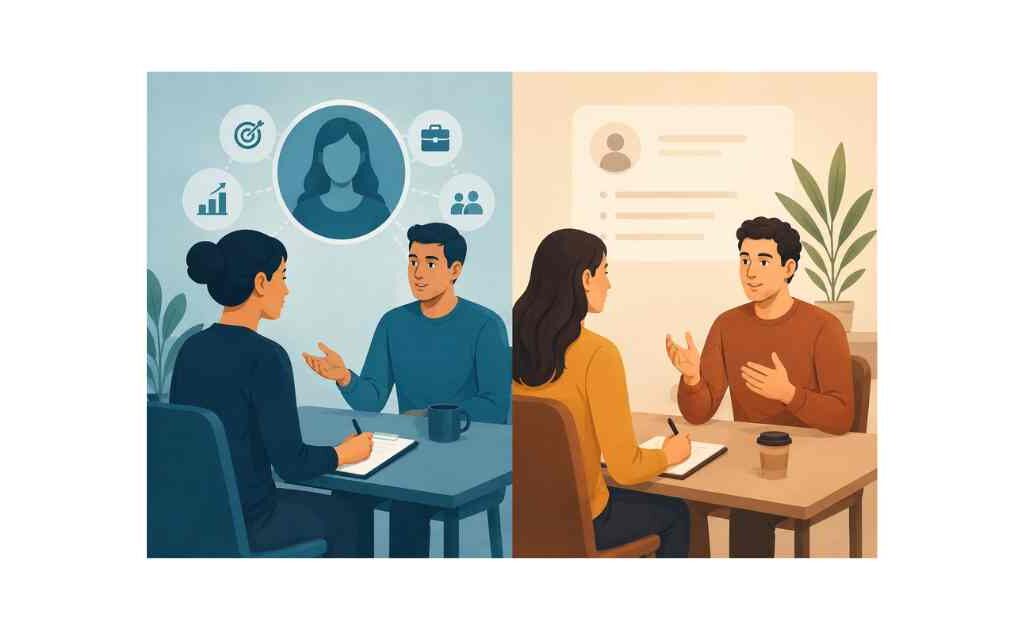
Quick answer: A persona interview is a semi-structured, one-on-one conversation with a current, former, or prospective Customer Interviews, designed to uncover the goals, frustrations, behaviors, and decision criteria that become the building blocks of a buyer persona.
The phrase “customer interviews for persona development” matters because not all interviews produce persona-ready data. A support call captures complaints. A sales discovery call captures buying signals. A usability session captures interface friction. A persona interview, by contrast, is deliberately broad and deliberately deep: it explores the person’s world, not just their interaction with your product.
| Dimension | Persona interview | General customer interview | User interview |
|---|---|---|---|
| Primary goal | Build a complete, reusable audience profile | Answer a specific business or product question | Understand product usage and usability |
| Scope | Whole workflow, motivations, decision-making | Usually one topic or feature | Usually one product or flow |
| Participants | Current, churned, and prospective customers | Mostly current customers | Current users or test participants |
| Output | Persona fields: goals, frustrations, behaviors, criteria | Feature feedback, NPS drivers | Task success, UX issues |
| Shelf life | Months to years (living document) | One project | One study |
Persona interviews also differ from user interviews in who they include. User interviews often focus on people using your product right now. Customer Interviews Persona development additionally needs churned customers (who reveal unmet needs), prospects (who reveal evaluation criteria), and sometimes competitors’ Customer Interviews (who reveal market expectations).
Why the distinction protects your research
When teams run generic customer interviews and then try to “squeeze” personas out of the leftovers, they get profiles full of feature feedback and empty of motivation. Designing the interview for Customer Interviews persona development from the start — with questions mapped to persona fields, which we’ll cover in Step 1 — is the single highest-leverage decision in this entire process.
Why Interviews Are the Backbone of Persona Development

Surveys tell you what is happening. Analytics tell you where it happens. Only conversations tell you why it happens — and the “why” is the raw material of every useful persona.
Interviews capture what other methods can’t
- Motivations behind behaviors. Analytics shows a user exported a report every Friday at 4 p.m. Only an interview reveals she does it because her CEO demands a weekly status email — a frustration and a goal you can design for.
- Workarounds and shadow workflows. Customer Interviews rarely mention their duct-tape spreadsheets in surveys. In conversation, workarounds surface within minutes, and each one is an unmet need wearing a disguise.
- Emotional stakes. Purchasing decisions, tool adoption, and churn are emotional before they are rational. Quotes like “I dread Monday status meetings” carry more design weight than any satisfaction score.
- The Customer Interviews own language. Personas double as messaging assets. The exact words Customer Interviews use — “prove we’re not wasting money,” “keep the team off my back” — become landing-page headlines and sales scripts.
The cost of skipping interviews
Assumption-based personas fail in three expensive ways: they encode internal bias as user truth, they give stakeholders a false sense of confidence, and they anchor roadmaps to problems nobody has. Every hour invested in customer interviews for persona development is insurance against quarters spent building the wrong thing.
The 4 Types of Personas You Can Build from Interviews

Not all personas serve the same job. The Interaction Design Foundation and persona researcher Lene Nielsen describe four classic persona perspectives, and your interview emphasis should shift depending on which type you’re building:
| Persona type | What it emphasizes | Interview questions to weight heavily |
|---|---|---|
| Goal-directed | The outcomes the user needs to achieve | “What does success look like?” “What are you accountable for?” |
| Role-based | The person’s function, responsibilities, and context | “Walk me through your week.” “Who do you report to?” |
| Engaging | Emotions, stories, and personal perspective to build empathy | “What frustrates you most?” “Tell me about the last time it broke.” |
| Fictional | A composite built without research (use only as a hypothesis) | N/A — this is your proto-persona, to be tested by interviews |
Most high-performing teams build engaging, goal-directed personas: profiles rooted in real goals but written with enough human texture — quotes, stories, frustrations — that colleagues genuinely remember them. Notice that the fictional type is the only one not built from interviews; it’s your starting hypothesis, not your ending artifact.
Step 1 — Map Persona Fields to Questions (The Q→F Matrix)
The most common failure in persona interviews is asking questions that produce interesting but unusable answers. The fix is the Q→F Matrix (Question-to-Field Matrix): before scheduling a single interview, define exactly which persona field each question feeds.
Run a 60-minute proto-persona workshop first
Gather stakeholders and draft a fictional persona (type #4 above). Document your assumptions about goals, frustrations, behaviors, and decision criteria. These assumptions become hypotheses, and your interview guide becomes the test. This keeps interviews focused without making them narrow.
The Q→F Matrix
| Persona field | What you’re learning | Question style | Sample question |
|---|---|---|---|
| Goals | Desired outcomes and success metrics | Outcome questions | “What does a great quarter look like for you?” |
| Frustrations | Pain points, blockers, fears | Critical-incident questions | “Tell me about the last time this process broke down.” |
| Behaviors | Workflows, tools, habits, frequency | Walkthrough questions | “Walk me through the last time you did [task], step by step.” |
| Decision criteria | How and why choices get made | Trade-off questions | “What almost made you say no when you chose [tool]?” |
| Information sources | Influencers and channels | Ecosystem questions | “Who do you ask when you’re stuck?” |
| Context | Role, team, constraints, environment | Background questions | “How is your team structured, and where do you fit?” |
Every question in your guide must map to at least one field. If it doesn’t, cut it. If a field has no questions, add some. This matrix is also your synthesis shortcut later: when you tag interview data, the tags already mirror your persona template.
Step 2 — Decide How Many Customer Interviews You Need
“How many customer interviews for persona development?” is the question every team asks, and the honest answer is: enough to reach saturation, not enough to feel safe.
What the research suggests
- Marketing research benchmarks indicate 10–15 per Customer Interviews segment typically reach data saturation for persona work.
- Adele Revella, author of Buyer Personas, recommends 8–10 well-run interviews per segment when questions focus on the buying story.
- Saturation studies on qualitative interviews suggest code saturation — the point where no new themes emerge — often appears between roughly 9 and 17 interviews.
- Nielsen Norman Group notes there’s no universal academic consensus on saturation, which is exactly why you should watch for signals, not just counts.
Practical sample-size table
| Situation | Recommended interviews |
|---|---|
| Early-stage startup, one assumed segment | 8–10 total |
| Established product, single primary persona | 10–15 |
| Multi-segment product (3–4 personas) | 10–12 per segment |
| Enterprise or highly regulated market | 15–20 per segment, plus survey validation |
Three saturation signals that say “stop”
- No new codes. Your last three interviews produced zero themes you hadn’t already tagged.
- Predictable answers. You can anticipate responses before the participant finishes the sentence — and you’re right.
- Stable clusters. Your emerging persona groups haven’t shifted in a week of interviewing.
When two of three signals appear for a segment, stop interviewing that segment and start synthesizing. Continuing past saturation burns budget for confidence, not insight.
Step 3 — Recruit by Segment, Not Convenience
Recruiting the customers who are easiest to reach — usually your happiest fans — produces personas that describe your cheerleaders, not your market. Recruit deliberately across three rings:
| Ring | Who | What they reveal |
|---|---|---|
| Current customers | Loyal, average, and at-risk accounts | Real workflows, goals, and lived frustrations |
| Churned customers | People who left in the last 6–12 months | Unmet needs and the dealbreakers your fans tolerate |
| Non-customers | Prospects who didn’t buy; competitors’ Customer Interviews | Evaluation criteria, market expectations, objections |
Screener criteria that protect data quality
Screen for the attributes in your Q→F Matrix context field: role, seniority, company size, tool usage, and recency of the behavior you’re studying. Add one behavioral screener — “Describe the last time you [task]” — because people who can’t answer concretely will give you opinions instead of experiences.
Outreach that gets yes
Keep invitations short, honest, and reciprocal:
Subject: 30 minutes on how you handle [process]?
Hi [Name] — we’re researching how [role]s handle [process], and your experience looks exactly like what we need to understand. Would you join a 45-minute video conversation this week? No sales pitch, nothing to prepare. We’ll send a $100 gift card as thanks, and we’ll share a summary of what we learn.
Incentive benchmarks: $50–$100 for consumer participants, $100–$150 for B2B professionals, higher for niche executives. Always over-recruit by ~20% to absorb no-shows.
Step 4 — Run the 45-Minute Persona Interview (Full Script)
Below is a complete, field-tested script. Each block lists its time budget and the persona fields it feeds (in brackets). Treat it as a guide, not a cage — follow interesting threads, but keep one eye on the clock and the fields you still need.
Block 1: Warm-up (5 min) [Context]
- “To start, could you describe your role and what a typical week looks like?”
- “What are you most responsible for right now?”
Purpose: rapport plus context. Let them talk uninterrupted; early details often resurface as crucial clues later.
Block 2: Workflow walkthrough (10 min) [Behaviors]
- “Walk me through the last time you [core task]. Start from the very beginning.”
- “Which tools did you touch during that process?”
- “Which parts did you do manually, outside the official tools?”
- “Who else was involved, and what did they need from you?”
Purpose: actual behavior, not claimed behavior. Manual steps and workarounds are unmet needs.
Block 3: Goals and success (8 min) [Goals]
- “What does a great quarter look like for you, personally?”
- “What metrics or outcomes are you accountable for?”
- “If you could achieve one thing this year, what would it be?”
Purpose: the goals field of your persona. Push until answers are specific (“cut reporting time in half”) rather than vague (“save time”).
Block 4: Frustrations and pain (10 min) [Frustrations]
- “Tell me about the last time this process broke down. What happened?”
- “What was the most time-consuming or annoying part?”
- “What have you tried to fix it? Why didn’t that work?”
- “What do you wish the people around you understood about this?”
Purpose: critical-incident questions produce stories with timestamps, stakes, and emotions — the richest material in any persona.
Block 5: Decisions and information (8 min) [Decision criteria][Information sources]
- “Think back to when you chose [current tool]. What almost made you say no?”
- “Who else weighed in on that decision, and what did they care about?”
- “When you’re evaluating something new, where do you look first?”
- “Whose opinion do you trust most on tools like this?”
Purpose: buying criteria and influence maps — essential for B2B buyer personas and for marketing channel strategy.
Block 6: Wrap-up (4 min)
- “If you had a magic wand, what’s the first thing you’d change?”
- “Is there anything I should have asked but didn’t?”
- “Could you introduce me to a colleague who sees this differently?”
Purpose: the magic-wand question surfaces priorities; the last question feeds your recruitment pipeline for the next segment.
The 5 qualities of a good persona interview question
- Open-ended — begins with who/what/where/when/why/how; impossible to answer with “yes.”
- Non-leading — never embeds the answer (“Don’t you hate the reporting?” is contaminated data).
- Past-behavior anchored — asks about a specific remembered event, not hypotheticals.
- Specific and scenario-based — tied to a real task, tool, or moment.
- Story-permitting — invites emotion and narrative, because stories carry the “why.”
Logistics checklist: 45–60 minutes; one moderator plus one note-taker (or recording + AI transcription); quiet environment; consent recorded; 10–15 minute buffer between sessions for reflection notes.
Step 5 — Probe for Stories: Techniques That Reveal Motivation
A script gets you answers; probing gets you truth. The difference between average and exceptional persona interviews is what happens after the first response.
- The 5 Whys. Borrowed from Toyota’s problem-solving tradition: after any frustration, ask “why” up to five times to descend from symptom to root cause. “The report was late” → “because data was scattered” → “because tools don’t integrate” → root need: unified visibility.
- Laddering. Move answers up or down the abstraction ladder. Concrete detail: “Show me exactly what you clicked.” Abstract meaning: “And what would that free you up to do?” Personas need both rungs.
- Critical incident technique. Anchor every claim to one remembered event: “Don’t tell me generally — tell me the last specific time.”
- Echo and silence. Repeat the last three words someone said, then stay quiet. Participants instinctively elaborate, often revealing the emotionally honest layer.
- The bias checkpoint. Ask about the past, never the future. “Would you use a feature like X?” produces polite fiction. “How did you solve X last month?” produces data.
Rule of thumb: if you’ve talked more than 30% of the time, stop and hand the conversation back.
Step 6 — Synthesize: From Transcripts to Persona Clusters
Interviews don’t create personas; synthesis does. This is the phase most teams skip, and it’s precisely why so many published personas feel hollow.
1. Tag with the Q→F taxonomy
Because your questions were mapped to persona fields, tagging is fast. Code every meaningful quote with a field tag (Goals, Frustrations, Behaviors, Criteria, Sources, Context) plus a theme tag (“reporting burden,” “tool sprawl,” “executive visibility”). AI transcription and tagging tools (Dovetail, Marvin, Condens) accelerate this dramatically — but a human must review every AI-assigned tag.
2. Affinity map into clusters
Spread coded quotes on a digital board (Miro, FigJam) and group by natural relationship, not by your org chart. Labels should be sharp: “Needs visibility without micromanagement,” not “management stuff.” Merge duplicates, split broad clusters, and promote any solo quote that carries intense emotion — sometimes one furious paragraph is the seed of a persona.
3. Find the persona boundaries
A cluster becomes a persona candidate when it shows a distinct combination of goals and behaviors. Two groups with the same job title but different goals are two personas; two groups with different titles but identical goals are one.
4. Draft, then compress
Write each persona as a one-page profile: name, role, context, 2–3 goals, 2–3 frustrations, key behaviors, decision criteria, information sources, and one verbatim quote that captures the whole person. If a detail doesn’t inform a product, design, or marketing decision, delete it.
Step 7 — Validate, Format, and Socialize the Persona
A persona is a hypothesis until real Customer Interviews recognize themselves in it.
Validation interviews: Recruit 3–5 new participants matching each draft persona and ask: “Does this description sound like you? What’s accurate? What’s wrong?” Adjust until the profile earns nods, not polite silence.
Stakeholder stress-test: Walk sales, support, and Customer Interviews success through each persona. They hold thousands of undocumented conversations; their objections are free data.
Socialization that sticks: Launch personas in a live session built around audio clips of real Customer Interviews — hearing frustration in a human voice converts skeptics faster than any slide. Embed personas in onboarding, PRDs, design reviews, and campaign briefs. Print them. Put them where decisions happen.
Maintenance cadence: Review quarterly against support tickets and analytics; re-validate with 5 interviews every 6–12 months. Personas are living documents or dead documents — there is no third state.
Worked Example: Building “Ops Manager Olivia” from 12 Interviews

An illustrative case study of the full pipeline in action.
Setup: A B2B project-management vendor hypothesized its mid-market persona was frustrated by “tool complexity.” It ran 12 interviews with operations managers (10–15 per segment benchmark), tagging with the Q→F Matrix.
What the affinity map revealed: Complexity barely clustered. Three dominant themes emerged instead:
“I need to know projects are on track without hovering over my team constantly.” [Frustrations/Goals]
“I spend Sunday nights copying numbers into a slide deck because my CEO wants Monday updates.” [Behaviors/Frustrations]
“Every tool we tried died because my team quietly went back to spreadsheets.” [Behaviors/Criteria]
The insight: The core tension wasn’t complexity — it was visibility versus autonomy. Olivia needs real-time progress transparency without becoming a micromanager, and executive reporting without manual labor.
The resulting persona (compressed):
- Name: Ops Manager Olivia, 150-person tech company
- Goals: Live visibility into project health; executive reports in minutes; tools her team adopts voluntarily
- Frustrations: 5+ weekly hours of manual status reporting; team tool abandonment; pressure from above, resistance from below
- Decision criteria: Slack/Workspace integration, near-zero training, automated reporting
- Quote: “I want to know we’re on track without becoming the person who keeps asking ‘is this done yet?'”
Operational impact: Product prioritized automated status digests and Slack integration; marketing’s new headline — “Project visibility without the micromanagement” — lifted demo requests; sales added one discovery question (“How many hours do you spend compiling status updates?”) that became its strongest opener. None of this existed in the original “complexity” hypothesis. The interviews built it.
7 Mistakes That Ruin Customer Interviews
- Interviewing only fans. Loyal Customer Interviews describe tolerance, not the market. Always include churned and prospective Customer Interviews .
- Leading questions. “Don’t you love our new dashboard?” contaminates your own data. Ask neutrally, then probe.
- Future-casting. “Would you pay for X?” invites fantasy. Ask only about remembered past behavior.
- No synthesis plan. Recordings without tagging become a data graveyard. Schedule synthesis sessions before interviews begin.
- Frankenstein personas. Merging contradictory segments to please stakeholders produces profiles that describe nobody. Split them.
- Demographics over motivations. Age and job title don’t predict behavior; goals and frustrations do. Lead with psychographics.
- Set-and-forget personas. Markets drift. Without a quarterly review and semi-annual re-validation, even great personas decay into folklore.
Templates & Tools for Customer Interviews for Persona Development
The download kit
A complete kit should include: proto-persona canvas, Q→F Matrix worksheet, the 45-minute script above, screener survey, outreach email template, affinity-mapping board, one-page persona canvas, and validation interview guide. Gate it behind an email capture — it’s your strongest lead magnet on this topic.
Tool stack (2026)
| Function | Tools |
|---|---|
| Recruitment & panels | User Interviews, Prolific, Respondent |
| Scheduling & incentives | Calendly, Tremendous |
| Recording & transcription | Otter.ai, Grain, Zoom |
| Tagging & synthesis | Dovetail, Marvin, Condens |
| Affinity mapping | Miro, FigJam, Mural |
| Documentation & repository | Notion, Dovetail, Confluence |
Use AI to transcribe, cluster, and draft — never to decide. Synthetic, AI-only personas inherit training-data bias and miss the lived detail that makes personas actionable; treat AI as a research assistant, not a researcher.
FAQs: Customer Interviews for Persona Development
How do you develop Customer Interviews?
Develop Customer Interviews in seven steps: draft proto-persona hypotheses, map questions to persona fields, recruit 10–15 participants per segment, run semi-structured interviews, tag and affinity-map the data into clusters, draft one-page personas, then validate them with 3–5 confirmation interviews before socializing.
What is a persona interview?
A persona interview is a semi-structured, one-on-one conversation with a current, former, or prospective customer, designed to uncover the goals, frustrations, behaviors, and decision criteria used to build a research-backed persona.
What are the four types of Customer Interviews?
The four classic persona types are goal-directed (focused on outcomes), role-based (focused on function and responsibilities), engaging (focused on stories and emotions to build empathy), and fictional (assumption-based composites used only as starting hypotheses).
What are 5 qualities of a good customer interview question?
A strong customer interview question is open-ended, non-leading, anchored in past behavior, specific to a real scenario, and story-permitting — together these qualities produce detailed, honest narratives instead of one-word or biased answers.
How many customer interviews do I need for personas?
Most teams reach saturation with 10–15 interviews per segment; Adele Revella’s buyer-persona research suggests 8–10 focused interviews can suffice. Stop when new interviews repeat existing themes and your clusters stabilize.
Should I interview churned Customer Interviews for persona development?
Yes. Churned customers reveal unmet needs and deal breakers that loyal customers have learned to tolerate — often the most honest material Customer Interviews your entire dataset.
Can AI replace customer interviews for persona development?
No. AI accelerates transcription, tagging, and clustering, but AI-generated “synthetic personas” lack verified human motivation and inherit dataset bias. Use AI for synthesis support; keep humans as the source of truth.
Conclusion: Replace Conference-Room Fiction with Customer Interviews Evidence
Customer interviews for persona development are the bridge between the customers you imagine and the customers you actually serve. When you map every question to a persona field, recruit across fans, churned users, and prospects, probe for past-behavior stories, and synthesize with disciplined tagging and affinity mapping, personas stop being decorative PDFs and start being decision-making instruments.
Start small if you must — eight interviews and one validated persona will outperform a wall of assumptions every time. But start with the pipeline: hypothesis, script, saturation, synthesis, validation. Your roadmap, your messaging, and your customers will all speak the same language.
Ready to run your first persona interview? Download the complete Persona Interview Kit — the 45-minute script, Q→F Matrix, screener, outreach templates, and affinity board — and turn your next twelve conversations into personas your whole company will actually use.