
Product-Led vs Sales-Led GTM Strategy: The Short Answer
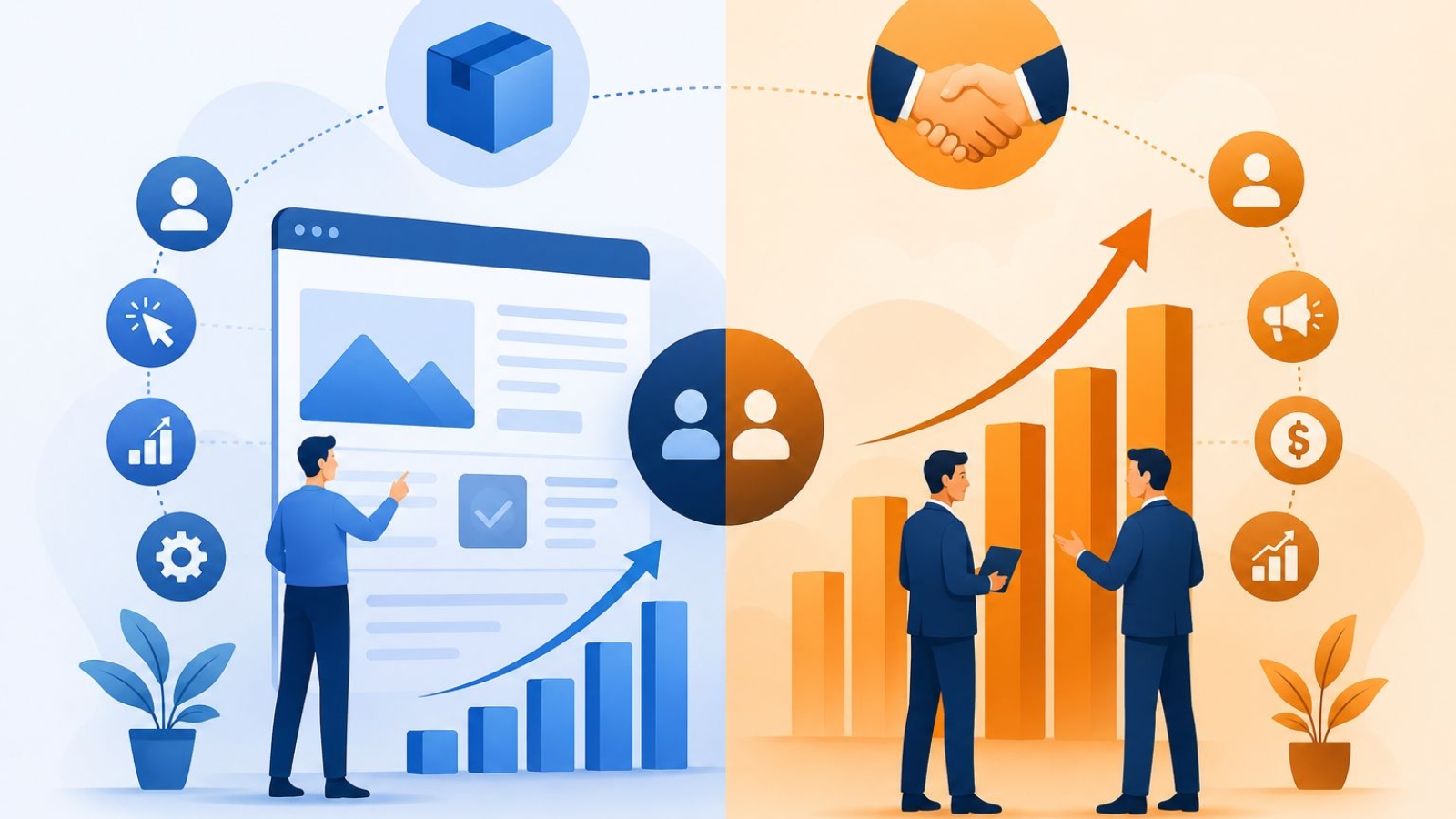
A product-led GTM strategy uses the product experience as the primary mechanism for attracting, activating, converting, retaining, and expanding customers. A sales-led GTM strategy relies primarily on salespeople to educate prospects, manage evaluations, negotiate contracts, and close deals.
Neither model is universally better.
PLG tends to work best when customers can understand and experience value quickly with little human assistance. SLG tends to work better when products are complex, expensive, highly customized, or purchased by multiple stakeholders. A hybrid GTM strategy combines both when self-service adoption and human-assisted selling can reinforce each other.
The important question is therefore not simply:
“Should we choose PLG or SLG?”
It is:
“Which GTM motion allows our ideal customers to reach value and make a buying decision with the least unnecessary friction while producing sustainable unit economics?”
That distinction matters because the choice affects your pricing, onboarding, product design, marketing channels, sales organization, customer success model, technology stack, and revenue economics.
Recent SaaS discussions increasingly emphasize hybrid models rather than treating PLG and SLG as mutually exclusive approaches. Current 2026 coverage also highlights product-led sales, product-qualified leads, and increasingly AI-assisted product experiences as important extensions of the traditional PLG model. (Userpilot)
What Is a Product-Led GTM Strategy?
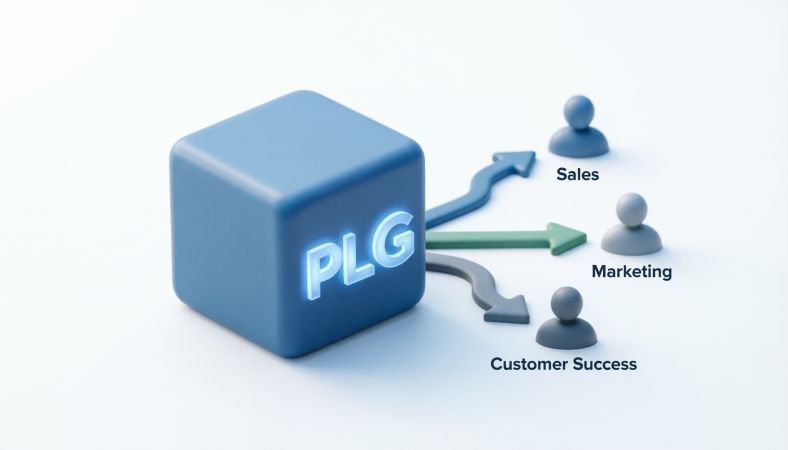
A product-led go-to-market strategy makes the product itself the central driver of customer acquisition, activation, conversion, retention, and expansion.
Instead of requiring a prospect to speak with a salesperson before experiencing value, the company allows users to discover and evaluate the product directly.
A typical product-led journey looks like this:
Discover → Sign Up → Explore → Activate → Experience Value → Convert → Expand → Refer
For example, a prospect might discover a SaaS product through search, social media, community recommendations, or a referral. They create an account, start a free trial, complete an onboarding flow, use a core feature, experience the product’s value, and eventually upgrade.
The product becomes part of the selling process.
That does not mean a PLG company has no sales team. Mature product-led businesses can use sales teams to engage high-intent users, larger accounts, or customers with complex requirements.
In fact, product-led sales is increasingly positioned as a bridge between self-service product adoption and human-assisted selling. (Appcues)
Key characteristics of product-led GTM
A product-led GTM strategy commonly includes:
- Free trials
- Freemium plans
- Self-service signup
- Interactive onboarding
- Fast time-to-value
- In-product education
- Usage-based pricing
- Product analytics
- Product-qualified leads
- In-app upgrades
- Product-driven referrals
- Self-service support
- Expansion based on usage
The defining characteristic isn’t simply offering a free trial.
A company isn’t automatically product-led because it has a freemium plan.
PLG requires the product experience to play a meaningful role in how customers discover, evaluate, adopt, and expand their relationship with the company. Appcues similarly distinguishes PLG from simply offering a free trial or freemium pricing. (Appcues)
How Does Product-Led GTM Work?
A successful product-led GTM motion usually follows a sequence like this:
1. Attract the right users
Marketing creates demand through:
- SEO
- Content
- Communities
- Social media
- Product-led content
- Referrals
- Partnerships
- Integrations
- Paid acquisition
The objective is not merely traffic.
It is to attract people who have a problem your product can solve.
2. Remove barriers to signup
Instead of forcing prospects into lengthy forms or sales calls, PLG businesses typically minimize friction.
The user might be able to:
- Start immediately
- Use a free version
- Begin a trial
- Import data
- Connect an integration
- Create something meaningful within minutes
3. Get users to the activation point
Activation occurs when a user experiences the product’s core value.
For example:
- A project-management user creates their first project and invites teammates.
- A design user creates their first design and shares it.
- An analytics user connects data and generates their first report.
- An email-marketing user sends their first campaign.
The exact activation event depends on the product.
4. Convert product usage into revenue
Once users understand the value, conversion can happen through:
- Usage limits
- Premium features
- Additional seats
- Advanced integrations
- Higher data limits
- Enterprise functionality
5. Expand accounts
Expansion can occur when users:
- Add teammates
- Increase usage
- Upgrade plans
- Purchase additional products
- Need advanced functionality
- Expand across departments
This creates a growth loop:
More usage → More value → More adoption → More expansion
What Is a Sales-Led GTM Strategy?

A sales-led go-to-market strategy uses a human sales organization as the primary engine for converting prospects into customers.
Instead of asking prospects to figure out the product independently, salespeople guide the buyer through the evaluation and purchasing process.
A typical sales-led journey looks like this:
Prospect → Qualify → Discovery → Demo → Evaluation → Proposal → Negotiation → Close → Expansion
Sales-led GTM is particularly useful when customers need significant education, customization, implementation support, security validation, procurement approval, or executive alignment before purchasing.
Core components of sales-led GTM
A sales-led organization may include:
- Business development representatives
- Sales development representatives
- Account executives
- Sales engineers
- Solutions consultants
- Account managers
- Customer success managers
- Sales operations
- Revenue operations
The sales team may generate demand through outbound prospecting, respond to inbound leads, conduct discovery calls, run demonstrations, manage proofs of concept, negotiate pricing, and coordinate stakeholders.
Why sales-led GTM works
Human interaction becomes valuable when the buyer’s problem cannot easily be solved through a self-service product experience.
For example, imagine an enterprise purchasing a cybersecurity platform.
The buyer may need answers about:
- Security architecture
- Compliance
- Data residency
- Integrations
- Implementation
- User permissions
- Procurement
- Legal terms
- Service-level agreements
- Pricing
- Migration
A free trial alone may not answer those questions.
A salesperson or solutions consultant can help remove those barriers.
Product-Led vs Sales-Led GTM: The 12 Key Differences
The simplest way to understand product-led growth vs sales-led growth is to compare how each model moves a customer from awareness to revenue.
| Factor | Product-Led GTM | Sales-Led GTM |
|---|---|---|
| Primary growth engine | Product | Sales organization |
| Customer entry | Signup/trial | Demo/contact sales |
| Buying experience | Self-service | Sales-assisted |
| Product involvement | Very high | Moderate to high |
| Sales involvement | Low to selective | High |
| Time-to-value | Usually fast | Often longer |
| Sales cycle | Shorter | Longer |
| Typical deal complexity | Low to moderate | Moderate to high |
| Customer education | Product/content | Sales/customer-facing teams |
| Scalability | High digital scalability | Headcount-dependent |
| Key buying signal | Product behavior | Sales engagement |
| Core metrics | Activation, conversion, retention | Pipeline, win rate, ACV |
Let’s examine the differences in more detail.
1. Customer Acquisition
PLG attempts to let customers discover and evaluate the product independently.
SLG usually requires a prospect to enter a sales process.
PLG:
Content → Signup → Product
SLG:
Marketing/outbound → Lead → Sales → Product
2. Buying Journey
PLG reduces the number of human interactions required to purchase.
SLG intentionally introduces human interactions because those interactions add value.
Neither is automatically better.
The right question is whether the buyer wants or needs assistance.
3. Sales Involvement
In PLG, sales may become involved after the customer demonstrates buying intent.
In SLG, sales often becomes involved much earlier.
This difference has major implications for CAC and organizational design.
4. Product Experience
PLG requires the product to communicate value.
That means onboarding, UX, documentation, templates, in-app guidance, and activation are strategic growth assets.
In SLG, the product is still important, but the salesperson may explain its value before the buyer experiences it.
5. Time-to-Value
PLG generally performs better when users can experience meaningful value quickly.
The shorter the path from:
Signup → Value
the easier it becomes to support self-service adoption.
Complex enterprise software may require configuration, integrations, migration, training, and approvals before value can be realized.
That naturally increases the need for sales and customer-facing teams.
6. Pricing
PLG frequently uses:
- Freemium
- Free trials
- Usage-based pricing
- Per-seat pricing
- Tiered self-service plans
SLG commonly uses:
- Custom pricing
- Annual contracts
- Negotiated discounts
- Enterprise packages
- Volume pricing
A hybrid model can use public pricing for smaller customers and custom contracts for larger accounts.
7. Average Contract Value
Low or moderate contract values can make self-service economics attractive.
Higher ACVs can justify substantial sales involvement.
However, ACV alone shouldn’t determine your GTM model.
A $20,000 product that customers can understand and implement independently could still support PLG.
A $2,000 product requiring extensive customization might need sales assistance.
The underlying issue is economic and buying complexity, not an arbitrary price threshold.
8. Sales Cycle
PLG generally aims to compress the time between discovery and purchase.
SLG often involves:
- Multiple meetings
- Multiple stakeholders
- Product evaluation
- Procurement
- Security review
- Legal negotiation
Consequently, sales-led businesses often operate with longer sales cycles.
9. Customer Acquisition Cost
PLG can reduce the amount of human labor required to acquire and onboard each customer.
But PLG isn’t automatically cheap.
A sophisticated PLG organization may invest heavily in:
- Product development
- Growth teams
- Analytics
- Onboarding
- Experimentation
- Content
- Infrastructure
- Customer education
SLG has more direct sales costs, including salaries, commissions, enablement, management, and sales technology.
The correct comparison is not:
PLG = cheap
SLG = expensive
Instead, compare the full customer acquisition economics of each motion.
10. Scalability
PLG can potentially acquire and onboard many customers without adding salespeople at the same rate.
SLG often requires additional human capacity as the customer base and pipeline expand.
That makes PLG attractive for highly repeatable products.
SLG remains powerful where every additional customer can generate substantial revenue.
11. Customer Expansion
PLG can identify expansion opportunities through usage.
For example:
More users → More seats → Higher plan → More revenue
SLG can identify expansion through account relationships.
For example:
Department A → Department B → Enterprise-wide deployment
The strongest companies often combine these approaches.
12. Data and Buying Signals
PLG generates behavioral data.
Examples include:
- Login frequency
- Feature usage
- Number of users
- Usage limits
- Integration activity
- Collaboration
- Workspace creation
- Invitation activity
Sales teams can use these signals to prioritize accounts.
That creates product-led sales.
Product-Led vs Sales-Led Funnel
One of the biggest differences between the two GTM models is how the funnel works.
Product-Led Funnel
Traffic
↓
Signup
↓
Activation
↓
Aha Moment
↓
Product Adoption
↓
Conversion
↓
Expansion
↓
Advocacy
The product carries much of the buyer’s journey.
Sales-Led Funnel
Lead
↓
Qualification
↓
Discovery
↓
Demo
↓
Evaluation
↓
Proposal
↓
Negotiation
↓
Closed-Won
↓
Expansion
The sales team carries much of the buyer’s journey.
PLG vs SLG Economics: CAC, ACV, Payback and Scalability
A GTM model should ultimately be judged by economics.
Consider four important variables.
Customer Acquisition Cost
How much does it cost to acquire one customer?
For PLG, calculate the total cost of:
- Acquisition
- Product infrastructure
- Onboarding
- Growth
- Support
- Product analytics
For SLG, include:
- Sales salaries
- Commissions
- Sales management
- SDR costs
- Sales tools
- Marketing
- Travel
- Enablement
- Solutions engineering
Average Contract Value
ACV determines how much human involvement can economically be justified.
If your customers pay $500 per year, a highly customized sales process may destroy margins.
If customers pay $100,000 per year, spending significant resources on the account may be rational.
CAC Payback
CAC payback measures how long it takes for gross profit from a customer to recover acquisition costs.
A GTM motion that generates more revenue but takes substantially longer to recover acquisition costs isn’t necessarily healthier.
Customer Lifetime Value
The right GTM model should support:
Acquisition → Retention → Expansion
A cheap acquisition model isn’t useful if customers churn quickly.
Likewise, an expensive sales process can still work if it produces large, durable accounts.
Advantages of Product-Led GTM
1. Faster customer access
Customers can start without waiting for a sales call.
2. Lower friction
Self-service removes unnecessary steps from the buying journey.
3. Scalable acquisition
Digital product experiences can serve many users simultaneously.
4. Strong product feedback
User behavior provides continuous signals about what customers actually need.
5. Faster experimentation
Teams can test onboarding, pricing, features, and conversion experiences.
6. Potentially stronger product adoption
Customers experience the product before committing.
7. Expansion opportunities
Usage can naturally lead customers toward higher-value plans.
Disadvantages of Product-Led GTM
PLG isn’t a shortcut.
1. The product must be genuinely easy to understand
If users cannot figure out how to achieve value, self-service becomes a liability.
2. Activation can be difficult
Thousands of signups don’t matter if only a small percentage activate.
3. Free users can create misleading growth
Signup volume is not revenue.
4. Enterprise customers may still need humans
Large customers often require security, procurement, legal, implementation, and negotiation support.
5. Product analytics become critical
Without behavioral data, identifying friction and buying intent becomes difficult.
Advantages of Sales-Led GTM
1. Excellent for complex products
Salespeople can explain sophisticated solutions.
2. Supports large contracts
Higher ACVs can justify high-touch selling.
3. Handles complex buying committees
Sales can coordinate executives, users, IT, procurement, finance, legal, and security.
4. Enables customization
Sales teams can position solutions around specific customer requirements.
5. Builds relationships
Human interaction can be valuable for strategic accounts.
Disadvantages of Sales-Led GTM
1. Higher acquisition costs
Human selling requires substantial resources.
2. Longer sales cycles
Complex evaluation processes can delay revenue.
3. Headcount dependency
Growing revenue often requires additional sales capacity.
4. Sales bottlenecks
Limited sales capacity can restrict growth.
5. Buying friction
Some modern buyers prefer researching and testing software independently before talking to sales.
What Is a Hybrid GTM Strategy?
A hybrid GTM strategy combines product-led and sales-led motions.
Instead of forcing every customer through the same journey, the company uses different levels of human assistance based on customer needs and potential value.
A simple hybrid model looks like this:
Product creates demand and adoption → Data identifies intent → Sales assists valuable opportunities
This is often called product-led sales (PLS).
Current SaaS coverage increasingly treats hybrid PLG + SLG as an important model, particularly for companies serving both self-service and enterprise segments. (Userpilot)
How Product-Led Sales Works
Product-led sales starts with product behavior.
Imagine 100 users sign up.
Instead of asking salespeople to contact all 100 users, the company looks for signals such as:
- High usage
- Multiple team members
- Premium feature usage
- Integration setup
- Repeated sessions
- Usage approaching limits
- Multiple departments adopting the product
The highest-intent accounts become sales opportunities.
The process becomes:
User → Product Usage → Intent Signal → PQL → Sales Outreach → Opportunity → Revenue
This is more efficient than treating every signup equally.
What Is a Product-Qualified Lead?
A product-qualified lead (PQL) is a user or account whose product behavior indicates meaningful buying intent.
For example, a PQL might:
- Invite five coworkers
- Use a premium feature
- Reach a usage limit
- Connect a business-critical integration
- Create multiple projects
- Return to the product frequently
- Add billing information
- Invite users from another department
The exact definition depends on your product.
A useful PQL framework combines:
Fit + Intent + Product Behavior
For example:
High-fit company + high usage + repeated engagement = high-priority sales opportunity
This gives sales teams better context before initiating outreach.
PLG vs SLG vs Hybrid: Which Should You Choose?
There is no universal GTM model.
Use this decision framework.
Factor 1: Product Complexity
Ask:
Can a new customer understand and use the core product without a salesperson?
If yes, PLG becomes more attractive.
If no, SLG or hybrid becomes more appropriate.
Factor 2: Time-to-Value
Ask:
How quickly can a new customer achieve a meaningful outcome?
If value can be reached in minutes or hours, PLG has a natural advantage.
If implementation takes weeks or months, sales and customer success become more important.
Factor 3: ACV
Ask:
Is the revenue from each customer large enough to support human-assisted selling?
Higher ACV generally provides more room for sales involvement.
But don’t use ACV as your only criterion.
Factor 4: Buyer Complexity
Ask:
How many people participate in the purchase?
A single user can often adopt software independently.
An enterprise purchase may involve:
- End users
- Managers
- IT
- Security
- Procurement
- Finance
- Legal
- Executives
The more complex the buying committee, the more valuable sales assistance becomes.
Factor 5: Implementation Requirements
PLG works best when implementation is simple.
SLG becomes more attractive when customers need:
- Migration
- Configuration
- Integration
- Training
- Custom development
- Compliance reviews
Factor 6: Customer Preference
Don’t design the buying journey around your internal organization.
Study what customers actually want.
If prospects repeatedly say:
“Let me try it first.”
That is a strong PLG signal.
If prospects repeatedly say:
“Can someone walk us through how this works for our organization?”
That supports a sales-assisted motion.
Factor 7: Expansion Potential
Ask:
Can customer usage naturally expand over time?
If yes, PLG can create strong usage-driven expansion.
If expansion requires account negotiation, enterprise contracts, or cross-department selling, SLG can add significant value.
PLG vs SLG Decision Matrix
| Business Condition | Recommended GTM Motion |
|---|---|
| Simple product + fast activation | Product-led |
| Low-friction self-service purchase | Product-led |
| Individual users | Product-led |
| Viral collaboration | Product-led |
| High ACV | Sales-led or hybrid |
| Complex implementation | Sales-led |
| Multiple stakeholders | Sales-led |
| Long procurement process | Sales-led |
| SMB + enterprise segments | Hybrid |
| Self-service adoption + enterprise expansion | Hybrid |
| Strong product usage signals | Product-led sales |
| Product creates demand but sales closes large accounts | Hybrid |
The key takeaway is simple:
Choose the GTM motion based on how customers buy—not on which model is currently fashionable.
Product-Led vs Sales-Led GTM Metrics
The metrics you prioritize should match your GTM motion.
Product-Led Metrics
Track:
- Signup rate
- Activation rate
- Time-to-value
- Trial-to-paid conversion
- Free-to-paid conversion
- Product engagement
- Feature adoption
- PQL volume
- PQL-to-paid conversion
- Retention
- Expansion
- Net revenue retention
- Referral rate
PLG metrics should connect product behavior to revenue outcomes rather than focusing only on vanity metrics such as total registrations. Current PLG measurement guidance similarly emphasizes behavioral signals tied to activation, conversion, retention, and expansion. (Appcues)
Sales-Led Metrics
Track:
- Qualified leads
- Sales-qualified opportunities
- Pipeline value
- Pipeline coverage
- Demo-to-opportunity rate
- Opportunity-to-close rate
- Win rate
- Average contract value
- Sales cycle length
- CAC
- CAC payback
- Revenue per sales representative
- Expansion revenue
Hybrid Metrics
Hybrid organizations should add:
- PQL-to-SQL conversion
- Product-assisted pipeline
- Product-assisted revenue
- Sales-assisted conversion
- Product usage before opportunity
- Expansion after sales intervention
- Revenue by acquisition motion
- Self-service vs assisted conversion
- Enterprise expansion from PLG accounts
These metrics reveal whether product and sales are working together rather than operating as disconnected departments.
Product-Led vs Sales-Led GTM Examples
Examples are useful, but copying another company’s GTM model without understanding its economics is dangerous.
Product-Led Examples
Dropbox
Cloud storage can be understood through direct usage. Sharing and collaboration can also introduce the product to additional users.
Lesson: Products with simple core value and natural sharing can benefit from product-driven adoption.
Calendly
The scheduling experience itself can expose the product to people who weren’t originally users.
Lesson: A product can become a distribution channel when customers naturally share it.
Figma
Collaboration makes product usage visible to additional users.
Lesson: Collaborative products can create organic acquisition loops.
Sales-Led GTM Examples
Sales-led motions are particularly common in categories where buying decisions involve significant financial, technical, or organizational risk.
Examples include:
- Enterprise cybersecurity
- Complex ERP
- Large-scale infrastructure
- Enterprise data platforms
- Highly customized business software
The common characteristic isn’t simply “expensive software.”
It is high buying complexity and high perceived risk.
Hybrid GTM Examples
Many mature SaaS businesses combine self-service product experiences with sales assistance.
The pattern is often:
Self-service entry → Product adoption → Account identification → Sales engagement → Enterprise expansion
This allows smaller customers to move quickly while giving larger accounts access to human support.
The hybrid model is also increasingly discussed as the practical direction for mature SaaS organizations rather than merely a compromise between PLG and SLG. (Userpilot)
Common Mistakes When Choosing PLG vs SLG
Mistake 1: Choosing PLG because it is trendy
PLG cannot compensate for a product that doesn’t deliver value quickly.
Mistake 2: Assuming a free trial equals PLG
A free trial is a pricing or acquisition mechanism.
PLG is a broader GTM philosophy.
Mistake 3: Hiring a large sales team too early
If product-market fit is uncertain, scaling sales may simply scale inefficient acquisition.
Mistake 4: Removing sales from enterprise deals
A product-led entry point doesn’t mean every customer should remain self-service.
Mistake 5: Treating every signup as a lead
A thousand inactive users aren’t more valuable than 50 highly engaged users.
Mistake 6: Ignoring activation
Signup is not success.
Value realization is success.
Mistake 7: Measuring the wrong metrics
Traffic, downloads, and registrations don’t automatically create revenue.
Mistake 8: Building a hybrid model without rules
Hybrid doesn’t mean:
“Let’s do PLG and SLG simultaneously for everyone.”
It means:
Use product and sales where each creates the most value.
How to Transition From Sales-Led to Product-Led GTM
A sales-led company doesn’t have to abandon its sales organization.
Instead, start by identifying repeatable parts of the buying process.
Step 1: Identify common customer use cases
Find problems that can be solved without customization.
Step 2: Simplify onboarding
Reduce unnecessary forms, meetings, and setup requirements.
Step 3: Build a self-service experience
Let users experience the product before contacting sales.
Step 4: Define activation
Identify the event that indicates meaningful value.
Step 5: Add product analytics
Measure where users succeed and where they drop off.
Step 6: Introduce product-qualified leads
Send high-intent accounts to sales.
Step 7: Keep sales focused on high-value opportunities
Sales should add value rather than simply repeat information already available inside the product.
How to Transition From PLG to Sales-Led or Hybrid GTM
You may need additional sales involvement when:
- Enterprise customers become a larger percentage of revenue
- ACV increases
- Buying committees become larger
- Customers request custom contracts
- Security reviews become common
- Implementation becomes more complex
- Expansion requires negotiation
- Large accounts show strong product usage
The transition doesn’t have to destroy self-service adoption.
A stronger model is often:
PLG for discovery and adoption + SLG for high-value conversion and expansion
How AI Is Changing Product-Led vs Sales-Led GTM
AI is introducing a new dimension to the PLG vs SLG discussion.
Traditional PLG assumes:
A human discovers the product, learns the interface, and uses the product to achieve an outcome.
AI-assisted products can change that sequence.
The user may instead describe the desired outcome and let the software perform much of the work.
This can reduce the effort required to reach value.
Current 2026 PLG research and commentary increasingly discuss agentic product experiences, where AI can perform tasks on behalf of users, as an evolution of traditional PLG rather than a replacement for it. (Userpilot)
For GTM teams, this creates several implications.
1. Time-to-value becomes even more important
If AI can reduce a task from 20 minutes to 20 seconds, the activation experience changes dramatically.
2. Product education changes
Instead of teaching users every feature, products can help users accomplish outcomes directly.
3. Product usage data becomes more important
AI-assisted behavior can create new signals for intent and adoption.
4. Content needs to be machine-readable
For GEO and AI search visibility, businesses should make important product information easy for AI systems to understand.
That includes:
- Clear definitions
- Structured headings
- Concise answers
- Specific comparisons
- Transparent pricing information where appropriate
- Product documentation
- Use cases
- Customer examples
- FAQs
- Consistent terminology
This is increasingly relevant because buyers can discover products through AI answer engines before visiting a company’s website.
How to Build a Product-Led GTM Strategy
If you’ve determined that PLG fits your business, use this framework.
Step 1: Define your ICP
Identify:
- Company size
- Industry
- Role
- Problem
- Buying trigger
- Product maturity
- Budget
- Existing alternatives
Step 2: Identify the core value event
Ask:
What must the user accomplish before they understand why this product matters?
That’s your activation target.
Step 3: Reduce time-to-value
Remove unnecessary steps between signup and meaningful value.
Step 4: Build self-service onboarding
Use:
- Templates
- Checklists
- Guided setup
- Interactive tutorials
- Product tours
- Contextual help
Step 5: Design conversion triggers
Identify natural reasons to upgrade.
Step 6: Create PQL signals
Determine which behaviors indicate buying intent.
Step 7: Connect product and sales data
Your CRM and product analytics should work together.
Step 8: Measure the entire customer journey
Don’t stop at signup.
Track:
Acquisition → Activation → Conversion → Retention → Expansion
How to Build a Sales-Led GTM Strategy
If SLG is the better fit, build the sales motion around customer complexity.
Step 1: Define your ICP
Prioritize accounts where your solution produces meaningful economic value.
Step 2: Define buying committees
Identify:
- Champion
- User
- Economic buyer
- Technical evaluator
- Procurement
- Executive sponsor
Step 3: Build your sales process
Define:
Prospecting → Qualification → Discovery → Demo → Evaluation → Proposal → Negotiation → Close
Step 4: Develop strong sales enablement
Provide:
- Case studies
- ROI materials
- Battlecards
- Demo environments
- Security documentation
- Implementation plans
- Comparison guides
Step 5: Establish qualification criteria
Don’t allow salespeople to spend equal time on every lead.
Step 6: Measure conversion at every stage
Identify where deals stall.
Step 7: Build expansion into the model
The first contract shouldn’t be the end of the customer journey.
The Best GTM Strategy May Not Be PLG or SLG
This is the most important conclusion of the entire comparison.
A SaaS company can have:
- PLG for individual users
- Product-led sales for high-intent accounts
- Sales-led enterprise acquisition
- Customer success for expansion
- Account-based marketing for strategic accounts
These aren’t contradictory.
They can be different layers of the same GTM system.
Consider a hypothetical SaaS company.
Small customer
A user discovers the product through Google.
→ Starts a free trial
→ Activates
→ Upgrades online
PLG
Growing company
Ten users adopt the product.
→ Usage increases
→ PQL signal appears
→ Sales contacts the account
→ Team upgrades
Product-led sales
Enterprise company
The customer requires:
- Security review
- SSO
- Procurement
- Custom implementation
- Annual contract
SLG
One company can therefore operate all three motions.
A Simple Framework for Choosing Your GTM Motion
Use this five-question test.
Question 1
Can customers understand your value without talking to sales?
If yes → PLG potential.
Question 2
Can customers reach value quickly?
If yes → stronger PLG potential.
Question 3
Does your product require significant customization or implementation?
If yes → stronger SLG potential.
Question 4
Does your product have strong usage signals that predict buying intent?
If yes → consider product-led sales.
Question 5
Do you serve both small self-service customers and complex enterprise accounts?
If yes → hybrid is likely worth evaluating.
Product-Led vs Sales-Led GTM: Final Comparison
| Category | Product-Led | Sales-Led | Hybrid |
|---|---|---|---|
| Acquisition | Self-service | Sales-assisted | Both |
| Activation | Product | Sales/product | Product |
| Conversion | Product experience | Sales process | Product + sales |
| Best for | Simple products | Complex products | Mixed segments |
| ACV | Low–moderate | Moderate–high | Broad |
| Sales involvement | Selective | High | Intent-based |
| Scalability | High | Lower | High |
| Customer experience | Self-service | High-touch | Flexible |
| Key signal | Usage | Engagement | Usage + engagement |
| Expansion | Usage-driven | Account-driven | Both |
Frequently Asked Questions About Product-Led vs Sales-Led GTM
What is the difference between product-led and sales-led GTM?
Product-led GTM uses the product experience as the primary driver of customer acquisition, activation, conversion, and expansion. Sales-led GTM relies primarily on sales teams to educate, qualify, negotiate, and close customers.
Is PLG better than SLG?
No. PLG is not inherently better than SLG. PLG is generally better suited to products that are easy to understand, easy to adopt, and capable of delivering value quickly. SLG is often more effective for complex, high-value products requiring customization, education, negotiation, or multiple stakeholders.
Can a SaaS company use both PLG and SLG?
Yes. A hybrid GTM strategy can use PLG for self-service acquisition and adoption while using sales for high-value accounts, complex implementations, enterprise conversion, and expansion.
What is product-led sales?
Product-led sales is a GTM motion where sales teams use product usage and engagement signals to identify high-intent users or accounts and initiate targeted sales conversations. It connects product behavior with human selling. (Appcues)
What is a product-qualified lead?
A product-qualified lead (PQL) is a user or account whose product behavior indicates a strong likelihood of becoming a paying or expanding customer.
Examples include reaching a usage threshold, inviting multiple teammates, adopting a premium feature, or repeatedly using a high-value workflow.
Does offering a free trial mean a company is PLG?
No.
A free trial is only one tactic.
A genuinely product-led GTM strategy uses the product as a meaningful mechanism for acquisition, activation, conversion, retention, and expansion. (Appcues)
Which GTM model has a lower CAC?
PLG can have lower marginal acquisition costs because fewer human interactions may be required. However, PLG still requires significant investment in product, growth, onboarding, analytics, and customer experience.
The right comparison is fully loaded CAC and resulting customer economics, not the GTM label.
Is sales-led growth dead?
No.
Sales-led growth remains highly relevant for complex enterprise purchases where buyers need customization, implementation support, negotiation, security review, procurement, or strategic guidance.
The shift is toward using sales where human involvement creates meaningful value rather than requiring every customer to follow a high-touch process.
Is product-led growth dead because of AI?
No. PLG is evolving.
AI can change how users reach product value, how onboarding works, and how software is discovered and operated. Current 2026 discussions increasingly frame this as an evolution toward more agentic product experiences. (Userpilot)
When should a startup choose PLG?
PLG can be a strong option when the startup has:
- A simple core use case
- Fast time-to-value
- Low-friction onboarding
- A digital distribution opportunity
- Self-service buyers
- A product users can evaluate independently
- Strong potential for collaboration or referrals
When should a startup choose sales-led GTM?
SLG may be more appropriate when the startup sells:
- High-value software
- Complex enterprise solutions
- Highly customized products
- Security-sensitive products
- Products requiring implementation
- Solutions purchased by multiple stakeholders
What is the best GTM strategy for SaaS in 2026?
There is no universal answer.
For many SaaS companies, the strongest approach is a hybrid GTM strategy where product-led experiences handle self-service discovery and adoption while sales teams focus on high-value, complex, or expansion opportunities. Recent 2026 industry coverage strongly emphasizes this convergence rather than a strict PLG-versus-SLG divide. (Userpilot)
Conclusion: Choose the GTM Motion That Matches How Customers Buy
Product-led vs sales-led GTM strategy isn’t a contest to determine which growth philosophy is superior.
It is a design decision.
PLG works when the product can demonstrate its value with minimal assistance. SLG works when human expertise helps customers navigate complexity, risk, customization, and organizational buying. Hybrid GTM combines the two when different customer segments or stages of the buying journey require different levels of assistance.
The most useful way to approach the decision is to evaluate:
Product complexity + time-to-value + ACV + buyer complexity + implementation requirements + customer preference + expansion potential.
If customers can discover value independently, make that experience effortless.
If customers need expert guidance, provide it.
If smaller customers want self-service while enterprise customers need a sales team, don’t force everyone into one funnel.
Build the GTM system around the buying journey.
And remember the central principle:
The best GTM strategy is not the one that minimizes sales or maximizes product usage. It is the one that creates the shortest, most valuable path from customer problem to customer outcome while producing sustainable revenue.
That is the real difference between simply choosing PLG vs SLG and building a GTM strategy that can scale.