

What Is a SaaS Go-To-Market Strategy?
A SaaS go-to-market strategy is a structured plan that defines how a software company identifies its ideal customers, positions its product, sets pricing, chooses a go-to-market motion, acquires users, converts them into paying customers, and grows recurring revenue through retention and expansion.
Unlike a simple product launch plan, SaaS GTM covers the customer lifecycle beyond the initial purchase. Because SaaS companies depend on recurring revenue, acquisition, activation, retention, and expansion all influence the commercial outcome. Current SaaS GTM frameworks increasingly emphasize this broader lifecycle alongside unit economics and GTM-motion selection. (GTM Labs)
In practical terms, a SaaS GTM strategy answers:
- Who is the ideal customer?
- What problem are you solving?
- Why should customers choose your product?
- How should you price and package it?
- How will customers discover and evaluate it?
- Should you use product-led, sales-led, or hybrid growth?
- How will you convert prospects into customers?
- How will you activate and retain them?
- How will you increase revenue from existing accounts?
- Which metrics prove the strategy is working?
A useful way to visualize the entire SaaS GTM system is:
Market → ICP → Buyer → Positioning → Pricing → GTM Motion → Acquisition → Activation → Retention → Expansion → Revenue
This guide explains each stage and provides a practical framework you can adapt to a SaaS startup, B2B SaaS company, enterprise software business, or growing subscription-based product.
SaaS Go-To-Market Strategy: Key Takeaways
If you only have a few minutes, remember these principles:
- Start with a specific ICP. A broad audience creates weak positioning and inefficient acquisition.
- Understand the buying process. SaaS purchases may involve users, champions, executives, IT, procurement, and finance.
- Sell outcomes, not features. Your value proposition should connect the product to measurable customer value.
- Choose your GTM motion deliberately. Product-led, sales-led, channel-led, marketing-led, and hybrid models have different economics.
- Align pricing with value. Packaging should make the buying decision understandable and create logical expansion paths.
- Treat activation as part of GTM. Getting a signup is not the same as creating a customer.
- Build retention into the strategy. Churn can erase the gains created by acquisition.
- Design for expansion. Upsells, additional seats, usage, cross-sells, and higher tiers can become major growth levers.
- Measure revenue efficiency. CAC, payback, LTV:CAC, conversion, retention, and expansion matter more than vanity metrics alone.
- Iterate continuously. A SaaS GTM strategy should evolve based on customer feedback, win/loss data, product usage, and revenue performance.
Why Is a SaaS Go-To-Market Strategy Important?

A SaaS product can have excellent technology and still struggle commercially.
The problem may not be the product itself. It may be:
- The wrong target market
- An unclear value proposition
- Poor positioning
- An unsuitable pricing model
- The wrong acquisition channel
- A mismatched sales motion
- Complicated onboarding
- Low activation
- High churn
- Weak sales and marketing alignment
A SaaS GTM strategy brings these decisions into one commercial system.
A strong SaaS GTM strategy helps you:
Reach the right customers
Instead of spending resources on everyone, you identify accounts and users with the highest potential fit.
Improve positioning
You create a clear reason for the target customer to choose your solution.
Reduce acquisition waste
Channel selection and GTM motion are based on customer behavior rather than assumptions.
Improve conversion
Relevant messaging, pricing, demos, trials, and sales processes reduce friction.
Accelerate time-to-value
Better onboarding helps users reach the product’s core value faster.
Improve retention
A customer who repeatedly receives value is more likely to renew.
Increase expansion revenue
Successful customers can move to higher tiers, add seats, increase usage, or purchase additional products.
Create predictable growth
The ultimate objective is to turn isolated wins into a repeatable acquisition and revenue engine.
Amplitude’s SaaS GTM framework similarly treats audience research, value proposition, pricing, distribution, acquisition, onboarding, feedback, and cross-functional alignment as interconnected parts of the strategy. (Amplitude)
SaaS GTM Strategy vs. SaaS Marketing Strategy vs. SaaS Sales Strategy
These terms are often used interchangeably, but they serve different purposes.
| Strategy | Primary Purpose | Main Question |
|---|---|---|
| SaaS GTM Strategy | Commercialize the product | How will we successfully bring this product to this market? |
| SaaS Marketing Strategy | Generate awareness and demand | How will we attract and educate potential buyers? |
| SaaS Sales Strategy | Convert opportunities | How will we turn qualified prospects into customers? |
| Product Strategy | Build the right product | What should we build and for whom? |
| Product Launch Strategy | Introduce a product | How will we announce and distribute the product? |
| Growth Strategy | Increase sustainable revenue | How will we improve acquisition, retention, and expansion? |
A SaaS go-to-market strategy is broader than a marketing strategy.
Marketing may generate demand. Sales may close deals. Product may create the solution. Customer success may drive adoption.
GTM connects all of them around a defined market and commercial objective.
What Makes a SaaS Go-To-Market Strategy Different?
SaaS has several characteristics that change how GTM should be designed.
1. Revenue is recurring
Traditional software can involve a one-time transaction.
SaaS usually depends on recurring subscriptions, making retention and expansion strategically important.
2. Distribution can be digital
A SaaS company can reach customers through:
- SEO
- Content
- Product-led growth
- Free trials
- Paid advertising
- Sales teams
- Partnerships
- Marketplaces
- Communities
3. The product can become part of acquisition
In a product-led model, users may experience the product before speaking with sales.
The product itself becomes part of the marketing and conversion experience.
4. Activation matters
A signup doesn’t automatically represent value.
The user needs to reach a meaningful first-value moment.
5. Retention affects growth
If new customers arrive but existing customers leave, acquisition becomes increasingly expensive.
Modern SaaS GTM frameworks therefore place recurring revenue, retention, expansion, and unit economics alongside traditional acquisition considerations. (GTM Labs)
The 10-Part SaaS Go-To-Market Framework
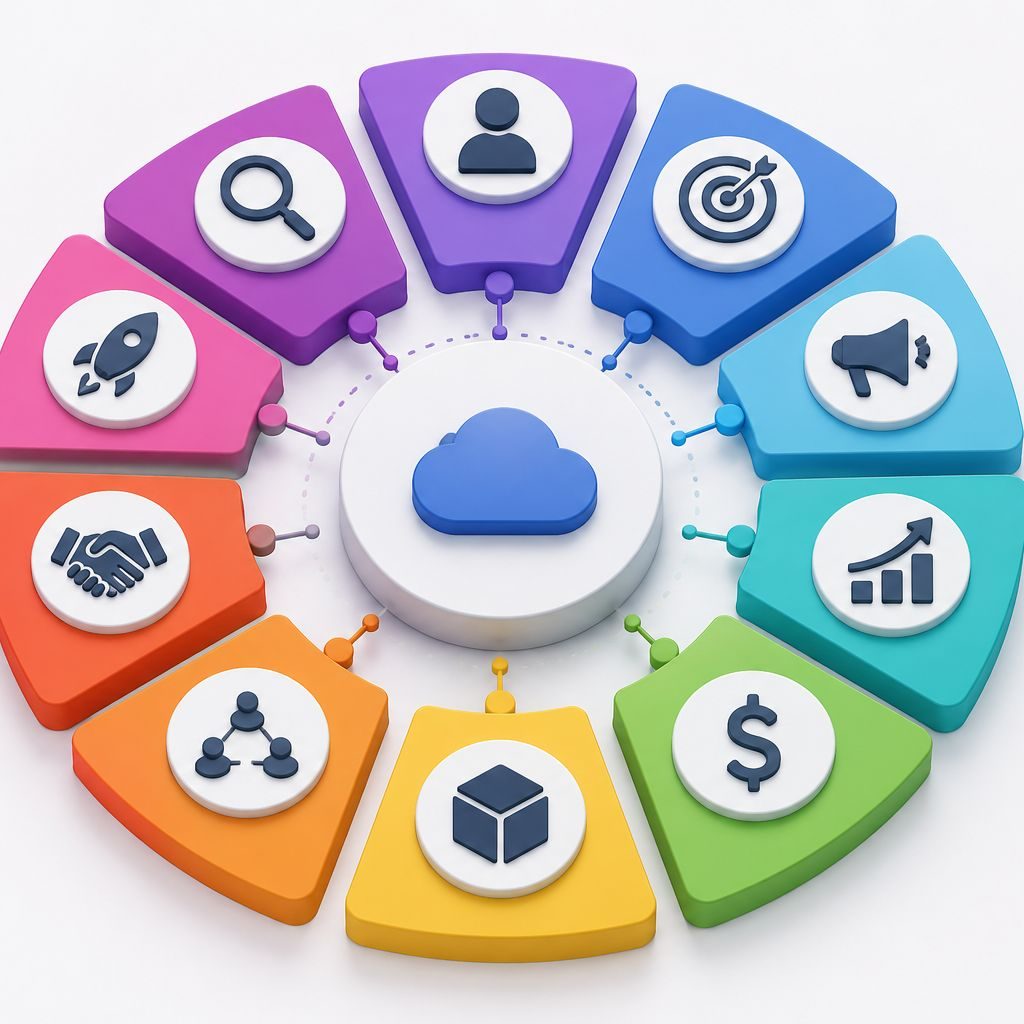
A practical SaaS GTM framework can be organized into ten connected areas:
- Target market
- Ideal customer profile
- Buying committee
- Value proposition
- Positioning and messaging
- Pricing and packaging
- GTM motion
- Customer acquisition
- Activation and onboarding
- Retention and expansion
Let’s break down each one.
1. Define Your SaaS Target Market
Your first job is not to find a marketing channel.
It is to decide where you want to compete.
A market can be defined by:
- Industry
- Company size
- Revenue
- Geography
- Business model
- Growth stage
- Technology environment
- Customer maturity
- Specific business problem
Instead of:
“Our SaaS product is for businesses.”
Create a much narrower definition:
“Our platform helps 100–1,000 employee B2B SaaS companies improve enterprise pipeline visibility and sales forecasting.”
The second statement gives your GTM team a market it can actually research and reach.
Use TAM, SAM, and SOM
TAM — Total Addressable Market
The total potential demand if every relevant customer purchased your category.
SAM — Serviceable Available Market
The portion you can serve based on geography, capabilities, product requirements, and other constraints.
SOM — Serviceable Obtainable Market
The portion you realistically expect to capture within a defined period.
But market size shouldn’t be the only consideration.
Evaluate:
- Pain severity
- Buying urgency
- Budget availability
- Competitive intensity
- Customer accessibility
- Market growth
- Switching barriers
- Product fit
A smaller market with severe pain and strong buying intent can be more commercially attractive than a massive market with little urgency.
2. Define Your Ideal Customer Profile
Your Ideal Customer Profile (ICP) describes the type of organization most likely to benefit from your SaaS product and generate attractive long-term economics.
A strong SaaS ICP can include four categories.
Firmographic criteria
- Industry
- Employee count
- Revenue
- Location
- Business model
Technographic criteria
- CRM
- Cloud infrastructure
- Existing SaaS tools
- Integrations
- Technology stack
Behavioral criteria
- Product usage
- Buying behavior
- Growth patterns
- Engagement
- Existing workflow
Trigger criteria
Look for events that increase buying urgency:
- Funding
- New executive
- Rapid hiring
- Expansion
- Acquisition
- New regulation
- Product launch
- Existing contract expiration
- Operational change
Example SaaS ICP
| Attribute | Ideal Customer |
|---|---|
| Industry | B2B SaaS |
| Employees | 100–1,000 |
| Revenue | $10M–$100M |
| Geography | North America |
| Sales model | Mid-market/enterprise |
| Technology | Salesforce |
| Main problem | Poor pipeline visibility |
| Buying trigger | New VP of Sales |
| Budget | $50K+ annually |
| Negative fit | No sales team |
Create an ICP scoring system
You can score prospects from 0–100.
| Factor | Weight |
|---|---|
| Industry fit | 20 |
| Company size | 15 |
| Pain severity | 20 |
| Buying trigger | 15 |
| Technology fit | 10 |
| Budget | 10 |
| Timing | 10 |
| Total | 100 |
This helps sales and marketing prioritize accounts instead of treating every lead equally.
3. Understand the SaaS Buying Committee
The person using your software may not be the person paying for it.
A B2B SaaS buying committee can include:
- Economic buyer
- Champion
- End user
- Technical evaluator
- Executive sponsor
- Procurement
- Finance
- IT
- Security
Each stakeholder evaluates the product differently.
For example:
Sales VP: Wants revenue impact.
Sales Operations: Wants workflow efficiency.
Sales Representative: Wants less manual work.
Finance: Wants measurable ROI.
IT: Wants security and integration.
Your SaaS GTM messaging should therefore map:
Persona → Pain → Desired outcome → Objection → Proof → Message
This is especially important for enterprise SaaS, where several stakeholders can influence the purchase.
4. Build Your SaaS Value Proposition
A SaaS value proposition should make the product’s commercial value easy to understand.
Avoid making the value proposition a feature list.
Instead use:
Feature → Capability → Outcome → Business Impact
Example
Feature: Automated lead scoring
Capability: Prioritizes high-fit accounts.
Outcome: Sales representatives spend more time on qualified prospects.
Business impact: Higher sales productivity and potentially better pipeline efficiency.
Another useful formula is:
We help [target customer] achieve [desired outcome] by [unique mechanism], without [major alternative or pain].
For example:
We help mid-market SaaS teams increase qualified pipeline by prioritizing high-intent accounts and automating follow-up without requiring a larger SDR team.
The stronger the connection between your product and a measurable business outcome, the more useful your positioning becomes.
5. Develop SaaS Positioning and Messaging
Positioning answers:
Why this product, for this customer, instead of the alternatives?
Your positioning should define:
- Target customer
- Category
- Problem
- Desired outcome
- Differentiation
- Competitive alternative
- Proof
Positioning framework
For: target customer
Who: has a specific problem
Our product: provides a specific solution
That: delivers a valuable outcome
Unlike: the main alternative
Because: your differentiator is defensible
Your message should then adapt across:
- Website
- Product pages
- Ads
- Sales emails
- Webinars
- Demo
- Case studies
- Comparison pages
The core positioning stays consistent while the emphasis changes according to buyer stage and persona.
6. Build Your SaaS Pricing and Packaging Strategy
Pricing is part of your GTM strategy, not an afterthought.
Common SaaS pricing models include:
Per-seat pricing
Customers pay according to the number of users.
Usage-based pricing
Customers pay according to usage.
Tiered pricing
Different packages serve different customer needs.
Flat-rate pricing
One fixed price covers a defined product scope.
Freemium
A free version creates adoption while premium features drive monetization.
Free trial
Users experience the product for a defined period before purchasing.
Enterprise pricing
Large customers receive customized pricing based on users, usage, requirements, support, or implementation.
How should you choose?
Consider:
- How customers receive value
- How usage scales
- Customer budget
- ACV
- Product complexity
- Competitive alternatives
- Implementation requirements
- Expansion opportunities
Your packaging should also make the upgrade path obvious.
For example:
Starter → Growth → Business → Enterprise
Each tier should represent a meaningful increase in customer value rather than simply adding arbitrary features.
7. Choose the Right SaaS GTM Motion
One of the most important decisions in SaaS commercialization is choosing how customers will buy.
The major SaaS GTM motions include:
- Product-led growth
- Sales-led growth
- Marketing-led growth
- Channel-led growth
- Hybrid GTM
Recent SaaS GTM research and practitioner frameworks increasingly emphasize motion selection based on product complexity, ACV, buying behavior, and company stage rather than assuming that one model works for every SaaS company. (GTM Labs)
Product-Led Growth
The product is a primary driver of acquisition, activation, and expansion.
Typical mechanisms:
- Free signup
- Freemium
- Free trial
- Self-service onboarding
- Product invitations
- Usage-based upgrades
PLG can be effective when customers can understand and experience value without extensive sales assistance.
Sales-Led Growth
Salespeople guide prospects through evaluation and purchase.
Common activities:
- SDR outreach
- Account-based marketing
- Discovery calls
- Product demos
- Proof of concept
- Negotiation
- Enterprise contracts
Sales-led GTM can be appropriate for complex products, high-value contracts, and multi-stakeholder buying processes.
Marketing-Led Growth
Marketing becomes the primary source of demand.
Channels may include:
- SEO
- Content
- Webinars
- Paid search
- Research
- Thought leadership
Channel-Led Growth
Partners help distribute, sell, implement, or promote the product.
Examples include:
- Agencies
- Resellers
- Consultants
- Affiliates
- Integrations
- Technology partners
Hybrid GTM
A hybrid strategy combines multiple motions.
For example:
Free trial → Product activation → Usage signal → Sales outreach → Enterprise upgrade
For many SaaS businesses, the right answer is not choosing one permanent motion but defining which motion leads each segment and stage.
How to Choose the Right SaaS GTM Motion
Ask these questions:
1. How complex is your product?
Simple products can often support self-service.
Complex products may require sales and implementation support.
2. What is your average contract value?
Higher-value purchases can justify higher-touch sales processes.
3. How quickly can customers experience value?
If users can reach meaningful value in minutes or hours, PLG may be attractive.
If implementation takes weeks or months, sales assistance may be necessary.
4. How many stakeholders are involved?
One-person buying favors self-service.
A six-person buying committee usually needs more structured sales support.
5. How educated is the market?
A new category may require significant education before customers understand the problem and solution.
Practical decision matrix
| Situation | Potential GTM Motion |
|---|---|
| Low ACV + simple product | Product-led |
| High ACV + complex product | Sales-led |
| Enterprise accounts | Sales-led + ABM |
| Strong partner ecosystem | Channel-led |
| High search demand | Marketing-led |
| Self-service + enterprise expansion | Hybrid |
| Multiple customer segments | Segment-specific hybrid |
Do not select a GTM motion because it is fashionable.
Select it because it matches how your customer wants to buy.
8. Build Your SaaS Customer Acquisition Strategy
Once you know the market, ICP, positioning, pricing, and motion, choose acquisition channels.
Organic acquisition
Examples:
- SEO
- Educational content
- Comparison pages
- Templates
- Research reports
- Product-led content
- Case studies
Paid acquisition
Examples:
- Google Ads
- LinkedIn Ads
- Retargeting
- Industry publications
Outbound
Examples:
- Cold email
- LinkedIn prospecting
- SDR outreach
- Account-based campaigns
Partnerships
Examples:
- Agencies
- Consultants
- Integration partners
- Affiliates
- Resellers
Community
Examples:
- Industry communities
- Events
- User groups
- Founder communities
- Professional networks
Don’t launch every channel
Choose channels using:
ICP behavior + buying intent + economics + execution capacity
For example, if your ICP actively searches for solutions, SEO and search advertising may be strong candidates.
If the market has little search demand but clearly defined enterprise accounts, ABM and outbound may be more suitable.
9. Design the SaaS Acquisition Funnel
A SaaS acquisition funnel can be structured as:
Awareness → Interest → Evaluation → Trial/Demo → Activation → Purchase
Each stage needs a different objective.
| Stage | User Question | Content | CTA |
|---|---|---|---|
| Awareness | What is this problem? | Educational content | Learn |
| Interest | Could this affect us? | Guides/checklists | Explore |
| Evaluation | Which solution is best? | Comparison/case study | Evaluate |
| Trial/Demo | Can this solve our problem? | Demo/trial | Start |
| Activation | Can I get value? | Onboarding | Use |
| Purchase | Is it worth paying for? | ROI/proof | Upgrade |
This prevents a common GTM mistake: asking every visitor to “Book a Demo” regardless of buying stage.
10. Optimize SaaS Activation and Onboarding
A user who signs up is not necessarily an activated customer.
Activation happens when a user reaches a meaningful product-value milestone.
Examples:
- Creates the first project
- Connects an integration
- Invites a teammate
- Completes a workflow
- Generates the first report
- Publishes the first campaign
The exact activation event depends on the product.
Improve time-to-value
Your onboarding should reduce the distance between:
Signup → First meaningful result
Useful mechanisms include:
- Guided setup
- Templates
- Product tours
- Checklists
- Personalized onboarding
- Lifecycle emails
- In-app prompts
- Help documentation
- Customer success support
Amplitude specifically includes onboarding and feedback loops within its SaaS GTM creation process. (Amplitude)
The opportunity is to connect onboarding directly to GTM economics.
If acquisition creates more signups but onboarding produces poor activation, increasing acquisition spend can simply create more unconverted users.
SaaS Retention: Where GTM Continues After the Sale
A SaaS GTM strategy should not end at the contract.
Recurring revenue means the customer must continue receiving enough value to justify renewal.
Retention depends on:
- Product adoption
- Customer success
- Support
- Reliability
- Feature usage
- Business outcomes
- Relationship quality
- Switching costs
- Product fit
Track:
- Customer churn
- Revenue churn
- Gross revenue retention
- Net revenue retention
- Product usage
- Renewal rate
A useful lifecycle is:
Acquire → Activate → Adopt → Retain → Expand
That is more appropriate for SaaS than:
Acquire → Sell → Done
SaaS Expansion Strategy
Existing customers can become an important source of growth.
Expansion opportunities include:
More seats
A company grows its user base.
Higher usage
Consumption increases.
Upgrades
Customers move from Starter to Business or Enterprise.
Cross-sells
Customers adopt additional products.
New departments
The product expands from one team to multiple teams.
Geographic expansion
The same account deploys the product across additional markets.
This makes Net Revenue Retention (NRR) an important SaaS GTM metric because it reflects the ability of an existing customer base to maintain and expand recurring revenue.
SaaS Sales and Marketing Alignment
Your GTM strategy will struggle if marketing and sales operate from different assumptions.
They should agree on:
- ICP
- Buyer personas
- Messaging
- Qualification
- Lead definitions
- Opportunity stages
- Revenue targets
- Attribution
- Feedback process
A practical loop is:
Marketing → Demand → Sales → Revenue → Customer Success → Product Feedback → Marketing
For example, sales may discover that a particular industry objection repeatedly prevents conversion.
That insight should influence:
- Website messaging
- Content
- Sales enablement
- Product positioning
- Case studies
GTM should therefore function as a feedback system, not a static document.
SaaS Product Launch Strategy
Launching a SaaS product requires more than publishing an announcement.
Pre-launch
Validate:
- ICP
- Problem
- Positioning
- Pricing
- Competitive alternatives
- Product readiness
- Onboarding
- Sales collateral
Use beta users and early customers to test assumptions.
Launch
Coordinate:
- Website
- Product pages
- Social media
- Content
- PR
- Paid campaigns
- Sales outreach
- Partners
- Webinars
Post-launch
Track:
- Signups
- Activation
- Trial conversion
- Demo conversion
- Pipeline
- Paid conversion
- Retention
- Customer feedback
The launch should be treated as the beginning of the GTM process, not its conclusion.
SaaS GTM Strategy by Growth Stage
A SaaS company shouldn’t use the same GTM strategy at every stage.
Pre-Product-Market Fit
Focus on:
- Customer interviews
- Problem validation
- Narrow ICP
- Founder-led sales
- Product feedback
- Early positioning
The goal is learning, not scale.
Early-Stage SaaS
Focus on:
- Repeatable acquisition
- Messaging
- Activation
- Customer proof
- First successful channel
- Sales process
The goal is to discover a repeatable path to customers.
Growth-Stage SaaS
Focus on:
- Channel diversification
- Sales specialization
- Demand generation
- Pricing optimization
- Retention
- Expansion
The goal is to make the growth engine repeatable.
Scale-Stage SaaS
Focus on:
- Segment-specific GTM
- Enterprise expansion
- International markets
- Partner ecosystems
- Revenue efficiency
- Organizational alignment
The goal is profitable, scalable growth.
B2B SaaS vs. B2C SaaS Go-To-Market Strategy
SaaS GTM changes significantly depending on who buys the product.
| Factor | B2B SaaS | B2C SaaS |
|---|---|---|
| Buyer | Business/committee | Individual |
| Sales cycle | Often longer | Usually shorter |
| Contract value | Often higher | Often lower |
| Sales assistance | Common | Often limited |
| Acquisition | SEO, ABM, outbound, partnerships | Paid, organic, referrals, product |
| Decision process | Multi-stakeholder | Individual/household |
| Pricing | Tiered/custom | Usually transparent |
| Retention | Adoption + business value | Usage + habit |
| Expansion | Seats, usage, departments | Plans, usage, features |
This distinction matters when choosing your SaaS GTM motion, acquisition channels, pricing model, and success metrics.
SaaS GTM Metrics and KPIs
The right metrics should follow the customer lifecycle.
Acquisition metrics
Track:
- Website conversion rate
- Cost per lead
- Customer acquisition cost
- Qualified traffic
- Account engagement
Activation metrics
Track:
- Signup-to-activation rate
- Time-to-value
- Trial activation
- Product adoption
Revenue metrics
Track:
- MRR
- ARR
- ACV
- ARPU
- New ARR
Retention metrics
Track:
- Customer churn
- Revenue churn
- Gross revenue retention
- Net revenue retention
Efficiency metrics
Track:
- CAC
- CAC payback
- LTV:CAC
- Sales cycle
- Pipeline velocity
Current 2026 SaaS GTM discussions increasingly emphasize metrics such as CAC payback, LTV:CAC, NRR, pipeline efficiency, and net new ARR rather than relying solely on traffic or lead volume. (SaaS Hero)
How to Measure SaaS GTM ROI
Customer Acquisition Cost
CAC = Total Sales and Marketing Costs ÷ Number of New Customers
For example, if you spend $100,000 and acquire 20 customers:
CAC = $5,000
LTV:CAC
LTV:CAC = Customer Lifetime Value ÷ CAC
This compares the economic value of customers with the cost of acquiring them.
CAC Payback
CAC payback measures how long it takes to recover customer acquisition costs from the customer’s contribution to revenue or gross profit.
Net Revenue Retention
A simplified NRR formula is:
NRR = (Starting Revenue + Expansion − Contraction − Churn) ÷ Starting Revenue × 100
If NRR is above 100%, the existing customer base expanded despite churn and contraction.
These metrics should not be treated as universal pass/fail thresholds. SaaS economics vary significantly by ACV, margin, sales cycle, growth stage, market, and GTM motion.
SaaS GTM Benchmarks: What Should You Measure?
Avoid blindly applying a benchmark from another SaaS company.
A healthy metric for a PLG startup can look very different from a healthy metric for an enterprise SaaS company.
Instead, use metrics diagnostically.
Low traffic + strong conversion
Potentially a distribution problem.
High traffic + low conversion
Potentially a positioning, ICP, offer, or UX problem.
High signup + low activation
Potentially an onboarding or product-value problem.
Strong activation + low paid conversion
Potentially a pricing, packaging, or monetization problem.
Strong acquisition + high churn
Potentially an ICP, product-fit, onboarding, or customer-success problem.
Strong retention + high CAC
Potentially an acquisition or GTM-motion efficiency problem.
This diagnostic approach is more useful than chasing arbitrary benchmark numbers.
SaaS Go-To-Market Strategy Examples
Example 1: Product-Led SaaS
Product: Project management platform
ICP: Small and mid-sized technology companies
Motion: PLG
Funnel:
Website → Free account → First project → Team invite → Paid plan
Primary metrics:
- Activation
- Free-to-paid conversion
- Product usage
- Retention
Example 2: Enterprise SaaS
Product: Cybersecurity platform
ICP: Financial institutions with 500+ employees
Motion: Sales-led
Channels:
- ABM
- Executive events
- Outbound
- Industry content
- Partnerships
Funnel:
Target account → Executive engagement → Discovery → Demo → Security assessment → Pilot → Contract
Example 3: Hybrid SaaS
Product: Revenue intelligence platform
ICP: Mid-market and enterprise sales teams
Motion:
PLG acquisition + sales-assisted conversion
Funnel:
Free trial → Product usage → High-intent signal → Sales outreach → Demo → Upgrade
This model allows the product to generate buying signals while sales focuses on high-value accounts.
Example 4: Vertical SaaS
Product: Practice management software for dental clinics
ICP: Multi-location dental practices
Motion: Sales-led + content
Channels:
- Industry SEO
- Conferences
- Partnerships
- Outbound
- Referral programs
Positioning:
Focus on the specific operational challenges of dental practices instead of generic practice-management software.
Common SaaS Go-To-Market Mistakes
1. Targeting everyone
A broad ICP weakens positioning.
Fix: Start with a specific segment.
2. Building before validating the problem
A technically strong product doesn’t guarantee market demand.
Fix: Interview customers and validate the problem.
3. Choosing the GTM motion too late
Your product, pricing, onboarding, sales process, and acquisition strategy depend partly on the motion.
Fix: Decide early and validate it.
4. Copying competitors
A competitor’s GTM model may depend on different capital, brand authority, product maturity, or customer economics.
Fix: Build around your own ICP and economics.
5. Focusing only on acquisition
More signups don’t solve retention problems.
Fix: Measure activation, retention, and expansion.
6. Making the product difficult to evaluate
Complex onboarding can destroy PLG performance.
Fix: Reduce friction between signup and first value.
7. Ignoring pricing
Weak packaging can create unnecessary sales friction.
Fix: Test pricing and packaging based on customer value.
8. Measuring vanity metrics
Traffic and impressions can look impressive without generating revenue.
Fix: Connect activity to pipeline, revenue, retention, and efficiency.
9. Poor sales and marketing alignment
Different ICPs and qualification rules create wasted effort.
Fix: Create shared GTM definitions.
10. Scaling too early
More spend doesn’t fix weak positioning or poor product-market fit.
Fix: Validate the fundamentals before scaling acquisition.
SaaS Go-To-Market Strategy Template
Use this template to build your own SaaS GTM plan.
1. Business Objective
What revenue or growth outcome are you targeting?
2. Target Market
Which market segment will you prioritize?
3. ICP
Who is most likely to buy and succeed?
4. Buying Committee
Who influences the decision?
5. Pain Point
What expensive or urgent problem exists?
6. Value Proposition
What measurable outcome do you provide?
7. Positioning
Why should customers choose you instead of alternatives?
8. Pricing
How will customers pay?
9. GTM Motion
Will the strategy be:
- PLG
- Sales-led
- Marketing-led
- Channel-led
- Hybrid
10. Acquisition Channels
Which channels will reach your ICP?
11. Funnel
How does a prospect move from awareness to purchase?
12. Activation
What is the first meaningful value event?
13. Retention
Why will customers stay?
14. Expansion
How will accounts grow?
15. Metrics
Which metrics determine success?
16. Execution Timeline
What happens during the first 30, 60, and 90 days?
30-60-90 Day SaaS GTM Plan
Days 1–30: Validate
Focus on:
- Market research
- ICP
- Customer interviews
- Competitor analysis
- Positioning
- Messaging
- Pricing
- GTM motion
- KPI selection
Deliverable
A validated SaaS GTM strategy.
Days 31–60: Build
Create:
- Website messaging
- Landing pages
- Sales collateral
- Case studies
- Content
- Email sequences
- CRM workflows
- Trial/onboarding experience
- Analytics
- Campaign assets
Deliverable
A functioning GTM system ready for market execution.
Days 61–90: Launch and Optimize
Launch selected acquisition channels.
Measure:
- Traffic
- Leads
- Qualified accounts
- Trials
- Demos
- Activation
- Conversion
- Pipeline
- Revenue
- Retention
Then identify the biggest constraint.
For example:
Strong traffic → weak conversion: Improve positioning or offer.
Strong signups → weak activation: Improve onboarding.
Strong activation → weak payment: Review pricing or value communication.
Strong acquisition → high churn: Review ICP and product fit.
This makes the 90-day plan a learning system rather than simply a calendar of marketing tasks.
When Should You Hire a SaaS GTM Consultant?
External SaaS GTM expertise can be useful when internal teams understand the product but lack clarity around commercialization.
You may consider SaaS GTM consulting if you are:
- Launching a new SaaS product
- Entering a new market
- Repositioning the company
- Struggling to define your ICP
- Experiencing high CAC
- Generating low-quality pipeline
- Unsure whether to use PLG or sales-led growth
- Building an enterprise sales motion
- Revising pricing and packaging
- Expanding internationally
- Trying to create repeatable growth
The value of a GTM consultant should extend beyond producing a presentation.
A useful engagement should result in clear decisions, execution priorities, measurable outcomes, and a process for optimization.
What Does SaaS GTM Consulting Include?
Depending on the company’s needs, a SaaS GTM consulting engagement can include:
Market Research
Identify attractive segments, customer needs, competitors, and market opportunities.
ICP Development
Define and score the accounts most likely to purchase and retain.
Competitive Analysis
Analyze alternatives, positioning gaps, pricing, messaging, and differentiation.
Positioning
Create a clear market position and value proposition.
Messaging
Develop messaging for different personas and buying stages.
Pricing and Packaging
Design pricing architecture aligned with customer value and expansion.
GTM Motion Selection
Evaluate PLG, sales-led, marketing-led, channel-led, and hybrid approaches.
Channel Strategy
Prioritize acquisition channels according to ICP behavior and economics.
Demand Generation
Build campaigns that generate qualified demand.
Sales Enablement
Create:
- Pitch decks
- Case studies
- Battlecards
- Email sequences
- Discovery frameworks
- Objection-handling resources
Activation and Retention
Identify friction in onboarding, product adoption, customer success, and renewal.
GTM Measurement
Build dashboards connecting marketing activity to pipeline, revenue, retention, and efficiency.
How Much Does SaaS GTM Consulting Cost?
There is no single price for a SaaS go-to-market strategy.
The investment depends on:
- Product complexity
- Company size
- Market complexity
- Research depth
- Number of segments
- Geographic scope
- Strategy-only vs. implementation
- Engagement duration
- Sales enablement requirements
- Marketing execution requirements
A short GTM audit is fundamentally different from a full commercialization program involving market research, positioning, pricing, demand generation, sales enablement, onboarding, analytics, and implementation.
When evaluating SaaS GTM consulting, compare scope, expertise, deliverables, implementation support, and expected commercial outcomes, not price alone.
Frequently Asked Questions About SaaS Go-To-Market Strategy
What is a SaaS go-to-market strategy?
A SaaS go-to-market strategy is a plan that defines how a software company identifies its target customers, positions its product, sets pricing, chooses distribution and sales channels, acquires users, converts them into customers, and grows recurring revenue.
What are the main components of a SaaS GTM strategy?
The main components include target-market definition, ICP, buyer personas, positioning, value proposition, pricing, GTM motion, customer acquisition, activation, retention, expansion, and measurement.
What are the main SaaS GTM models?
The major SaaS GTM models are product-led growth, sales-led growth, marketing-led growth, channel-led growth, and hybrid GTM.
Which SaaS GTM model is best?
There is no universal best model. PLG can work well for products with low friction and rapid time-to-value. Sales-led GTM can be better for complex, high-value solutions. Hybrid models can combine product-driven adoption with sales-assisted conversion and expansion.
What is the difference between SaaS GTM and SaaS marketing?
SaaS marketing focuses primarily on awareness, demand, content, campaigns, and acquisition. SaaS GTM is broader and includes market selection, ICP, positioning, pricing, sales motion, distribution, acquisition, activation, retention, and expansion.
What metrics should a SaaS company track?
Important SaaS GTM metrics include CAC, LTV:CAC, CAC payback, MRR, ARR, ACV, activation rate, conversion rate, churn, NRR, pipeline velocity, and sales cycle.
What is the most important part of SaaS GTM?
There is no single component that works independently. However, ICP definition and GTM-motion selection are foundational decisions because they influence positioning, channels, sales execution, pricing, and resource allocation. Recent SaaS GTM frameworks place particular emphasis on these decisions. (GTM Labs)
When should a SaaS company change its GTM strategy?
Consider changing the strategy when the existing motion produces consistently poor acquisition efficiency, weak conversion, high churn, poor market fit, declining pipeline, or when the company enters a new market or customer segment.
Final Thoughts: Build a SaaS GTM System, Not Just a Launch Plan
A successful SaaS go-to-market strategy doesn’t end when the product launches.
It begins with understanding the market and identifying the right customer. From there, it connects positioning, pricing, GTM motion, acquisition, activation, retention, and expansion into one measurable commercial system.
The most useful SaaS GTM framework is:
Market → ICP → Buyer → Positioning → Pricing → Motion → Acquisition → Activation → Retention → Expansion → Revenue
Every stage influences the next.
A weak ICP creates inefficient acquisition.
Weak positioning creates poor conversion.
The wrong GTM motion creates unnecessary sales or acquisition costs.
Poor onboarding creates low activation.
Low product adoption creates churn.
High churn makes acquisition economics harder to sustain.
And weak measurement makes it difficult to identify the actual constraint.
That is why SaaS companies should treat go-to-market as an ongoing operating system for revenue, rather than a one-time launch document.
Start with a narrow market. Validate the ICP. Understand the buying committee. Build positioning around measurable customer outcomes. Select the GTM motion that fits how customers actually buy. Make pricing and packaging easy to understand. Build acquisition channels around buyer behavior. Optimize the path to first value. Protect retention. Create expansion opportunities. Then measure every stage against revenue and customer economics.
The companies that execute this well don’t simply generate more leads or launch more campaigns.
They build a repeatable SaaS growth engine.
Suggested Internal Linking Opportunities
For stronger SEO, AEO, and topical authority, link this article naturally to related pages such as:
- What Is a Go-To-Market Strategy?
- B2B Go-To-Market Strategy
- Go-To-Market Strategy Framework
- GTM Strategy for Startups
- How to Create a Go-To-Market Strategy
- Go-To-Market Strategy vs Marketing Strategy
- Product-Led Growth Strategy
- SaaS Marketing Strategy
- SaaS Sales Strategy
- SaaS Pricing Strategy
- SaaS Customer Acquisition Strategy
- SaaS Product Launch Strategy
- Go-To-Market Strategy Consulting
Recommended CTA
Ready to turn your SaaS growth strategy into a repeatable revenue engine?
Get a SaaS GTM assessment to identify gaps in your ICP, positioning, GTM motion, acquisition channels, pricing, and revenue funnel—and build a practical roadmap for sustainable growth.