

SaaS Buyer Persona Development
SaaS Buyer Persona Development
Table of Contents
Seventy percent of B2B SaaS buyer journeys reach the evaluation stage before a sales representative enters the conversation. When your buyer personas only serve marketing teams, revenue leaks from your pipeline. Most SaaS companies build profiles describing who clicks buttons and navigates interfaces. These user personas miss the decision-makers holding budget authority, signing contracts, and evaluating ROI calculations.
Commercial buyer persona development changes this dynamic. This approach maps the entire buying committee, identifies economic drivers, and aligns your go-to-market strategy with how enterprise software purchases actually happen. The difference between a user persona and a commercial buyer persona determines whether your prospect becomes a trial user or a paying customer.
This guide delivers a systematic framework for developing commercial-grade buyer personas that shorten sales cycles, improve win rates, and increase average contract values. You’ll learn how to mine existing customer data, conduct strategic interviews, map buying committees, and activate personas across sales, marketing, and product teams.
User Persona vs. Commercial Buyer Persona: Understanding the Distinction
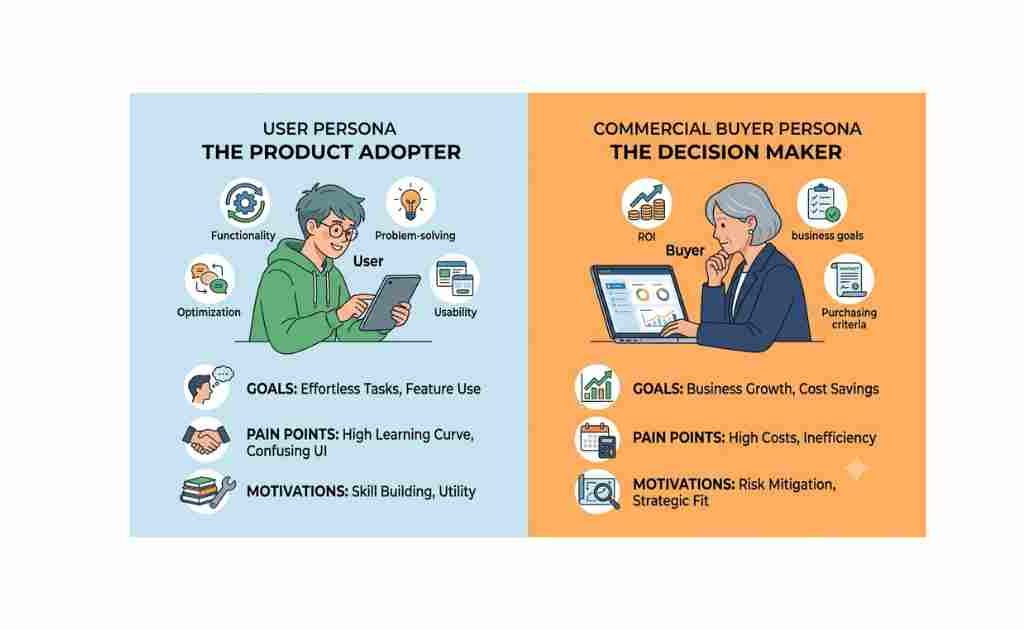
SaaS Buyer Persona Development companies often confuse the person using the software with the person purchasing it. This confusion creates misaligned messaging, wasted ad spend, and frustrated sales teams. A marketing manager might evaluate ten project management tools, demo three, and recommend one. The CFO reviews the recommendation, checks the budget, evaluates the ROI projection, and signs the purchase order. These are two different personas requiring two different approaches.
User Persona Characteristics:
- Focuses on daily workflows and task completion
- Prioritizes user experience, interface design, and feature functionality
- Measures success through adoption rates and productivity gains
- Engages with product tutorials, feature announcements, and user communities
- Typically operates at individual contributor or middle management levels
Commercial Buyer Persona Characteristics:
- Evaluates total cost of ownership and ROI timelines
- Assesses risk, compliance requirements, and vendor stability
- Requires business case justification and executive approval
- Engages with case studies, ROI calculators, and security documentation
- Holds budget authority or influences budget allocation decisions
The commercial buyer persona framework recognizes that B2B SaaS purchases involve multiple stakeholders. Gartner research shows that an average B2B buying group includes six to ten decision-makers, each with different priorities and concerns. Your persona development must account for this complexity.
Consider a CRM platform purchase. The sales representative wants intuitive contact management and mobile access. The sales manager needs pipeline visibility and forecasting accuracy. The VP of Sales requires territory management and quota tracking. The IT director evaluates data security and integration capabilities. The finance manager analyzes subscription costs against revenue projections. Each role represents a distinct commercial persona requiring tailored messaging and proof points.
Commercial buyer personas answer different questions than user personas:
- What business outcome justifies this investment?
- What happens if we don’t solve this problem?
- How does this compare to alternative solutions?
- What risks come with implementation?
- How quickly will we see measurable results?
- Who else needs to approve this decision?
When you develop personas addressing these commercial concerns, your content resonates with economic buyers. Your sales conversations shift from feature demonstrations to business outcome discussions. Your pricing pages speak to ROI, not just functionality.
The 5-Step Framework for Commercial Persona Development
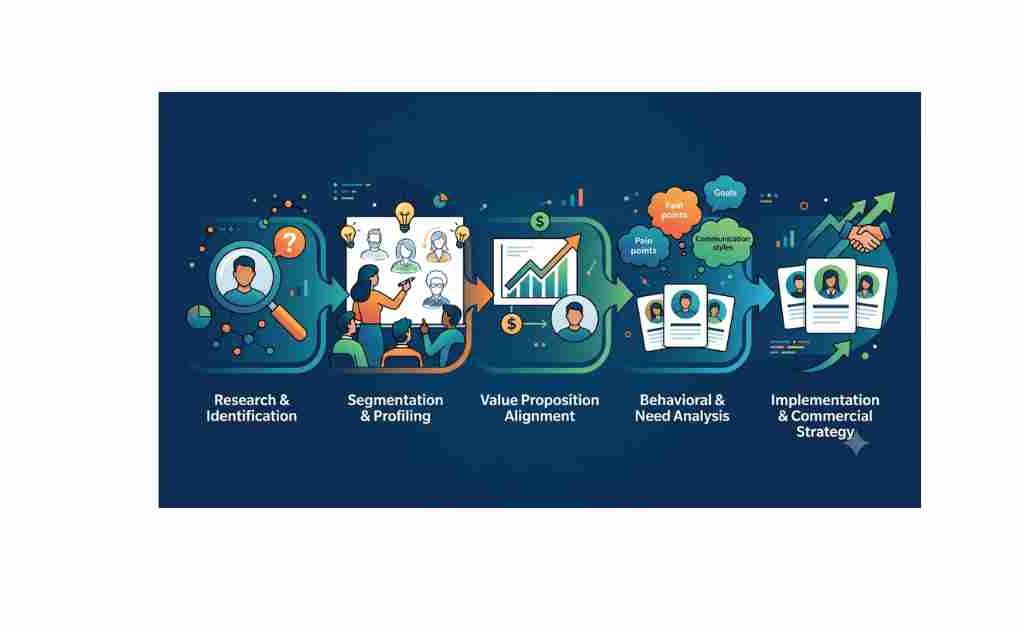
Building commercial buyer personas requires systematic data collection, strategic analysis, and cross-functional collaboration. This five-step framework transforms raw customer data into actionable intelligence that drives revenue growth.
Step 1: Mine Your CRM and Sales Conversation Data
Your existing customers contain the blueprint for your ideal buyer personas. Before conducting new research, extract insights from data you already possess. This approach grounds your personas in reality rather than assumptions.
Data Sources to Analyze:
CRM Records: Export closed-won and closed-lost opportunities from the past 12-18 months. Segment by deal size, sales cycle length, and product tier. Look for patterns in job titles, company size, industry vertical, and geographic location. Identify which characteristics correlate with faster sales cycles and higher win rates.
Sales Call Recordings: Use conversation intelligence platforms like Gong, Chorus, or Avoma to analyze discovery calls and demo sessions. Search for recurring questions, objections, and buying signals. Note which stakeholders participate in calls at different stages. Track which topics dominate conversations with economic buyers versus end users.
Email Communications: Review email threads between sales reps and prospects. Identify which content gets forwarded internally, which questions require multiple stakeholders to answer, and which objections appear repeatedly.
Support Tickets: Analyze pre-sales technical questions and post-sales implementation challenges. These reveal concerns that influence purchasing decisions and adoption success.
Win/Loss Analysis: Conduct structured interviews with prospects who chose competitors or decided not to purchase. Ask why they evaluated your solution, what criteria mattered most, who participated in the decision, and why they selected an alternative.
Quantitative Metrics to Track:
- Average deal size by job title of economic buyer
- Sales cycle length by company size and industry
- Win rate by source channel and persona type
- Product tier adoption by department and use case
- Churn rate by buyer persona and implementation success
Create a spreadsheet documenting these patterns. Look for clusters of characteristics that define your most profitable, easiest-to-close, and longest-retaining customers. These clusters form the foundation of your commercial buyer personas.
Step 2: Map the Buying Committee Structure
B2B SaaS purchases rarely involve a single decision-maker. Understanding the buying committee structure helps you develop personas for each role and create content addressing their specific concerns.
The Four Essential Buying Committee Roles:
The Champion: This person experiences the problem daily and advocates for your solution internally. They research options, request demos, and build the business case. Champions typically hold individual contributor or manager-level positions. They care about features, ease of use, and solving immediate pain points.
The Economic Buyer: This role controls the budget and evaluates financial justification. Economic buyers include CFOs, finance directors, or department heads with P&L responsibility. They focus on ROI, total cost of ownership, budget cycles, and opportunity cost.
The Technical Buyer: IT directors, security officers, and systems architects evaluate technical feasibility. They assess integration requirements, data security, compliance standards, scalability, and implementation complexity. Technical buyers can approve or veto purchases regardless of business value.
The Blocker: Not every stakeholder supports your solution. Blockers might include users comfortable with legacy systems, teams concerned about change management, or executives with competing priorities. Understanding potential blockers helps you anticipate objections and develop mitigation strategies.
Mapping Exercise:
For your top three customer segments, document:
- Typical job titles for each buying committee role
- Department and reporting structure
- Decision-making authority level
- Influence on other stakeholders
- Primary success metrics and KPIs
- Key concerns and risk factors
- Preferred communication channels and content formats
Create visual diagrams showing how these roles interact during the evaluation process. Note which stakeholders engage at each stage: awareness, consideration, evaluation, decision, and implementation.
Step 3: Conduct Strategic Commercial Interviews
Quantitative data reveals patterns, but qualitative research uncovers motivations. Strategic interviews with existing customers and recent prospects provide depth and nuance that analytics cannot capture.
Who to Interview:
- Recent customers (closed in last 90 days)
- Customers who expanded their contracts
- Customers who churned within 12 months
- Prospects who evaluated but didn’t purchase
- Champions who successfully built internal business cases
- Economic buyers who approved purchases
Interview Structure:
Opening Context (5 minutes): Explain the purpose, assure confidentiality, and set expectations for a 30-45 minute conversation.
Problem Identification (10 minutes):
- What business challenge prompted you to search for a solution?
- How did this problem impact your team or organization?
- What happened when you tried to solve this before?
- What triggered the decision to act now versus six months ago?
Evaluation Process (10 minutes):
- Who else participated in evaluating solutions?
- What criteria mattered most in your decision?
- Which competitors or alternatives did you consider?
- What information helped you compare options?
- How did you build consensus among stakeholders?
Decision Factors (10 minutes):
- What ultimately convinced you to choose this solution?
- What concerns or objections did you need to overcome?
- How did you justify the investment?
- What would have prevented you from moving forward?
- How did the buying process differ from your expectations?
Post-Purchase Reflection (5 minutes):
- Has the solution delivered expected outcomes?
- What surprised you after implementation?
- What advice would you give someone evaluating similar solutions?
Recording and Analysis:
With permission, record interviews for accurate transcription. Use AI-powered tools to identify themes, sentiment, and frequently mentioned phrases. Create a spreadsheet tracking responses by persona type, company size, and industry.
Look for patterns in:
- Trigger events that initiate searches
- Evaluation criteria and weighting
- Objections requiring resolution
- Content that influenced decisions
- Stakeholders involved at each stage
- Timeline from awareness to purchase
Step 4: Define Trigger Events and Buying Signals
Commercial buyer personas include more than demographics and firmographics. Understanding trigger events—the specific circumstances that prompt a purchase evaluation—helps you identify prospects at the right moment with the right message.
Common SaaS Trigger Events:
Organizational Changes:
- New leadership hires (new CMO, CTO, VP of Sales)
- Department restructuring or expansion
- Merger, acquisition, or IPO preparation
- Geographic expansion or office openings
- Significant funding rounds (Series A, B, C)
Performance Pressures:
- Missing revenue or growth targets
- Increasing customer churn rates
- Declining productivity metrics
- Rising operational costs
- Compliance audit failures
Technology Shifts:
- Legacy system sunsetting or end-of-life
- Security breaches or compliance violations
- Integration requirements from new tools
- Scalability limitations with current stack
- Digital transformation initiatives
Market Dynamics:
- New competitive threats
- Regulatory changes requiring new capabilities
- Customer demand for new features or services
- Industry best practice evolution
Buying Signals to Monitor:
Intent data reveals when organizations actively research solutions. Track:
- Website visits to pricing, features, and comparison pages
- Content downloads (ROI calculators, security documentation, case studies)
- Third-party review site activity (G2, Capterra, TrustRadius)
- Job postings for roles requiring your solution
- Technology stack changes detected through tools like BuiltWith
Combine trigger events with buying signals to prioritize accounts and personalize outreach. A company that just raised Series B funding and is hiring five sales representatives represents a different opportunity than a company experiencing high customer churn.
Step 5: Map Personas to Pricing Tiers and Product Packages
Not all buyer personas purchase the same product tier. Your commercial persona development must account for this variation. The economic buyer evaluating an enterprise contract differs from the manager purchasing a team license.
Analysis Framework:
Review your customer base segmented by:
- Product tier (Free, Starter, Professional, Enterprise)
- Contract value (ACV)
- Department or use case
- Company size and maturity
Identify patterns in:
- Which personas typically initiate trials versus request enterprise demos?
- What triggers upgrades from one tier to the next?
- Which stakeholders must approve enterprise purchases versus team licenses?
- How do evaluation criteria differ by price point?
Persona-Pricing Alignment:
Create a matrix showing:
- Self-Service Buyers: Typically individual contributors or managers purchasing team licenses under $10K annually. They prioritize ease of setup, transparent pricing, and quick time-to-value. Content needs: product tours, pricing pages, self-service documentation.
- Sales-Assisted Buyers: Department heads or directors evaluating mid-market solutions ($10K-$50K annually). They require demos, business case support, and stakeholder alignment. Content needs: case studies, ROI calculators, demo environments, implementation guides.
- Enterprise Buyers: C-level executives and procurement teams evaluating six-figure contracts. They demand security reviews, custom integrations, SLA negotiations, and executive sponsorship. Content needs: security documentation, custom proposals, executive briefings, reference calls.
This mapping ensures your content, sales process, and product packaging align with how different personas actually buy.
Anatomy of a High-Converting SaaS Commercial Persona
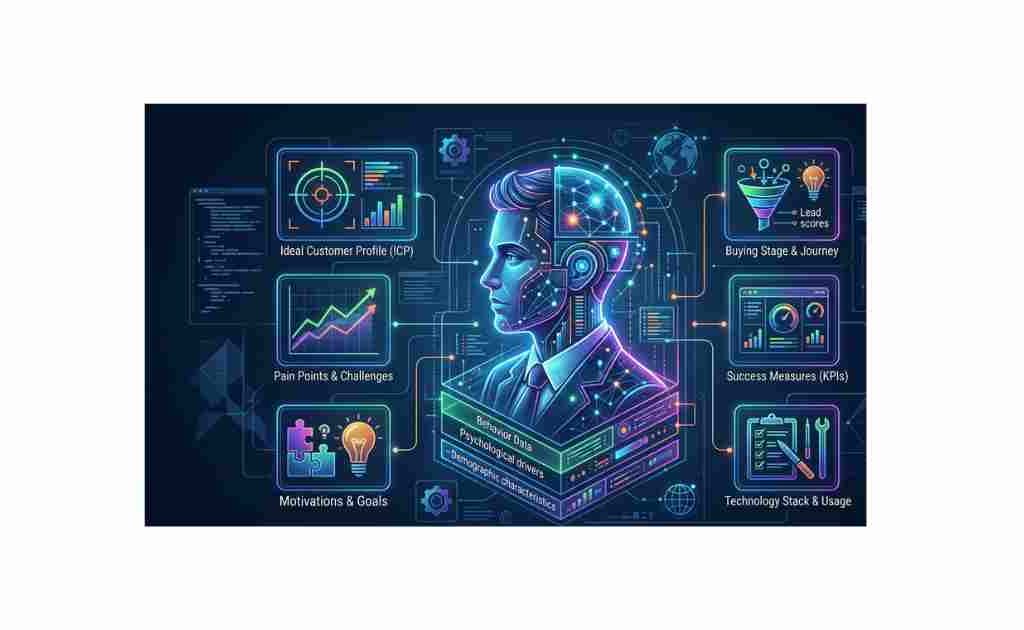
A commercial buyer persona template must capture more than job title and industry. It needs to document the complete decision-making context, including business objectives, success metrics, buying process, and content preferences.
Commercial Persona Template:
1. Persona Identity
- Name and Title (e.g., “CFO Caroline” or “IT Director Ian”)
- Department and Reporting Structure
- Company Size and Stage (startup, growth, enterprise)
- Geographic Location and Time Zone
2. Business Context
- Primary Responsibilities and Accountabilities
- Key Performance Indicators (KPIs) They Own
- Strategic Initiatives for Current Fiscal Year
- Budget Size and Allocation Authority
- Reporting Requirements to Executive Team or Board
3. Problem Awareness
- Symptoms That Signal the Problem Exists
- Business Impact of Not Solving the Problem
- Current Workarounds or Legacy Solutions
- Trigger Events That Prompt Evaluation
- Awareness Level: Do they know the problem exists?
4. Solution Evaluation
- Must-Have Requirements (non-negotiable)
- Nice-to-Have Features (differentiators)
- Evaluation Criteria and Weighting
- Competitors or Alternatives They Consider
- Information Sources They Trust (analyst reports, peer reviews, case studies)
5. Buying Process
- Typical Buying Committee Composition
- Decision-Making Timeline (weeks, months, quarters)
- Budget Cycle and Approval Process
- Procurement and Legal Requirements
- Implementation Constraints (resources, timeline, change management)
6. Objections and Risks
- Common Concerns (cost, complexity, security, adoption)
- Perceived Risks (vendor stability, implementation failure, user resistance)
- Competitive Disadvantages They Might Cite
- Internal Politics or Competing Priorities
7. Success Metrics
- How They Define ROI
- Time-to-Value Expectations
- Adoption and Utilization Targets
- Business Outcomes They Must Demonstrate
- Reporting and Analytics Requirements
8. Content and Communication Preferences
- Preferred Channels (email, phone, LinkedIn, events)
- Content Formats (whitepapers, webinars, demos, case studies)
- Messaging Tone (technical, business-focused, executive summary)
- Best Times to Engage
- Influencers They Trust (analysts, peers, internal champions)
9. Sales Engagement Strategy
- Discovery Questions That Uncover Pain
- Proof Points That Build Credibility
- Objection Handling Scripts
- Stakeholder Mapping Questions
- Next-Step Recommendations
This template creates a comprehensive profile that sales, marketing, and product teams can activate immediately.
Real-World Examples of SaaS Commercial Buyer Personas

Abstract frameworks become useful when applied to specific scenarios. These three examples demonstrate how commercial buyer personas differ across roles and how to tailor your approach for each.
Example 1: The Economic Buyer – CFO Patricia
Profile:
- Title: Chief Financial Officer or VP of Finance
- Company: Mid-market B2B SaaS company, 200-500 employees
- Budget Authority: $50K-$500K annually for software investments
Business Context:
Patricia manages cash flow, forecasts revenue, and controls operational expenses. She reports to the CEO and board, presenting monthly financial reviews and annual budget planning. Her KPIs include gross margin, operating expenses as a percentage of revenue, and cash runway.
Problem Awareness:
The sales team requests a new sales enablement platform costing $150K annually. Patricia sees the current tech stack includes three overlapping tools with low adoption. She questions whether another subscription delivers measurable ROI or just adds complexity.
Evaluation Criteria:
- Total cost of ownership (subscription, implementation, training, support)
- Payback period and ROI projection
- Impact on existing software spend (can we cancel redundant tools?)
- Vendor financial stability and longevity
- Contract flexibility (annual vs. multi-year, cancellation terms)
Buying Process:
Patricia requires a formal business case with three-year financial projections. She consults with the CFO peer network, reviews analyst reports from Gartner or Forrester, and demands references from similar companies. Procurement negotiates terms, and legal reviews the contract. Timeline: 60-90 days.
Objections:
- “We’ve invested in similar tools before with poor adoption”
- “Can’t we build this internally or use our existing stack?”
- “The ROI projection seems optimistic”
- “What happens if we need to cancel after year one?”
Content That Converts:
- ROI calculator with customizable inputs
- Case studies showing payback period and measurable outcomes
- Total cost of ownership comparison versus alternatives
- Security and compliance documentation
- Executive briefing deck for board presentations
Sales Approach:
Lead with business outcomes, not features. Provide detailed financial models. Offer pilot programs with success metrics. Connect Patricia with peer CFOs who’ve made similar investments.
Example 2: The Technical Buyer – IT Director Ian
Profile:
- Title: IT Director, VP of Engineering, or CISO
- Company: Enterprise organization, 1000+ employees
- Budget Authority: Influences technical decisions, approves architecture
Business Context:
Ian manages technology infrastructure, ensures security compliance, and evaluates integration complexity. He reports to the CTO or CIO and collaborates with department heads on technology selections. His KPIs include system uptime, security incident frequency, and integration success rates.
Problem Awareness:
The marketing department wants to purchase a marketing automation platform. Ian receives the security questionnaire and integration requirements. He evaluates whether the platform meets SOC 2 Type II compliance, supports SSO, and integrates with existing CRM and analytics tools.
Evaluation Criteria:
- Security certifications (SOC 2, ISO 27001, GDPR compliance)
- Data encryption (at rest and in transit)
- Single sign-on (SSO) and identity management
- API documentation and integration capabilities
- Scalability and performance benchmarks
- Disaster recovery and business continuity plans
- Vendor security incident history
Buying Process:
Ian conducts technical due diligence, reviews architecture diagrams, and requests penetration test results. He involves the security team, infrastructure team, and legal counsel. He creates a technical evaluation scorecard comparing vendors. Timeline: 45-60 days.
Objections:
- “The platform doesn’t support our SSO provider”
- “Data residency requirements aren’t met”
- “API rate limits are too restrictive”
- “No dedicated instance option for enterprise”
- “Insufficient audit logging capabilities”
Content That Converts:
- Security whitepaper and compliance certifications
- Architecture diagrams and data flow documentation
- API documentation and integration guides
- SLA guarantees and uptime history
- Technical reference calls with similar companies
- Proof of concept environment for testing
Sales Approach:
Provide technical documentation upfront. Schedule architecture review sessions. Offer proof of concept with success criteria. Connect Ian with your solutions engineering team.
Example 3: The Champion – Marketing Manager Michelle
Profile:
- Title: Marketing Manager or Director of Demand Generation
- Company: Growth-stage SaaS company, 100-300 employees
- Budget Authority: Recommends purchases, influences budget allocation
Business Context:
Michelle manages lead generation campaigns, marketing automation, and content strategy. She reports to the VP of Marketing and collaborates with sales on lead quality. Her KPIs include marketing qualified leads (MQLs), conversion rates, and campaign ROI.
Problem Awareness:
Michelle struggles with manual processes, disconnected tools, and limited visibility into campaign performance. She researches marketing automation platforms, attends webinars, and requests demos. She builds the business case and advocates for purchase internally.
Evaluation Criteria:
- Ease of use and learning curve
- Campaign management capabilities
- Lead scoring and segmentation
- Integration with existing CRM
- Reporting and analytics dashboards
- Customer support and training resources
- Pricing and contract terms
Buying Process:
Michelle identifies needs, researches solutions, requests demos, and compares options. She builds a business case showing projected impact on MQLs and conversion rates. She presents recommendations to the VP of Marketing and finance. She coordinates with IT on technical requirements. Timeline: 30-45 days.
Objections:
- “Implementation will take too long”
- “The team won’t adopt a new tool”
- “We can’t afford it this quarter”
- “Our current process works well enough”
Content That Converts:
- Product demos and free trials
- Customer success stories from similar companies
- Implementation timeline and onboarding plan
- Training resources and certification programs
- ROI calculator showing impact on MQLs and revenue
- Comparison guides versus competitors
Sales Approach:
Empower Michelle with business case templates. Provide executive briefing materials for her VP. Offer implementation support and training. Connect her with peer marketing managers for reference calls.
Activating Commercial Personas for Go-to-Market Success
Developing personas creates value only when teams activate them. This section explains how to integrate commercial buyer personas into sales playbooks, marketing campaigns, and product development.
Sales Team Activation
Discovery Call Scripts:
Create persona-specific question frameworks. When speaking with CFO Patricia, ask about budget cycles, ROI expectations, and approval processes. When speaking with IT Director Ian, ask about security requirements, integration needs, and technical constraints.
Demo Customization:
Train sales engineers to tailor demonstrations based on persona. Show CFOs financial dashboards and ROI projections. Show IT Directors security features and integration capabilities. Show Champions workflow automation and ease of use.
Objection Handling Playbooks:
Document common objections by persona and provide response frameworks. When Patricia objects to cost, present ROI calculations and case studies. When Ian objects to security, provide compliance documentation and architecture reviews.
Stakeholder Mapping:
Equip sales reps with questions to identify buying committee members: “Who else will be involved in this decision?” “What does your approval process look like?” “Who controls the budget for this type of investment?”
Marketing Team Activation
Content Calendar Alignment:
Map content creation to persona needs and buying stages. Create awareness-stage content (blog posts, infographics) addressing trigger events. Develop consideration-stage content (comparison guides, webinars) helping personas evaluate options. Produce decision-stage content (case studies, ROI calculators) supporting final selection.
Account-Based Marketing (ABM):
Use persona data to identify target accounts. When a company experiences a trigger event (new funding, leadership hire), launch persona-specific campaigns. Send CFOs financial impact content. Send IT Directors technical documentation. Send Champions product tutorials.
Advertising and Retargeting:
Segment ad campaigns by persona. LinkedIn ads targeting CFOs should emphasize ROI and business outcomes. Ads targeting IT Directors should highlight security and compliance. Use website behavior to identify persona type and serve personalized content.
Email Nurture Sequences:
Create persona-specific email workflows. CFO sequences focus on business case development and financial justification. IT Director sequences provide technical resources and security information. Champion sequences offer implementation guidance and adoption strategies.
Product Team Activation
Feature Prioritization:
Use persona insights to inform product roadmap. If economic buyers consistently request usage analytics for budget justification, prioritize reporting features. If technical buyers demand SSO integration, make authentication a priority.
User Experience Design:
Design onboarding flows that address persona concerns. CFOs need to see value realization metrics quickly. IT Directors need configuration options and security settings. Champions need intuitive interfaces and quick wins.
Pricing and Packaging:
Align pricing tiers with persona purchasing authority. Self-service tiers should enable Champions to purchase without approval. Enterprise tiers should provide the security, compliance, and support that IT Directors and CFOs require.
Tools and Technology for Persona Development and Activation
Modern SaaS companies leverage technology to make persona development more efficient and activation more effective.
Conversation Intelligence:
Platforms like Gong, Chorus, and Avoma record and analyze sales calls. Use AI to identify patterns in questions, objections, and buying signals by persona type.
Intent Data:
Tools like 6sense, Bombora, and G2 Intent reveal when companies actively research solutions. Combine intent data with persona profiles to prioritize accounts and personalize outreach.
CRM and Marketing Automation:
Salesforce, HubSpot, and Marketo enable persona-based segmentation. Tag contacts by persona type and create automated workflows delivering persona-specific content.
Account-Based Marketing Platforms:
Demandbase, Terminus, and RollWorks help identify target accounts, engage buying committees, and measure account engagement across personas.
Customer Data Platforms:
Segment, mParticle, and RudderStack unify customer data from multiple sources, creating comprehensive persona profiles based on actual behavior.
AI and Machine Learning:
Use AI to analyze customer data, predict which personas convert best, and recommend personalized content and next-best-actions for sales reps.
Measuring Persona Effectiveness
Persona development requires ongoing measurement and refinement. Track these metrics to evaluate impact:
Sales Metrics:
- Win rate by persona type
- Sales cycle length by persona
- Average deal size by persona
- Pipeline velocity by persona
Marketing Metrics:
- Content engagement by persona
- Conversion rates by persona
- Cost per acquisition by persona
- Lead quality scores by persona
Product Metrics:
- Feature adoption by persona
- Time-to-value by persona
- Customer satisfaction (NPS/CSAT) by persona
- Churn rate by persona
Review these metrics quarterly. Update personas based on new data, changing market conditions, and evolving customer needs.
Conclusion
Commercial buyer persona development separates high-growth SaaS companies from those struggling with long sales cycles and low win rates. Understanding the difference between users and economic buyers, mapping buying committees, and activating personas across go-to-market functions creates measurable revenue impact.
Start with data you already possess. Analyze closed-won and closed-lost deals. Interview recent customers and lost prospects. Map buying committees for your top three customer segments. Create detailed persona profiles including business context, evaluation criteria, trigger events, and content preferences.
Activate personas through sales playbooks, marketing campaigns, and product decisions. Measure effectiveness through win rates, sales cycle length, and customer satisfaction. Refine personas quarterly based on new insights.
The companies winning in competitive SaaS markets don’t guess who their buyers are. They develop deep, data-driven understanding of commercial buyer personas and align their entire organization around serving those personas effectively.
Your next step: Schedule interviews with five recent customers and five lost prospects this month. Ask about their buying process, decision criteria, and stakeholder involvement. Document patterns. Build your first commercial buyer persona. Share it with sales, marketing, and product teams. Measure the impact on pipeline velocity and win rates.
Commercial buyer persona development isn’t a one-time project. It’s an ongoing discipline that keeps your go-to-market strategy aligned with how customers actually buy. Start today.