
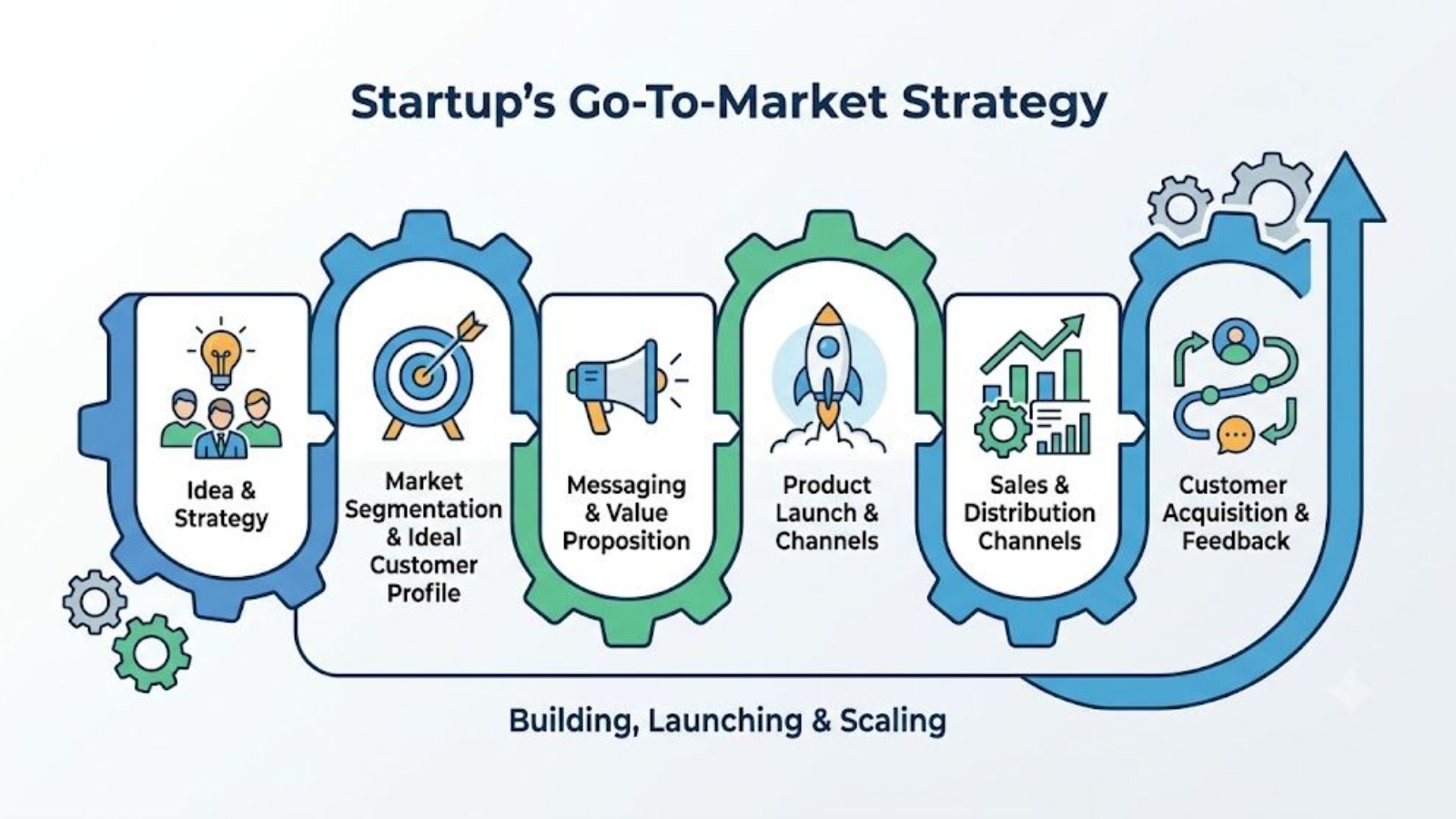
A startup can have a strong product, talented founders, and an attractive price—and still struggle to acquire customers. The problem is often not the product itself. It is the absence of a clear path connecting the right customer to the right solution through the right channel at the right time.
That path is the foundation of a go-to-market (GTM) strategy.
A GTM strategy for startups defines who you want to serve, which problem you solve, how you position your product, how customers discover and evaluate it, how they buy, and which metrics determine whether your approach is working.
For early-stage companies, GTM is more than a launch plan. It is a system for testing assumptions, finding product-market fit, acquiring early customers, learning from them, and building a repeatable growth engine.
This guide explains how to create a startup GTM strategy from the ground up, including customer research, ICP development, positioning, GTM motions, acquisition channels, pricing, launch planning, metrics, a 90-day execution framework, common mistakes, and practical examples.
What Is a GTM Strategy for Startups?
A GTM strategy for startups is a structured plan for bringing a product or service to a specific market and turning potential customers into paying customers.
It answers six fundamental questions:
- Who is the ideal customer?
- What problem does the startup solve?
- Why is the solution better or different from alternatives?
- Where can potential customers be reached?
- How will they evaluate and purchase the product?
- Which metrics will show whether the strategy is succeeding?
A startup go-to-market strategy usually connects product, marketing, sales, pricing, customer success, and distribution.
Unlike a simple product launch plan, GTM does not end when the product becomes available. It covers the complete journey from identifying a target market to generating demand, converting customers, onboarding them, retaining them, and eventually scaling the acquisition model.
Simple Definition
A startup GTM strategy is a plan that determines how a startup will identify its target customers, communicate its value, reach those customers, convert them into buyers, and create a repeatable path to growth.
The emphasis on “repeatable” matters.
Getting 10 customers through personal contacts is useful. Building a process that can consistently generate qualified customers is much more valuable.
GTM Strategy vs. Marketing Strategy vs. Product Launch
These terms are often used interchangeably, but they have different purposes.
| Strategy | Primary Purpose | Main Question |
|---|---|---|
| GTM Strategy | Bring an offering to a market and create a repeatable commercial path | How will we win customers? |
| Marketing Strategy | Generate awareness, demand, and engagement | How will we attract and influence prospects? |
| Product Launch | Introduce a product or major feature | How will we create initial attention and adoption? |
| Growth Strategy | Increase acquisition, retention, and revenue over time | How will we scale? |
A product launch is therefore only one part of a broader GTM strategy.
A startup might launch successfully and still have a weak GTM strategy if it cannot consistently acquire, convert, and retain customers afterward.
Why Is a GTM Strategy Important for Startups?
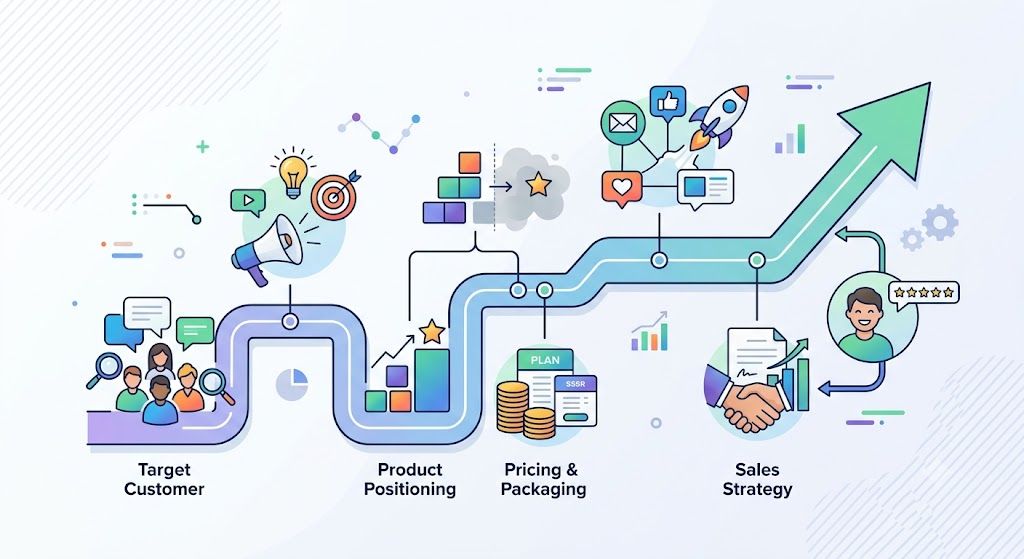
Startups operate under constraints that make inefficient customer acquisition particularly expensive.
They often have:
- Limited budgets
- Small teams
- Limited brand recognition
- Incomplete customer data
- Unproven positioning
- Uncertain product-market fit
- Limited sales capacity
- Shorter financial runways
A GTM strategy helps concentrate limited resources on the opportunities most likely to produce meaningful results.
Instead of asking:
“How can we promote our startup everywhere?”
the better question is:
“Where does our ideal customer already spend time, what problem motivates them to act, and what is the most efficient way to help them choose us?”
That shift can dramatically improve decision-making.
The Core Principle: Validate Before You Scale
Early-stage startups should generally avoid treating assumptions as facts.
You may believe:
- Your target audience is correct.
- Customers urgently need the product.
- Your pricing is attractive.
- Your preferred marketing channel will work.
- Customers understand your positioning.
- Your onboarding experience is sufficient.
A GTM strategy turns these assumptions into testable hypotheses.
The process becomes:
Hypothesis → Test → Evidence → Learning → Adjustment → Repeat
This is why an effective startup GTM strategy should be treated as a learning system rather than a static document.
When Should a Startup Build a GTM Strategy?

A startup does not need to wait until the product is completely finished.
The GTM process can begin before launch.
Pre-Launch Stage
At this stage, focus on:
- Market research
- Customer interviews
- Problem validation
- Competitor analysis
- Initial ICP definition
- Positioning
- Waitlist creation
- Early demand testing
The objective is to discover whether a meaningful problem exists and whether a specific group of people cares enough to solve it.
MVP Stage
Once an MVP exists, the focus shifts toward real-world learning.
Prioritize:
- Early adopters
- Customer feedback
- Product usage
- Activation
- Initial conversions
- Objection discovery
- Pricing experiments
The goal is not maximum reach. It is useful evidence.
First 10 Customers
Founder-led selling can be extremely valuable at this stage.
Founders can personally:
- Identify prospects
- Conduct demos
- Handle objections
- Close customers
- Onboard users
- Gather feedback
These conversations often reveal information that analytics alone cannot provide.
First 100 Customers
Once early demand becomes clearer, startups can begin identifying repeatable channels.
Test:
- Content
- SEO
- Outbound
- Partnerships
- Communities
- Paid acquisition
- Referral programs
- Product-led acquisition
The goal is to discover which channels can produce customers consistently.
Post-Product-Market-Fit Stage
After finding evidence of product-market fit, the GTM strategy can become more scalable.
Focus shifts toward:
- Channel optimization
- Sales specialization
- Marketing automation
- Retention
- Customer expansion
- Brand development
- Partnerships
- International or segment expansion
The 10-Step GTM Strategy for Startups

A practical startup GTM framework can be organized into ten steps:
Market → ICP → Validation → Positioning → GTM Motion → Channels → Pricing → Launch → Conversion → Measurement
Let’s examine each one.
Step 1: Define Your Beachhead Market

One of the most common startup mistakes is trying to target everyone.
A product may theoretically serve thousands of customer types, but an early-stage startup usually benefits from choosing a narrower beachhead market.
A beachhead market is the initial segment where you have a strong opportunity to gain traction.
For example, instead of:
“Our software is for businesses.”
you could define:
“Our software helps independent digital agencies with 10–50 employees manage client projects and deadlines.”
The second statement gives the startup a much clearer direction.
How to Evaluate a Beachhead Market
Consider:
Problem Severity
Is the problem inconvenient, expensive, risky, or urgent?
Ability to Pay
Does the target customer have the financial capacity to purchase the solution?
Accessibility
Can you reach these customers through identifiable channels?
Market Size
Is the segment large enough to support your growth objectives?
Competition
Are competitors already serving the market?
Competition isn’t necessarily a reason to leave. It can indicate that customers already recognize the problem.
Founder Advantage
Do you have expertise, relationships, distribution, technology, or insight that gives you an advantage?
A useful rule is:
Start narrow enough to become relevant, then expand after you prove the model.
Step 2: Build Your Ideal Customer Profile
Your Ideal Customer Profile (ICP) describes the customer most likely to receive significant value from your offering and become a successful customer.
For B2B startups, an ICP might include:
- Industry
- Company size
- Revenue range
- Location
- Technology stack
- Business model
- Decision-maker
- Buying authority
- Pain points
- Budget
- Growth stage
- Buying triggers
For B2C startups, consider:
- Age
- Location
- Income range
- Interests
- Behaviors
- Needs
- Purchase frequency
- Lifestyle
- Buying triggers
- Preferred channels
ICP Template
Use this structure:
Target customer:
Who are they?
Problem:
What frustrating or expensive problem do they experience?
Trigger:
What causes them to search for a solution?
Desired outcome:
What result do they want?
Current alternative:
How are they solving the problem today?
Objections:
Why might they hesitate to buy?
Buying behavior:
How do they research and purchase?
The more specific your ICP becomes, the easier it becomes to develop relevant messaging and channel strategies.
Step 3: Validate the Problem Before Scaling
A startup should not assume that a large market automatically means strong demand.
Before investing heavily in advertising, sales teams, or content production, validate the problem.
Customer Interviews
Talk directly to potential customers.
Ask questions such as:
- How do you currently solve this problem?
- What is frustrating about your current approach?
- How often does the problem occur?
- What does it cost you?
- What have you already tried?
- Why didn’t those alternatives work?
- Who decides whether to purchase a solution?
- What would make you switch?
Avoid asking only:
“Would you buy this product?”
People often express positive opinions without actually purchasing.
Behavioral evidence is usually more useful.
Other Validation Methods
You can test demand through:
- Landing pages
- Waitlists
- Pre-orders
- Paid pilots
- Concierge services
- Prototypes
- Demo requests
- Search behavior
- Community discussions
- Small paid campaigns
The objective is to find evidence that the problem is real and commercially meaningful.
Step 4: Create Your Positioning and Value Proposition
Positioning explains how you want your target audience to perceive your product compared with alternatives.
It should answer:
Who is this for?
What problem does it solve?
What outcome does it create?
Why should customers choose it?
What makes it different?
Your positioning is not simply a slogan.
A slogan can be memorable, but positioning provides the strategic foundation behind your messaging.
Value Proposition Formula
A practical formula is:
For [target customer] who [specific problem], [product] is a [category] that helps them [desired outcome] because [key differentiator].
For example:
For small marketing agencies struggling with scattered client workflows, Product X is a project management platform that centralizes tasks, deadlines, and approvals so teams can deliver client work with fewer delays.
This is more informative than:
“The future of productivity.”
Focus on Outcomes
Customers usually care less about a feature than the result produced by that feature.
Instead of:
“Automated reporting dashboard”
communicate:
“Generate client performance reports in minutes instead of building them manually every week.”
Features explain the product.
Outcomes explain the value.
Step 5: Choose the Right GTM Motion
Your GTM motion determines how customers move from awareness to purchase.
The most common startup GTM motions include:
Product-Led Growth
Customers discover, try, and often purchase through the product itself.
Best suited to:
- SaaS
- Self-service products
- Low-friction tools
- Freemium products
- Products with simple onboarding
The product experience becomes a major part of the sales process.
Sales-Led GTM
A sales team or founder guides prospects through evaluation and purchase.
Often appropriate for:
- Enterprise software
- High-ticket services
- Complex products
- Large contracts
- Products requiring customization
Marketing-Led GTM
Content, SEO, social media, email, advertising, and other marketing activities generate demand.
This can work well when customers actively search for information or solutions.
Community-Led GTM
The startup builds trust and demand through communities, professional groups, events, or user networks.
This can be particularly effective in specialized markets.
Partner-Led GTM
Partners, agencies, distributors, affiliates, integrations, or complementary businesses help reach customers.
This can provide distribution without requiring the startup to build every acquisition channel internally.
Hybrid GTM
Some startups combine multiple motions.
For example:
Free product → self-service signup → automated onboarding → sales outreach for high-intent accounts
The right GTM motion depends on your customer, product complexity, price, sales cycle, and buying behavior.
Step 6: Select Your First Customer Acquisition Channels
There is no universal “best marketing channel for startups.”
The right channel is the one where your ICP is reachable and where your startup can develop an economic advantage.
Potential channels include:
- SEO
- Content marketing
- Founder-led sales
- Cold email
- Social media
- Communities
- Partnerships
- Referral marketing
- Influencer marketing
- Paid search
- Paid social
- Events
- Webinars
- Marketplaces
- Affiliate programs
Don’t Launch Ten Channels at Once
A startup with limited resources should generally prioritize a small number of channels.
A useful starting principle is:
One primary channel + one supporting channel.
For example:
B2B SaaS: Founder-led outbound + LinkedIn content
Local startup: Google Search/Maps + Instagram
Consumer product: Short-form video + creator partnerships
Developer tool: Technical content + developer communities
E-commerce startup: SEO/content + creator marketing
The exact mix should come from customer research rather than assumptions.
Step 7: Build Your Pricing and Offer Strategy
Pricing is not just a financial decision. It influences positioning, conversion, acquisition economics, and customer expectations.
Common startup pricing models include:
Freemium
A free version introduces users to the product, with paid features available for advanced needs.
Free Trial
Customers receive temporary access before purchasing.
Subscription
Customers pay recurring monthly or annual fees.
Usage-Based Pricing
Customers pay according to consumption.
Tiered Pricing
Different packages serve customers with different requirements.
Paid Pilot
The customer pays for a limited implementation before committing to a larger contract.
Test More Than the Price
You can test:
- Packaging
- Trial length
- Features
- Guarantees
- Billing frequency
- Annual discounts
- Onboarding
- Service levels
- Implementation support
Sometimes the issue isn’t that the price is too high. The customer may simply not understand the value.
Step 8: Create a Startup Launch Plan
A launch should not be treated as a single day.
A strong startup launch can be divided into three phases.
30 Days Before Launch
Focus on preparation:
- Define messaging
- Build landing page
- Create waitlist
- Recruit early users
- Prepare demos
- Create launch content
- Build prospect lists
- Contact potential partners
- Prepare email sequences
Launch Week
Coordinate:
- Product announcement
- Founder outreach
- Social posts
- Email campaign
- Product demonstrations
- Community posts
- Partner promotion
- Customer testimonials
- Media outreach where relevant
30 Days After Launch
This period is often more valuable than launch day itself.
Analyze:
- Traffic
- Leads
- Activation
- Conversions
- Customer feedback
- Acquisition sources
- Retention
- Objections
Then improve the parts of the funnel creating the largest bottlenecks.
Step 9: Build the Customer Conversion Journey
A GTM strategy should account for the entire customer journey.
A useful model is:
Awareness → Interest → Evaluation → Trial/Demo → Purchase → Activation → Retention → Referral
Awareness
The customer becomes aware of the problem or your solution.
Potential channels:
- Search
- Social media
- Content
- Communities
- Advertising
- Partnerships
Interest
The customer wants more information.
Useful assets:
- Educational articles
- Videos
- Guides
- Webinars
- Case studies
- Product pages
Evaluation
The prospect compares options.
Help them evaluate through:
- Demos
- Product comparisons
- Reviews
- Testimonials
- ROI calculators
- FAQs
- Detailed product pages
Purchase
Reduce friction with:
- Clear pricing
- Simple signup
- Multiple payment options
- Strong calls to action
- Helpful sales support
Activation
Getting a customer to purchase isn’t enough.
They must reach the product’s initial value quickly.
For example:
Signup → setup → first action → first result
The shorter this path becomes, the stronger the onboarding experience can be.
Retention
Track whether customers continue using the product or service.
Retention is especially important because continuously replacing lost customers can make acquisition economics unsustainable.
Referral
Satisfied customers can become a distribution channel.
Encourage:
- Referrals
- Reviews
- Testimonials
- Case studies
- User-generated content
- Community participation
Step 10: Measure, Learn, and Iterate
A GTM strategy needs measurable feedback.
Important startup GTM metrics include:
Customer Acquisition Cost (CAC)
How much does it cost to acquire a customer?
A simplified formula is:
CAC = Total Sales and Marketing Costs ÷ Number of New Customers
Conversion Rate
How many prospects take the desired action?
Activation Rate
How many new users reach the point where they experience meaningful value?
Customer Lifetime Value (LTV)
How much economic value does an average customer generate during their relationship with the business?
Churn Rate
How quickly are customers leaving?
Retention Rate
How many customers continue using or purchasing your offering?
CAC Payback Period
How long does it take to recover acquisition costs?
Revenue
Ultimately, GTM activities should contribute to sustainable revenue rather than simply increasing traffic or impressions.
Startup GTM Strategy by Business Model
A GTM strategy should change according to the business model.
GTM Strategy for B2B SaaS Startups
B2B SaaS companies often need to define:
- ICP
- Decision-makers
- Buying committee
- Sales cycle
- Product value
- Pricing
- Onboarding
- Retention
Potential channels include:
- Founder-led outbound
- SEO
- Webinars
- Partnerships
- Product-led acquisition
- Industry communities
For high-ticket SaaS, sales may play a much larger role than self-service signup.
GTM Strategy for B2C Startups
B2C startups often need to understand:
- Consumer behavior
- Emotional motivations
- Purchase frequency
- Price sensitivity
- Social proof
- Distribution
- Brand preference
Potential channels include:
- Short-form video
- Influencer marketing
- Social media
- Search
- Referral programs
- Paid advertising
- Creator partnerships
The customer journey should be as frictionless as possible.
GTM Strategy for E-commerce Startups
E-commerce GTM often combines:
- Product positioning
- Visual content
- Search
- Social media
- Creator marketing
- Paid acquisition
- Retargeting
- Reviews
- Referral programs
The key challenge is often balancing customer acquisition costs with repeat purchases and customer lifetime value.
GTM Strategy for Marketplace Startups
Marketplaces have a unique challenge: they often need to build two sides of the market.
For example:
Customers ↔ Providers
The startup must determine which side to develop first and how to create enough activity to make the marketplace useful.
Potential strategies include:
- Geographic concentration
- Niche specialization
- Supply-first acquisition
- Demand-first acquisition
- Manual matching
- Referral incentives
GTM Strategy for AI Startups
AI startups should avoid relying solely on the novelty of the technology.
Instead, focus on:
- Specific customer problem
- Measurable outcome
- Workflow improvement
- Reliability
- Differentiation
- Integration
- Trust
- Data/privacy expectations
- Total cost of ownership
The message should communicate what the customer can accomplish, not merely which technology powers the product.
GTM Strategy by Startup Stage
| Startup Stage | Main Objective | Primary GTM Focus |
|---|---|---|
| Pre-launch | Validate demand | Research + problem validation |
| MVP | Learn | Early adopters + feedback |
| First 10 customers | Prove demand | Founder-led sales |
| First 100 customers | Find repeatability | Channel experiments |
| Product-market fit | Optimize | Conversion + retention |
| Scaling | Expand | Repeatable acquisition |
This is important because a GTM strategy should evolve as the company develops.
A tactic that works for the first 10 customers may not be appropriate for the first 10,000.
How Much Should a Startup Spend on GTM?
There is no universal startup GTM budget.
The appropriate investment depends on:
- Business model
- Customer acquisition cost
- Average contract value
- Sales cycle
- Gross margin
- Customer lifetime value
- Available capital
- Product-market fit
- Channel economics
An early-stage startup should be careful about putting significant money into channels that haven’t been validated.
For example, spending heavily on paid advertising before understanding your ICP, messaging, conversion funnel, and retention can accelerate losses rather than growth.
A better approach is:
Test small → measure → identify evidence → increase investment
A Practical 90-Day GTM Strategy for Startups
A 90-day plan can turn a GTM framework into execution.
Days 1–30: Validate
Week 1
- Define target market
- Identify potential ICP
- Analyze competitors
Week 2
- Conduct customer interviews
- Identify pain points
- Map buying triggers
Week 3
- Develop positioning
- Create value proposition
- Test messaging
Week 4
- Choose initial GTM motion
- Select primary acquisition channel
- Build landing page and sales assets
Primary objective: Learn.
Days 31–60: Acquire
Focus on getting real customers.
Activities may include:
- Founder-led outreach
- Content publishing
- Social distribution
- Partnerships
- Product demos
- Community participation
- Small paid experiments
- Referral outreach
Track:
- Leads
- Qualified opportunities
- Conversion
- Activation
- Customer feedback
Primary objective: Generate evidence of repeatable demand.
Days 61–90: Optimize
Identify what is working.
Ask:
- Which channel generated the best customers?
- Which messages converted?
- Where do prospects drop off?
- Which objections occur repeatedly?
- Which customer segment retains best?
- What is the acquisition cost?
- What can be automated?
Then double down on the strongest opportunities.
Primary objective: Build a repeatable acquisition process.
Startup GTM Strategy Example
Consider a fictional startup called FlowDesk, a project management platform designed for small digital agencies.
Market
Instead of targeting every business, FlowDesk chooses:
Digital agencies with 10–50 employees.
ICP
The primary buyer is:
Agency owner or operations manager
Main problems:
- Missed deadlines
- Scattered communication
- Poor project visibility
- Manual reporting
Positioning
FlowDesk positions itself as a project management platform designed specifically for client-service agencies.
GTM Motion
The startup chooses:
Founder-led sales + content marketing
Why?
The product has enough complexity to benefit from demos, but the target market also searches for project management and agency workflow solutions.
Acquisition
Primary channels:
- Founder outreach
- SEO
- Agency communities
Offer
Instead of immediately pushing annual contracts, FlowDesk offers:
14-day implementation pilot
The pilot reduces perceived risk while giving the startup an opportunity to learn from real customers.
Conversion
The journey becomes:
LinkedIn/content → landing page → demo → pilot → onboarding → paid subscription
Metrics
FlowDesk tracks:
- Qualified leads
- Demo bookings
- Demo-to-pilot conversion
- Pilot-to-paid conversion
- Activation
- Retention
- CAC
- Revenue
This example demonstrates an important principle:
A GTM strategy is a connected system, not a collection of unrelated marketing tactics.
Common GTM Mistakes Startups Should Avoid
1. Targeting Everyone
A broad market sounds attractive but often creates vague messaging.
Start with a segment where the problem is particularly strong.
2. Launching Before Validating Demand
A polished product doesn’t guarantee demand.
Validate the problem and buying behavior before scaling distribution.
3. Copying Competitors
A competitor’s channel may work because of its brand, audience, budget, or existing distribution.
Study competitors, but build your strategy around your own advantages.
4. Choosing Channels Based on Personal Preference
Founders may prefer Instagram, LinkedIn, SEO, or paid advertising.
That preference shouldn’t determine your GTM channel.
Customer behavior should.
5. Using Feature-Heavy Messaging
Features explain what the product does.
Your messaging should also explain why the customer should care.
6. Trying Too Many Channels
A small team spreading itself across ten channels can become ineffective everywhere.
Concentrate resources until you find evidence of traction.
7. Scaling Paid Ads Too Early
Paid acquisition can amplify a working funnel.
It can also amplify a broken one.
Validate the fundamentals first.
8. Ignoring Retention
Acquiring customers who quickly leave can create an expensive growth illusion.
Track retention alongside acquisition.
9. Measuring Vanity Metrics
Traffic, impressions, followers, and clicks can be useful indicators, but they aren’t enough.
Connect marketing activity to qualified leads, customers, revenue, retention, and profitability.
10. Hiring a Large Sales Team Too Early
Founders should often understand the sales process before attempting to scale it.
Otherwise, the company may be trying to hire people to solve a process that hasn’t been proven.
11. Treating GTM as a One-Time Project
Markets change.
Customer behavior changes.
Competitors change.
Your product changes.
Your GTM strategy should evolve accordingly.
12. Failing to Talk to Customers
Analytics can tell you what happened.
Customer conversations can often help explain why it happened.
Both matter.
Startup GTM Strategy Checklist
Use this checklist before launching:
- Target market defined
- Beachhead market selected
- ICP documented
- Customer problem validated
- Competitor alternatives analyzed
- Positioning established
- Value proposition written
- GTM motion selected
- Acquisition channels prioritized
- Pricing model tested
- Launch timeline created
- Sales process documented
- Landing page prepared
- Onboarding process prepared
- Analytics configured
- Core KPIs defined
- Customer feedback system established
- 30-day plan created
- 60-day plan created
- 90-day optimization plan created
Frequently Asked Questions About GTM Strategy for Startups
What is a GTM strategy for a startup?
A GTM strategy for a startup is a plan for identifying the right customers, positioning a product, selecting acquisition channels, converting prospects, and building a repeatable path to revenue.
Why is a GTM strategy important for startups?
A GTM strategy helps startups focus limited time, money, and people on the customers, messages, channels, and sales processes most likely to generate traction.
When should a startup create a GTM strategy?
Startups should begin developing their GTM strategy before launch and continue refining it through MVP development, early customer acquisition, product-market fit, and scaling.
What are the main components of a startup GTM strategy?
The major components include target market, ICP, problem validation, positioning, value proposition, GTM motion, acquisition channels, pricing, launch strategy, customer journey, and performance metrics.
What is the best GTM strategy for an early-stage startup?
There is no single best GTM strategy. Early-stage startups often benefit from a narrow ICP, founder-led customer acquisition, direct customer conversations, focused channel testing, and rapid experimentation.
How many marketing channels should a startup use?
Early-stage startups generally benefit from concentrating on a small number of channels rather than spreading limited resources across many platforms. The ideal number depends on the team, audience, business model, and channel economics.
Should a startup use product-led or sales-led GTM?
The right choice depends on product complexity, price, customer type, sales cycle, and onboarding requirements. Simple, low-cost products may suit product-led growth, while complex or high-value products may benefit from sales-led GTM.
How much does a startup GTM strategy cost?
The cost varies widely. A startup can begin with low-cost activities such as customer interviews, founder-led outreach, organic content, and community participation before investing heavily in paid acquisition or large sales teams.
How long does it take to create a GTM strategy?
A basic GTM framework can be developed quickly, but a reliable strategy requires real customer and channel data. Startups should expect the strategy to evolve as they test assumptions and collect evidence.
Which metrics should startups track?
Important metrics can include qualified leads, conversion rate, activation rate, CAC, LTV, retention, churn, CAC payback period, revenue, and referral rate.
What is the biggest startup GTM mistake?
One of the biggest mistakes is trying to scale before proving that a specific customer segment has a strong problem, understands the value proposition, and can be reached through an economically viable channel.
Final Takeaway: Build a GTM System, Not Just a Launch Plan
A successful GTM strategy for startups does not begin with a large advertising budget or an elaborate launch campaign.
It begins with clarity.
Who needs the product?
What problem are they urgently trying to solve?
Why should they choose your solution?
Where can you reach them?
What will convince them to buy?
What happens after they become customers?
The strongest startup GTM strategies answer these questions with evidence rather than assumptions.
A practical framework is:
Narrow → Validate → Position → Choose → Launch → Measure → Learn → Scale
Start narrow enough to understand your customer deeply. Validate the problem before committing significant resources. Build positioning around customer outcomes. Choose a GTM motion that matches buying behavior. Focus on the channels where your audience is actually reachable. Launch with a plan for what happens before and after launch day. Measure business outcomes rather than vanity metrics. Then use what you learn to improve the system.
The objective of early-stage GTM isn’t to reach everyone.
It is to find the right customers, prove a repeatable way to acquire and retain them, and scale only after the evidence supports it.
That is what turns a startup GTM strategy from a document into a genuine growth engine.