

Somewhere in your CRM right now is an account that pays on time, refers colleagues, barely touches support, and renews without drama. Somewhere else is an account that churned in month two after exhausting your team and demanding custom work. Same product, same price, same onboarding — completely different outcomes.
The difference between those two accounts is your ideal customer profile. And learning how to identify your ideal customer profile is the highest-leverage exercise in go-to-market strategy, because every decision downstream — ad targeting, outbound lists, pricing, content, roadmap — either inherits its clarity or inherits its confusion.
Most guides stop at “list your best customers and find common traits.” That produces a poster, not a system. This guide gives you the full working version: a nine-step framework, a scoring matrix, disqualifiers, validation tests, three filled-in ideal customer profile examples, and a free ICP template you can copy today.
The Quick Answer
What is an ideal customer profile? An ideal customer profile (ICP) is a data-backed description of the customer or company that gets the most value from your product, generates the most revenue, and stays the longest. It is a hypothesis about fit that you upgrade with evidence.
How to identify your ideal customer profile in six moves:
- Isolate your best accounts by lifetime value, retention, and cost to serve.
- Find patterns across firmographic, technographic, and behavioral attributes.
- Interview 10–15 customers to uncover triggers and buying language.
- Define disqualifiers — who is explicitly not a fit.
- Score and tier attributes into a usable model.
- Validate with small ad, outbound, and landing page tests before committing.
Contents
- What Is an Ideal Customer Profile (ICP)?
- Why Identifying Your Ideal Customer Profile Matters
- Before You Start: 4 Data Sources You Need
- How to Identify Your Ideal Customer Profile in 9 Steps
- 3 Real Ideal Customer Profile Examples
- The 7 Qualities of a Good Customer
- Free ICP Template
- 7 ICP Mistakes That Kill Pipeline
- Best ICP Tools: Free vs Paid
- ICP FAQs
- Key Takeaways
What Is an Ideal Customer Profile (ICP)?

An ideal customer profile is a structured description of the account or consumer segment where your product creates outsized value: they buy faster, pay more over time, stay longer, and cost less to serve. In B2B, the ICP describes a company. In B2C, it describes a consumer segment — sometimes called a consumer profile. Either way, it is built from observed evidence, not imagination.
A useful mental model: your ICP is the answer to the question, “If we could only serve one type of customer for the next five years, who would make the business thrive?”
ICP vs Buyer Persona vs Target Market
These three get confused constantly, and the confusion wrecks targeting. Here is the clean separation:
| Concept | Describes | Answers | Example |
|---|---|---|---|
| Target market | The broad universe of possible buyers | “Where could we play?” | SMBs in North America |
| Ideal customer profile (ICP) | The account or segment with the highest value fit | “Who wins most from us, and vice versa?” | Construction firms, 50–500 employees, using spreadsheets for project tracking |
| Buyer persona | The individual humans inside that account | “Who influences the decision, and what do they care about?” | The ops manager who fears missed deadlines; the CFO who fears surprise costs |
The ICP selects the companies. Personas explain the people inside them. You need both, but the ICP comes first — personas built on the wrong ICP simply help you sell to accounts that will churn.
What Information Should Be Included in a Customer Profile?
A complete customer profile pulls from six attribute groups. B2B and B2C weight them differently:
| Attribute group | B2B example | B2C example |
|---|---|---|
| Firmographics / demographics | Industry, employee count, revenue, location | Age range, household income, urban/suburban |
| Technographics / stack | Uses Procore, no enterprise PM tool, Excel-heavy | iPhone user, shops via mobile apps |
| Behavioral | 3+ concurrent projects, weekly field-to-office reporting | Works from home 4 days/week, buys premium accessories |
| Situational triggers | Just won a large contract; opened a second office | New remote role; setting up a home office |
| Psychographics / culture | Values process over heroics; bottom-up tool adoption | Values health, aesthetics, researches on YouTube/Reddit |
| Value economics | Can afford $1k+/month; low customization needs | Willing to pay for quality; low return probability |
The sixth row is the one most guides skip. Economics — what a customer can pay and what they cost you — is half of “ideal.” A customer who loves you but can’t afford you is not in your ICP.
Why Identifying Your Ideal Customer Profile Matters

Teams that work from a documented ICP consistently see the same five shifts:
- Lower acquisition cost. Targeting a narrow, high-fit segment cuts wasted impressions and cold outreach. You stop paying to talk to people who were never going to buy.
- Higher win rates. When every prospect roughly matches your best customers, objections shrink and sales cycles compress, because the product was already shaped for them.
- Better retention and expansion. ICP-fit customers reach value faster, so they renew, upgrade, and survive onboarding instead of churning during it.
- Sharper messaging. Interview-sourced language from ideal customers writes your ads for you. “Stop tracking jobs on whiteboards” outperforms “better project visibility” every time.
- A defensible roadmap. Knowing exactly who you serve makes it easy to say no to feature requests that only non-ICP customers make.
The compound effect is the real prize. Each retained ideal customer refers similar customers, which makes next quarter’s pipeline cheaper and higher-fit than this quarter’s. Fit compounds; misfit compounds in the other direction.
Before You Start: The 4 Data Sources You Need
How to identify your ideal customer profile without guessing? Assemble evidence from four sources before touching a single attribute:
- Revenue data. Export your CRM and billing system. You need revenue per account, start date, renewals/expansions, and discounts.
- Behavioral data. Product usage, login frequency, feature adoption, support ticket volume. Usage patterns reveal who actually gets value, not just who signed.
- Interview data. Ten to fifteen recorded conversations with current customers (and a few churned ones). This is where triggers and language surface.
- External signals. Review sites, communities, competitor comment sections, and — for larger teams — intent and technographic data.
Score each account on revenue, retention, referrals, and support cost, then sort. Your top 10–20% is the raw material for everything that follows.
No Customers Yet? The Pre-Revenue ICP Method
If you are pre-revenue, your ICP is a hypothesis, and that is fine — as long as you label it one and test it. Build it from:
- Founder evidence. Whose problem did you personally observe? Whose workflow did you shadow?
- Competitor review mining. Read 3-star reviews of competitors. The complaints describe unmet needs; the reviewer metadata (company size, role, industry) describes who holds them.
- Problem interviews. Twenty conversations with people who experience the pain now, focused on what they currently do about it and what it costs them.
Write the ICP down, attach a review date, and treat every sales call as a data point. A hypothesis ICP that gets revised monthly beats a “researched” ICP that never ships.
How to Identify Your Ideal Customer Profile in 9 Steps
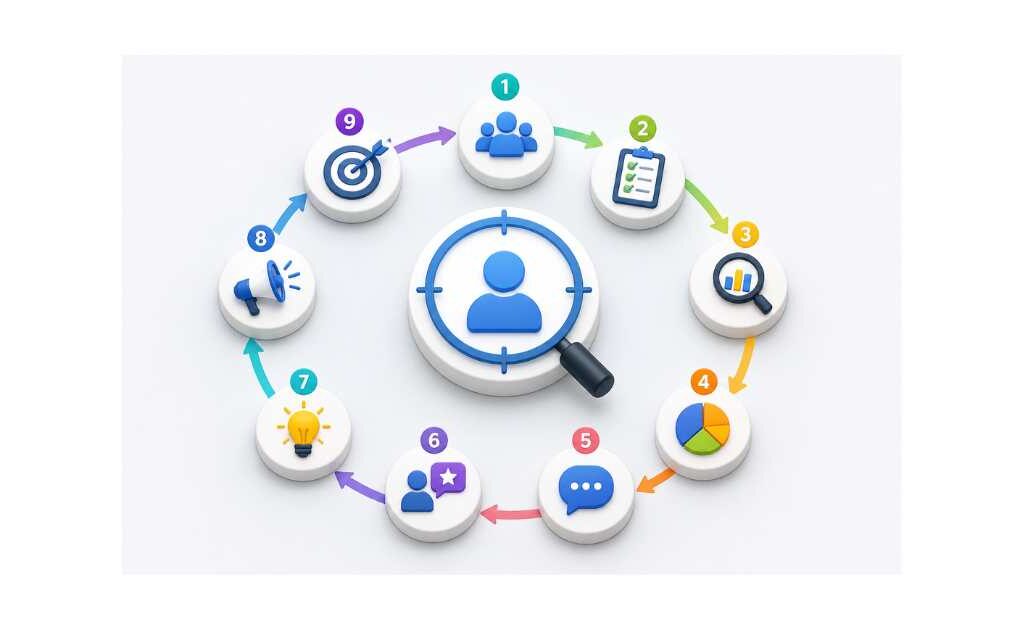
This is the complete framework. Each step produces an artifact, so you always know whether you’re done.
Step 1: Isolate Your Best Accounts
Rank every account on a composite score: lifetime revenue + retention length + referrals generated − support and customization cost. Take the top 10–20% as your “best customer list,” and — critically — also pull the bottom 20% as your “worst customer list.” The contrast between the two lists is where the sharpest ICP attributes come from. Aim for at least 10 accounts per list; below that, lean harder on interviews.
Step 2: Find Patterns Across Six Attribute Groups
Lay both lists side by side and scan for attributes that cluster in the best list and absent in the worst. Use the six groups from the table above: firmographics, technographics, behavioral, situational triggers, psychographics, and economics.
| Attribute group | Question to ask | Example finding |
|---|---|---|
| Firmographics | What size, industry, geography repeats? | 50–500 employees, construction, US/Canada |
| Technographics | What tools do they already run? | Spreadsheets + accounting software, no PM system |
| Behavioral | How do they use or buy differently? | 3+ concurrent projects; weekly reporting cadence |
| Situational | What happened right before they bought? | Won a big contract; hired a first ops lead |
| Psychographics | What do they value culturally? | Process over heroics; field teams willing to use software |
| Economics | What can they pay; what do they cost? | $1–3k/month affordable; standard onboarding suffices |
You are not looking for a long list. You are looking for the handful of attributes that discriminate — present in great customers, absent in bad ones.
Step 3: Interview 10–15 Customers
Data tells you what correlates with success; interviews tell you why, plus the exact words to use in messaging. Interview customers from your best list, and at least three churned customers. Ask:
- What was happening in your business right before you bought?
- What had you tried before, and why did it fail?
- Who else was involved in the decision, and what did each care about?
- What almost stopped you from buying?
- When was the moment you knew it was working?
- If we disappeared tomorrow, what would you do instead?
- How do you describe us to colleagues?
- What would make you switch away?
- Which capabilities are non-negotiable for you?
- What does this cost you if it fails — in money, time, or reputation?
Questions 1 and 6 are gold. Question 1 surfaces the trigger events you can target (a trigger is a moment when buying becomes urgent). Question 6 surfaces the real alternative you compete against, which is usually not a competitor but a workaround.
Step 4: Define Disqualifiers — Your Anti-ICP
An ICP that excludes nothing guides nothing. Write the anti-ICP: the attributes that, even when everything else fits, predict a bad outcome. Common disqualifiers include:
- Cannot afford the realistic price floor without heavy discounting
- Requires customization your delivery model was not built for
- Lacks the internal owner who makes adoption happen
- Buys on price alone in a commoditized comparison
- Operates in a regulated or geographic segment you cannot serve well
Publish the anti-ICP next to the ICP. Sales teams adopt ICPs faster when the document also gives them permission to walk away.
Step 5: Build an ICP Scoring Matrix
Turn attributes into a weighted score so any account can be graded 0–100 in a minute. Pick six to ten attributes, weight them by discriminating power, and define scoring rules so two teammates grade the same account identically.
| Attribute | Weight | Scoring rule (example) |
|---|---|---|
| Industry fit | 20 | Core industry = 20; adjacent = 10; other = 0 |
| Size / economics | 20 | Full price affordable = 20; discount-dependent = 5 |
| Trigger present | 20 | Active trigger in last 90 days = 20; none = 0 |
| Tech / behavioral fit | 15 | Current workaround matches = 15; partial = 8 |
| Adoption owner present | 15 | Named internal champion = 15; none = 0 |
| No disqualifiers | 10 | Any hard disqualifier = automatic downgrade |
The automatic-downgrade rule matters: disqualifiers should veto, not average out. A perfect-size company that cannot pay is not “mostly ideal.”
Step 6: Write Your ICP Statement
Compress the model into one sentence anyone can repeat:
We help [segment] that [situational trigger] achieve [measurable outcome] — unlike [real alternative], because [proof you win].
Example: “We help mid-market construction firms juggling three or more concurrent projects close their monthly books days faster — unlike generic spreadsheet workflows — because our job costing is built for construction, not adapted to it.”
If the statement cannot be spoken in one breath, the ICP is still too broad.
Step 7: Validate Before You Commit
Run three cheap tests before reallocating budget:
- Lookalike ad test. Build an audience of accounts matching the ICP and a control audience of your old broad targeting. Compare cost per qualified lead over two to three weeks.
- Outbound test. Send identical outreach to 100 ICP-scored accounts and 100 unscored accounts. Compare reply and meeting rates.
- Landing page test. Rewrite one page in ICP language (trigger headline, outcome claim, proof). Watch conversion and sales-accepted rate, not just clicks.
You are not proving the ICP perfect; you are proving it better than the alternative. Two of three tests clearly winning is enough to commit.
Step 8: Tier Your ICP
Not every fit account is an equal fit. Tiering tells each team how much effort to spend where:
| Tier | Fit score | Definition | Go-to-market treatment |
|---|---|---|---|
| Tier 1 | 80–100 | Full attribute match, trigger present | Named-account ABM, senior AE, custom outreach |
| Tier 2 | 60–79 | Strong fit, partial attributes or no active trigger | Segment campaigns, automated nurture until trigger fires |
| Tier 3 | 40–59 | Some fit, opportunistic | Inbound only; no outbound spend |
| Anti-ICP | Any score with a disqualifier | Predicted bad outcome | Disqualify early; refer out if possible |
Tiering is what turns the ICP from a marketing document into a resource-allocation system.
Step 9: Operationalize It and Set a Review Cadence
An ICP lives where work happens, or it dies. Wire it into:
- CRM fields and lead scoring, so every record carries a fit score
- Outbound list building and ad audiences
- Sales qualification calls, using disqualifiers as early-exit questions
- Content and case studies, organized by ICP segment and trigger
Then schedule a quarterly review with three trigger questions: Did churn cluster outside the ICP? Did any unexpected segment outperform? Did the market shift (pricing, regulation, new alternatives)? Update the model on evidence, not opinion.
3 Real Ideal Customer Profile Examples (Worked)
Abstract advice stalls; concrete examples move. Here are three filled-in profiles across business models.
Example 1: B2B SaaS — Project Management for Construction
- Firmographics: 50–500 employees; general contractors and engineering firms; US/Canada; $10M–$200M revenue
- Technographics: Runs Procore or AutoCAD; schedules in spreadsheets; no enterprise PM platform
- Behavioral: 3+ concurrent projects; weekly field-to-office reporting
- Trigger: Won a contract large enough that spreadsheets started breaking
- Disqualifiers: Under 10 employees; in-house platform team; price-only evaluation
- Statement: We help mid-market contractors juggling multiple concurrent projects stop losing margin to spreadsheet chaos — unlike generic PM tools — because our workflows mirror how job sites actually report.
Example 2: B2C E-commerce — Ergonomic Home Office Brand
- Demographics: 28–45; urban/suburban; $75k+ household income
- Behavioral: Works from home 3+ days weekly; buys premium desk accessories; follows setup and productivity content
- Psychographics: Values health and workspace aesthetics; researches via YouTube and Reddit before buying
- Trigger: New remote role, home office build-out, or recurring back pain
- Disqualifiers: Deal-only shoppers; one-off gift buyers with no category interest
- Statement: We help remote professionals who sit eight hours a day build workspaces that protect their bodies — unlike bargain furniture — because our designs are ergonomist-reviewed and built to last.
Example 3: B2B Services — Bookkeeping for Dental Practices
- Firmographics: Independent dental practices, 1–3 locations, $500k–$5M revenue
- Situational: Outgrew a generalist bookkeeper; owner doing admin at night; planning expansion or sale
- Behavioral: Owner is the bottleneck for every financial decision
- Disqualifiers: Hospital-owned DSO groups; practices seeking cheapest cash-basis option
- Statement: We help independent dental practice owners reclaim their evenings with books that are always audit-ready — unlike generalist bookkeepers — because we only serve dentistry and know its codes, payroll, and production reporting.
Notice the pattern across all three: specific segment, named trigger, measurable outcome, honest alternative, and explicit exclusions.
The 7 Qualities of a Good Customer

When scoring accounts, a “good” customer shows seven qualities. Use this list as a sanity check on your ICP attributes:
- Urgent, recurring need — the problem is a painkiller issue, not a vitamin.
- Budget and willingness to pay — they can afford the real price, not the fantasy one.
- Authority to decide — or a short, clear path to whoever does.
- Retention and expansion potential — they stay, upgrade, and grow with you.
- Referral behavior — they naturally bring the next customer.
- Low cost to serve — standard onboarding works; they don’t consume disproportionate support.
- Values alignment — how they want to buy matches how you sell and deliver.
A segment that scores high on conversion but fails qualities 4–7 is a trap: it fills pipeline and empties margin.
Free ICP Template
The companion template includes three assets designed to slot directly into the framework above:
- ICP Canvas — one page covering the six attribute groups, triggers, disqualifiers, and statement formula
- Scoring Sheet — the weighted 0–100 matrix with editable weights and automatic tier assignment
- Interview Script — the ten questions plus note-taking fields for triggers and quotable language
[Download the free ICP template — Notion, Google Sheets, and PDF versions] (insert your link here)
Copy it, fill it with your best-customer list, and you can complete a first ICP draft in one focused week.
7 ICP Mistakes That Kill Pipeline
| Mistake | Why it hurts | Fix |
|---|---|---|
| Building from assumptions, not evidence | Describes a fantasy customer | Start with revenue data + 10–15 interviews |
| ICP so broad it excludes nobody | “All SMBs” guides zero decisions | Add hard boundaries and disqualifiers |
| Confusing ICP with buyer persona | Targets people at wrong companies | ICP = account; persona = human inside it |
| 40 attributes, no weights | Unusable in real qualification | Keep 6–10 weighted attributes |
| No disqualifiers | Sales pursues predictable bad fits | Publish the anti-ICP beside the ICP |
| Set-and-forget | Market drifts; ICP goes stale | Quarterly review with trigger questions |
| Marketing owns it alone | Sales never applies it | Co-author with sales; wire into CRM scoring |
The deepest mistake is number one. Every other error is recoverable; an ICP built from opinion simply automates your biases at scale.
Best ICP Tools in 2026: Free vs Paid (Unbiased Comparison)
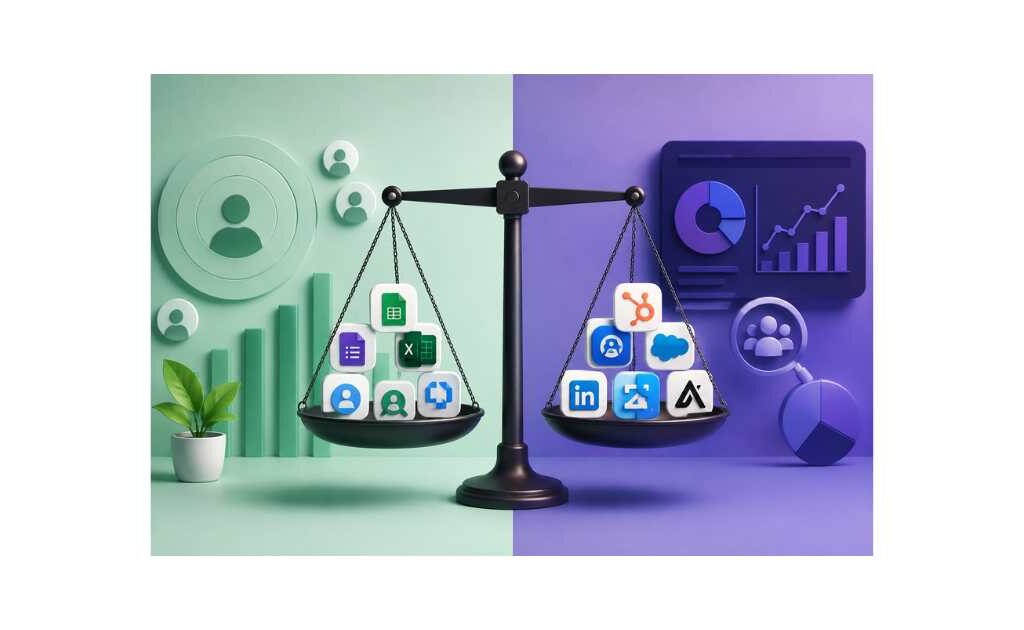
You do not need expensive software to identify your ideal customer profile. You need it to scale the process. Choose by stage:
| Job to do | Free options | Paid options | Best for |
|---|---|---|---|
| Assemble account data | CRM exports, billing exports, spreadsheets | HubSpot/Salesforce reporting | Everyone starts here |
| Run interviews | Calendly, video calls, Typeform | — | All stages |
| External research | G2/Capterra review mining, Reddit, LinkedIn search | ZoomInfo, Similarweb, intent platforms | Adding technographics & intent at scale |
| Score & operationalize | Scoring spreadsheet (in the template) | CRM lead scoring, ABM platforms | Teams with 2+ sales reps |
Rule of thumb: do steps 1–6 by hand once before buying anything. Tools amplify a working ICP; they cannot discover one for you.
ICP FAQs
How do you identify your ideal customer profile?
Rank accounts by lifetime value, retention, referrals, and support cost; analyze your top 10–20% for shared firmographic, technographic, and behavioral patterns; interview 10–15 customers; add disqualifiers; score and tier attributes; then validate with small ad, outbound, and landing page tests.
What are the 7 qualities of a good customer?
Urgent recurring need, budget and willingness to pay, authority to decide, retention and expansion potential, referral behavior, low cost to serve, and values alignment.
Can you provide some examples of ideal customer profiles?
Yes — for instance: mid-market construction firms using spreadsheets for multi-project tracking (B2B SaaS); remote professionals aged 28–45 furnishing home offices (B2C); independent dental practices with 1–3 locations needing specialist bookkeeping (services). See the worked examples above.
What information should be included in a consumer profile?
Demographics, geography, behavioral data (purchase and usage patterns), psychographics (values, research habits), situational triggers, and economics — income band, price tolerance, and return probability.
How often should you update your ICP?
Quarterly, plus immediate review after major triggers: a new product line, a pricing change, a new market, or churn clustering outside the current profile.
Does an ICP work for B2C businesses?
Yes. The unit changes from company to consumer segment, but the method is identical: isolate your best customers by value and retention, find discriminating attributes, and target accordingly.
Key Takeaways
- An ideal customer profile describes the account or segment that gets the most value from you and returns the most revenue, retention, and referrals.
- Build it from evidence: best/worst customer lists, six attribute groups, and 10–15 interviews.
- Disqualifiers matter as much as qualifiers — the anti-ICP protects margin.
- A weighted scoring matrix and tiers (1/2/3) turn the ICP into a daily decision tool.
- Validate with cheap tests, operationalize in the CRM, and review quarterly.
Identifying your ideal customer profile is not a workshop exercise; it is the operating system for your go-to-market. Get it right, and every channel you run afterward gets cheaper, sharper, and faster. Grab the template, block one week, and let your best customers write the blueprint.