
A VP of Marketing at a mid-market SaaS company once told me her team had “fourteen personas” pinned to a Miro board. When I asked which ones guided their paid acquisition strategy versus which ones shaped their onboarding emails, she paused. “They’re… the same ones,” she said.
Three months later, her team rebuilt the entire framework. Paid ads targeting the CFO’s compliance anxieties were being shown to junior analysts who just wanted keyboard shortcuts. Onboarding sequences written for the economic buyer were confusing the actual daily users. Churn at day 60 sat at 34%.
The root cause wasn’t bad data. It was treating a buyer persona and a customer persona as interchangeable documents.
They aren’t. And if your go-to-market strategy treats them as one, you’re leaking money at both ends of the funnel — overpaying for acquisition and underperforming on retention.
This guide breaks down exactly what separates the two, where each one lives in your revenue engine, and how to build them without recycling the same stale assumptions.
The Short Answer (For Those Skimming)

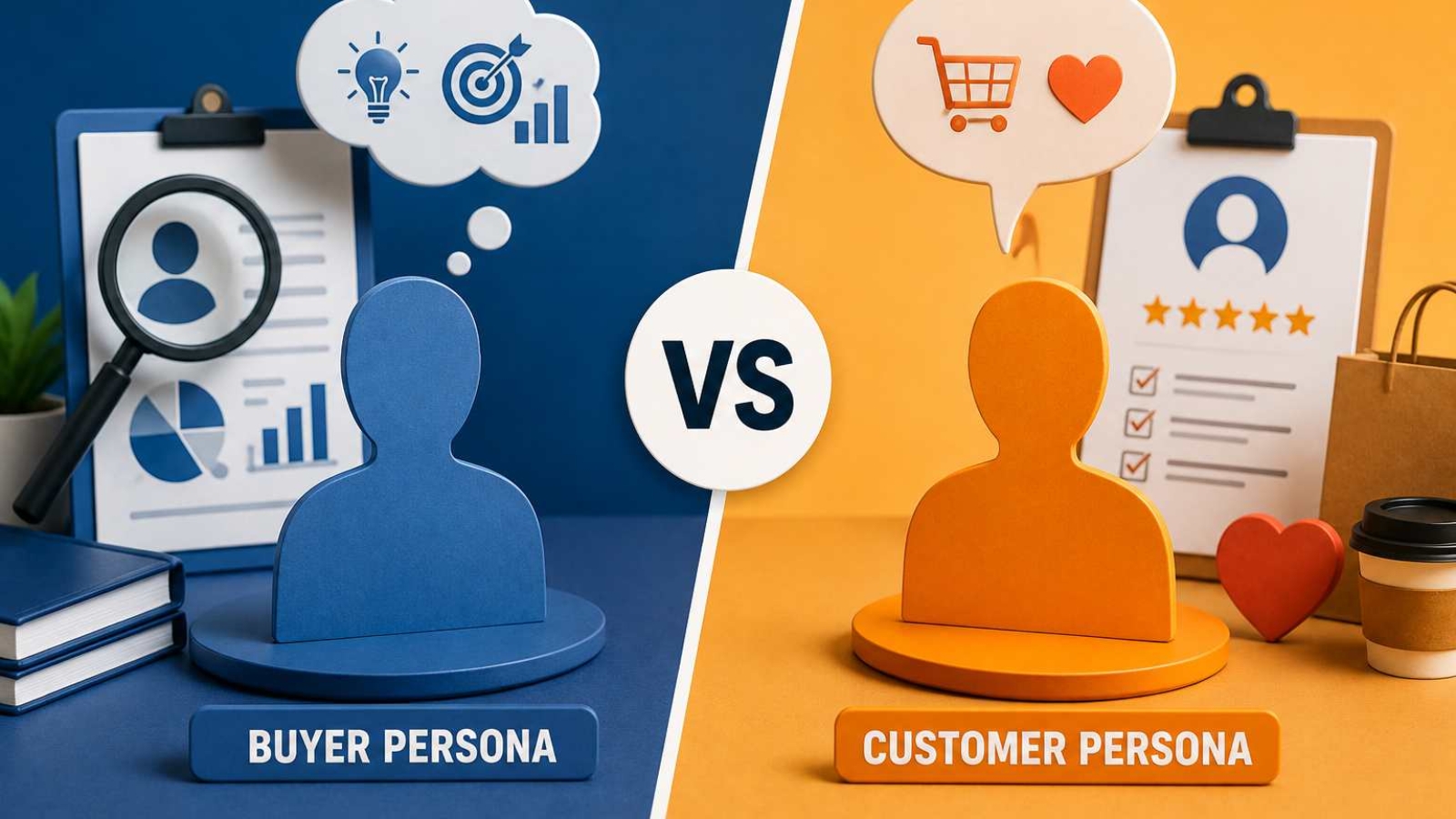
A buyer persona models the person who authorizes or influences the purchase decision. A customer persona models the person who uses, relies on, and renews the product after the contract is signed.
The buyer persona answers: “What will make them say yes?”
The customer persona answers: “What will make them stay, expand, and recommend?”
In B2B SaaS, enterprise services, marketplaces, and any model where the signer ≠ the operator, these are often two entirely different humans with different incentives, vocabularies, and success metrics. Even in B2C, the lens shifts: pre-purchase persuasion demands different research than post-purchase behavior mapping.
Now let’s unpack the layers.
What Is a Buyer Persona, Exactly?
A buyer persona is a research-backed profile of the individual (or committee role) responsible for evaluating, approving, and funding a purchase. This isn’t about who clicks “Add to Cart.” In complex sales, it’s about who builds the business case, who signs the PO, who vetoes the deal in a Thursday leadership meeting.
What a Buyer Persona Captures
- Role in the buying committee: Champion, economic buyer, technical evaluator, procurement gatekeeper, or executive sponsor.
- Decision triggers: A failed audit, a board mandate, a competitor’s launch, a contract renewal deadline.
- Objection patterns: “We don’t have budget until Q3.” “Legal needs a DPA before we pilot.” “I need three vendor comparisons.”
- Information diet: Where they research — G2 reviews, peer Slack communities, analyst reports (Gartner Magic Quadrant, Forrester Wave), LinkedIn thought leadership, or a direct intro from a trusted peer.
- Success criteria for the purchase: ROI threshold, compliance checkboxes, implementation timeline, integration requirements.
- Risk tolerance: How much career capital they’re spending by championing your solution internally.
A Concrete Example
“Compliance-First Catherine” – Director of IT Security, 200-person fintech
Catherine doesn’t care about your product’s sleek dashboard. She cares about SOC 2 Type II reports, data residency in the EU, and whether your pen-test results are from the last 12 months. She reports to the CISO. She will kill a deal over a missing subprocessor list. Her trigger event was a failed vendor risk assessment last quarter. She researches via Dark Reading, SANS forums, and direct conversations with security peers at other fintechs. She needs a one-page security whitepaper and a 15-minute technical Q&A before she’ll loop in procurement.
That’s a buyer persona. Specific. Tied to a moment in the buying journey. Useless for designing your in-app tutorial.
What Is a Customer Persona, Exactly?
A customer persona profiles the human on the other side of “Welcome aboard.” This is the person logging in on a Tuesday morning, filing a support ticket at 11 p.m., deciding in month nine whether to renew or quietly start evaluating alternatives.
What a Customer Persona Captures
- Usage behavior: Daily active vs. weekly, which 3 features they touch every session, where they rage-click.
- Onboarding friction points: Where they stall in the first 14 days. Which tooltip they skip. Which integration they attempt first.
- “Aha moment” definition: The specific action that correlates with long-term retention (e.g., “invited 3 teammates within 48 hours” or “connected their CRM and ran their first automated report”).
- Support interaction style: Do they search the knowledge base first, or do they open a live chat immediately? Do they prefer async Loom videos over written docs?
- Expansion signals: When do they hit plan limits? What triggers them to request a demo of your premium tier?
- Churn indicators: Login frequency drops below 2x/week. They stop attending QBRs. Their champion leaves the company.
A Concrete Example
“Pipeline-Pushing Priya” – Revenue Operations Analyst, uses your CRM daily
Priya logs in 6 hours a day. She lives in saved views and keyboard shortcuts. Her biggest frustration: bulk-editing 200 records still requires 4 clicks per field. She discovered your product through a YouTube tutorial, not a sales call. She’ll forgive a bug if support responds within 4 hours, but she’ll churn if a workflow she depends on changes without a 30-day deprecation notice. She advocates for you in her RevOps Slack group — but only if her NPS survey actually leads to visible fixes.
That’s a customer persona. Built from product analytics, support transcripts, and retention cohorts. It would be absurd to show Priya a “Why Choose Us Over Competitor X” comparison sheet. She already chose you. She needs you to work.
7 Concrete Differences Between a Buyer Persona and a Customer Persona
This is the comparison most articles gloss over with vague language. Here’s the operational breakdown:
| # | Dimension | Buyer Persona | Customer Persona |
|---|---|---|---|
| 1 | Funnel stage served | Awareness → Evaluation → Decision | Onboarding → Adoption → Retention → Expansion |
| 2 | Primary question | “Why should I approve this spend?” | “Does this actually solve my Tuesday problem?” |
| 3 | Data sources | Win/loss interviews, CRM notes, Gong/Chorus call transcripts, sales objection logs | Product analytics (Amplitude, Pendo, Mixpanel), CSAT/NPS verbatims, support ticket taxonomy, usage telemetry |
| 4 | Team ownership | Demand Gen, Sales Enablement, ABM | Product Management, Customer Success, Lifecycle Marketing |
| 5 | Content they consume | ROI calculators, security docs, case studies with hard numbers, competitive teardowns | In-app guides, feature release notes, community forums, advanced workflow tutorials |
| 6 | KPI tied to the persona | CAC, SQL-to-close rate, deal velocity, win rate against competitors | NPS, GRR/NRR, time-to-value, feature adoption rate, support ticket volume |
| 7 | Update cadence | Quarterly (market shifts, new competitors, pricing changes) | Monthly or per release cycle (product changes alter behavior fast) |
Notice that the data sources barely overlap. If you’re building both personas from the same 10-person interview panel, you’re building one persona wearing two hats. That’s where strategy breaks.
Why Conflating the Two Actually Hurts (Specific Failure Modes)
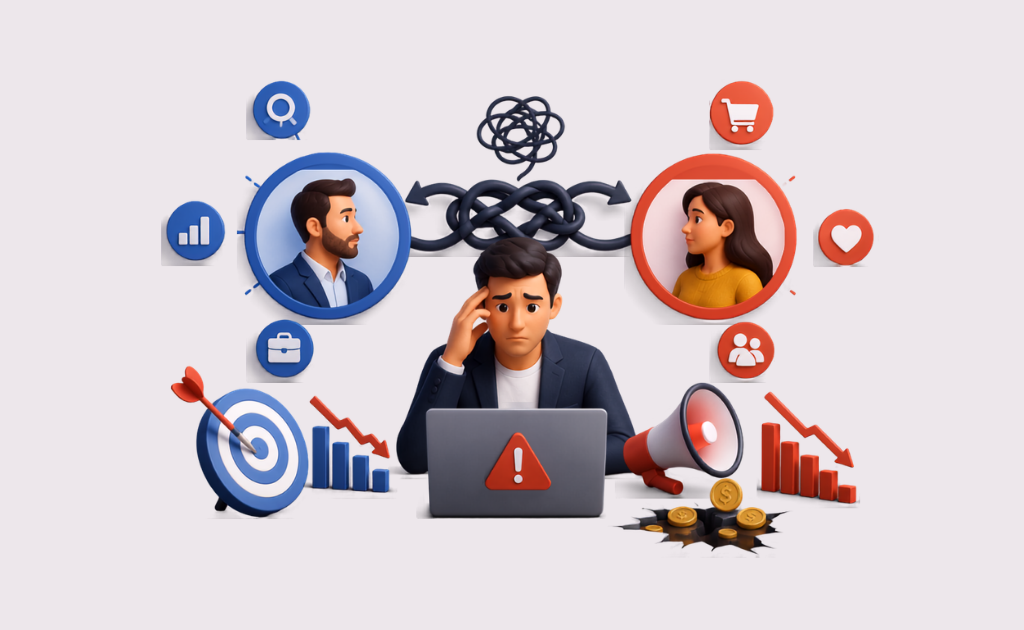
Let’s move past “alignment is important” platitudes. Here’s what goes wrong operationally:
1. Ad spend bleeds on the wrong audience.
Your paid search campaign targets “best project management software” and serves a landing page loaded with ROI language and executive testimonials. The clicker is a team lead who just wants to see the Gantt chart interface. Bounce rate: 78%. You blame the ad creative. The real issue: you wrote buyer-stage copy for a customer-stage searcher.
2. Sales and CS speak different languages about “the customer.”
Sales closes a deal by promising the CFO a 22% efficiency gain. CS inherits a team of five analysts who were never in the room and don’t care about efficiency percentages — they care that the CSV export is broken. The handoff document is one persona card that satisfies neither conversation.
3. Product roadmaps skew toward the buyer’s wishlist.
The buyer said, “I need admin-level reporting.” So you build it. But the daily users needed granular task-level notifications. Adoption stalls. The buyer is happy in the QBR. The users are silently evaluating Monday.com.
4. Lifecycle email sequences feel schizophrenic.
Email 1 post-purchase: “Here’s how to get your team onboarded.” Email 2: “Here’s a case study on how Company Y achieved 3x ROI.” The customer persona in email 1 doesn’t need to be re-sold. They need a checklist, a video, and a Slack channel link.
When You Need Both (And When One Suffices)
You Need Both When:
- B2B SaaS with a buying committee. The VP who signs is not the analyst who configures. The IT lead who approves security is not the marketer who builds campaigns in the tool. Minimum: one buyer persona per committee role, one customer persona per user segment.
- Marketplaces and platforms. The person who negotiates the enterprise contract ≠ the employees who log in daily.
- Any product with an admin/user split. Think: the HR director who buys the ATS vs. the recruiter who lives in it 8 hours a day.
- Usage-based or seat-based pricing models. The buyer cares about cost predictability. The customer cares about per-seat feature access.
One Persona Might Suffice When:
- Low-ticket B2C with a single decision-maker. A solo freelancer buying a $12/month design tool is both the buyer and the user. Even here, though, the messaging lens shifts: pre-purchase you address price anxiety and feature comparison; post-purchase you address workflow tips and community.
- Self-serve PLG products with no sales motion. The “buyer” and “customer” are the same person, but you still benefit from separating the acquisition mindset from the retention mindset in your content strategy.
How to Build a Buyer Persona Without Guessing
Stop with the “let’s brainstorm in a conference room” approach. Here’s a process that produces a persona your sales team will actually reference mid-call:
Step 1 – Mine your CRM and call recordings.
Pull 20 won deals and 20 lost deals from the last two quarters. Use Gong, Chorus, or Clari to tag: who was on the call, what objections surfaced, what questions stalled the deal, what content was shared before close.
Step 2 – Interview your sales reps, not just customers.
Ask AEs: “What’s the #1 reason deals slip?” “What question do you dread getting on a discovery call?” “What does the champion say to their boss to get budget approved?” You’re modeling the buyer’s internal sales process, not just their external behavior.
Step 3 – Map the committee, not just the “decision-maker.”
For B2B deals above $15K, there is almost never one buyer. Document the champion, the economic buyer, the technical evaluator, the procurement/legal gatekeeper, and the executive sponsor. Each gets a micro-persona with distinct objections.
Step 4 – Document the trigger event.
Personas without a trigger are just demographics. What happened that made them start looking? A failed audit. A competitor’s acquisition. A new CTO mandate. A contract expiring in 90 days. The trigger shapes the urgency and the messaging angle.
Step 5 – Write the persona as a narrative, not a bullet list.
Give them a name, a Tuesday morning, a Slack message they just received from their boss. Make it specific enough that a new SDR can read it and think, “Oh, I talked to this person yesterday.”
How to Build a Customer Persona Without Recycling Sales Assumptions
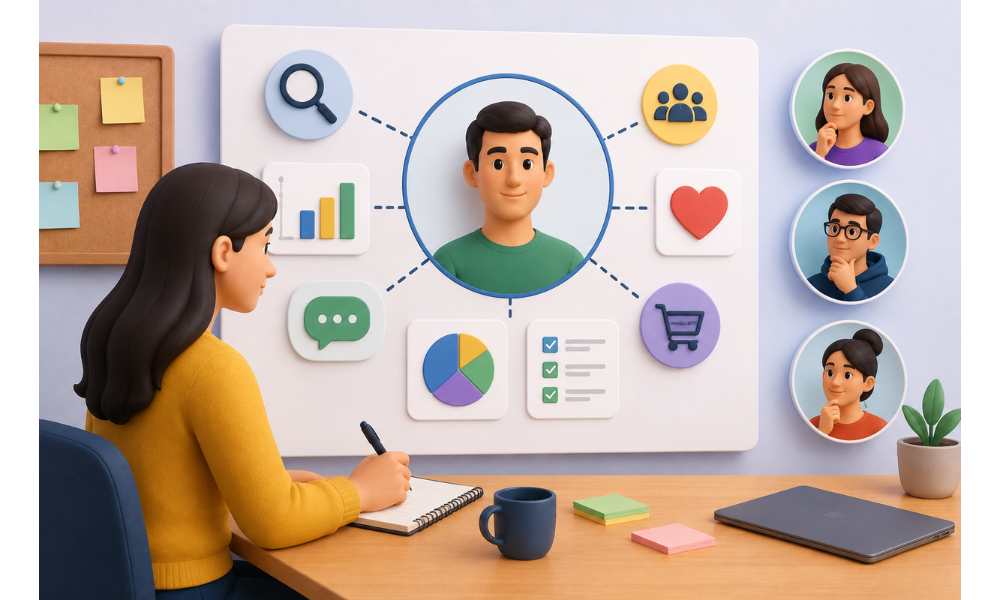
Step 1 – Pull behavioral data, not survey data.
Surveys tell you what people say. Product analytics tell you what they do. Use Amplitude, Pendo, Heap, or Mixpanel to identify: which features correlate with 6-month retention, where users drop off in onboarding, which user segments expand vs. contract at renewal.
Step 2 – Segment by behavior, not just firmographics.
“Marketing Manager at a 50-person company” is a demographic. “Logs in daily, uses automation builder, has invited 4 teammates, submitted 2 feature requests” is a behavioral segment. Build personas from the latter.
Step 3 – Read support tickets like a novelist.
Don’t just categorize them. Read the language. Where does frustration live? Is it the mobile app? The API rate limit? The fact that dark mode doesn’t exist? These details become the backbone of your customer persona’s “frustrations” section.
Step 4 – Conduct 5–8 interviews with customers in different lifecycle stages.
One in week 1 (onboarding). One in month 3 (adoption). One in month 11 (pre-renewal). One who churned. The persona isn’t static; it has a lifecycle arc.
Step 5 – Define the “aha moment” quantitatively.
Work with your product/data team. Is it “created 3 projects in the first week”? Is it “connected their Slack integration”? That single metric becomes the north star for your customer persona’s onboarding journey.
Putting Both to Work: A Tactical Example
Company: A mid-market B2B data-visualization platform. $45K average contract value. 6-month sales cycle.
Buyer Persona – “Budget-Guard Gerald,” VP of Finance
- Trigger: CFO asked for a single source of truth before the next board meeting.
- Objection: “We already have Tableau licenses.”
- Needs: TCO comparison, implementation timeline under 8 weeks, SOC 2 report, references from 2 companies in his industry.
- Content served: ROI calculator, security one-pager, executive case study with dollar figures, a 15-minute “board-ready demo” video.
- Owner: Sales + Demand Gen.
Customer Persona – “Dashboard-Building Dana,” Senior BI Analyst
- Trigger: Gerald bought the platform. Dana now has to migrate 14 legacy dashboards by Friday.
- Frustration: The migration wizard doesn’t handle custom SQL fields.
- Needs: Step-by-step migration guide, a dedicated Slack channel with a solutions engineer, keyboard shortcuts reference.
- Content served: Interactive onboarding checklist, migration video series, “power-user tips” weekly email, community forum access.
- Owner: CS + Product Education + Lifecycle Marketing.
Notice: Gerald never sees the migration guide. Dana never sees the TCO comparison. Same company, same product, two entirely different content ecosystems. That’s the operational payoff of splitting the personas.
Common Mistakes (That Even Mature Teams Make)
- Building personas once and never revisiting them. Markets shift. Competitors launch. Your product adds features that change user behavior. Set a 6-month review cycle minimum for buyer personas, and a per-release-cycle check for customer personas.
- Sourcing both from the same 12 interviews. You need sales call data for the buyer. You need product telemetry and support transcripts for the customer. Different inputs, different outputs.
- Making personas too broad. “Mid-level manager at a tech company” is not a persona. It’s a LinkedIn filter. Get specific: role, trigger, objection, Tuesday-morning context.
- Ignoring the influencer. In B2B, the person who first recommends your tool in a Slack thread or a team meeting often shapes the deal more than the signer. Give them a micro-persona.
- Writing personas in third-person corporate speak. “The user desires efficiency gains.” No. Write: “Dana needs to export a filtered view to CSV in under 10 seconds or she’ll screenshot it and paste it into a Google Doc like a psychopath.” Specificity creates empathy. Empathy creates better strategy.
Frequently Asked Questions
Q: Can the buyer and the customer be the same person?
A: Yes, especially in B2C, self-serve SaaS, and low-ticket purchases. However, even when it’s the same individual, the strategic lens differs. Pre-purchase messaging addresses evaluation anxiety and comparison shopping. Post-purchase messaging addresses onboarding friction, feature discovery, and habit formation. Treat them as two chapters, not one.
Q: How many personas should a company create?
A: There’s no universal number, but a useful guardrail: 2–3 buyer personas (mapped to buying committee roles) and 2–4 customer personas (mapped to behavioral segments). More than 8 total usually signals you’ve created demographics, not actionable personas. Fewer than 3 total usually means you’re over-generalizing.
Q: Which persona matters more for content marketing?
A: Both, but at different funnel stages. Top-of-funnel and mid-funnel content (comparison guides, ROI content, webinars) serves the buyer persona. Bottom-of-funnel and post-purchase content (tutorials, release notes, community content, advanced workflows) serves the customer persona. If your content calendar is 90% acquisition-focused, your retention content is likely an afterthought.
Q: How often should I update my personas?
A: Buyer personas: quarterly, or whenever a major competitor launches, pricing shifts, or your sales cycle length changes. Customer personas: monthly or per major product release, because usage behavior shifts fast. If you shipped a new feature last month, your customer persona’s “frustrations” and “aha moment” may have already changed.
Q: Do I need different personas for each product line?
A: If your product lines serve meaningfully different users or buying processes, yes. A company selling both an enterprise CRM and a self-serve email tool has different buyers, different committee structures, and different usage patterns. One persona cannot cover both without becoming useless.
The Bottom Line
A buyer persona gets you the meeting, the pilot, the signature. A customer persona gets you the renewal, the expansion, the referral. They are not synonyms. They are not two tabs in the same Notion doc. They are built from different data, owned by different teams, activated at different stages, and measured against different KPIs.
If your team currently has one persona document that’s supposed to do both jobs, that’s your first fix. Split it. Rebuild the buyer side from win/loss data and sales call transcripts. Rebuild the customer side from product analytics and support conversations. Then watch what happens to your CAC, your day-30 activation rate, and your net revenue retention.
The personas were never the problem. The conflation was.
Looking for a starting template? Download our free [Buyer Persona + Customer Persona dual-template] and build both in under 90 minutes with your existing CRM and analytics data.
Author’s Note on Sources: Frameworks referenced draw on persona methodology from Adele Revella’s Buyer Persona Institute, product-analytics best practices from Amplitude and Pendo, and CS operational models from Gainsight and ChurnZero. Specific stats and benchmarks should be verified against your own CRM and analytics stack before publishing.
Word count: ~3,010