

Introduction
Most businesses think they know their customers—but assumptions lead to ineffective marketing, wasted budgets, and poor conversions. Buyer persona research replaces guesswork with real customer insights.
Here’s the uncomfortable truth: 70–80% of personas created by marketing teams are based on internal assumptions rather than direct customer research. They’re essentially well-designed fiction. When you create marketing campaigns based on fiction, you get fictional results.
Buyer persona research is the systematic process of gathering, analyzing, and applying data about your ideal customers to create accurate, actionable profiles. It answers who your customers are, what drives their decisions, how they evaluate solutions, and why they choose—or reject—your offering.
In this guide, you’ll learn:
- A complete framework for conducting buyer persona research
- Step-by-step execution across qualitative and quantitative methods
- AI tools that accelerate analysis while preserving accuracy
- How to build personas that actually inform marketing, sales, and product decisions
- Real-world case studies demonstrating measurable outcomes
What You’ll Need: Download the accompanying templates, interview scripts, and AI prompt library to implement everything covered here. Resources are available throughout this guide.
Table of Contents
What Is Buyer Persona Research?

Buyer persona research is the process of gathering and analyzing data about your customers and prospects to build detailed, research-backed profiles of your ideal buyers. These profiles—buyer personas—represent specific segments of your target audience and capture demographics, psychographics, behavioral patterns, goals, pain points, and decision criteria.
The distinction between “buyer persona” and “buyer persona research” matters:
- Buyer persona: The final profile document
- Buyer persona research: The investigative process that produces it
A buyer persona is a semi-fictional representation of your ideal customer, built from real data rather than guesswork . It goes beyond age and job title to include what drives their decisions, what frustrates them, and how they prefer to interact with brands.
Research-Driven vs Assumption-Driven Personas
Here’s how they compare:
| Attribute | Research-Driven Personas | Assumption-Driven Personas |
|---|---|---|
| Foundation | Customer interviews, surveys, analytics | Opinion, gut feeling, best guesses |
| Accuracy | High—validated with real buyers | Low—frequently misaligned with reality |
| Actionability | Directly informs campaigns, content, product | Creates generic, ineffective marketing |
| Team Confidence | High—teams trust and use them | Low—gather dust in slide decks |
| Update Frequency | Regular, based on ongoing research | Rarely, if ever updated |
A data-backed buyer persona research includes: demographics (age, location, job title), firmographics (company size, industry), psychographics (goals, motivations, values), behavioral traits (how they research and buy), and buying committee role (decision-maker, influencer, champion, or end user) .
Why Research Always Comes Before Persona Creation
Personas built without research are worse than having no personas at all. They create a false sense of certainty and lead teams down the wrong path. Research provides the raw material. Personas are the refined output. Skip the research, and you’re marketing to an imaginary friend.
Why Buyer Persona Research Matters More Than Ever

In 2026, buyer behavior is more fragmented, digital-first, and influenced by more stakeholders than ever before. The average B2B purchase involves 13 stakeholders, each with different priorities and concerns . Without research-backed personas, you’re navigating this complexity blind.
Better Marketing ROI
Untargeted campaigns achieve just 0.2% conversion rates compared to targeted ones. Marketing teams using well-researched personas generate 209% more revenue from their marketing efforts . Personas eliminate waste by focusing budget on audiences that actually convert.
Higher Conversion Rates
Tailoring messaging to specific pain points and buying triggers improves response rates and deal velocity . When you understand what a buyer actually cares about, you can speak directly to that concern—rather than broadcasting generic messages that resonate with no one in buyer persona research .
Better Product Decisions
Product teams use persona research to prioritize features that solve real problems. When you know what end users struggle with daily, you build solutions they actually need—not what product managers assume they need.
More Effective Sales Conversations
Sales teams with documented personas have persona-specific talk tracks: what pain points to emphasize, which value propositions to lead with, and how to handle objections. This preparation shortens sales cycles and improves win rates .
Stronger Customer Retention
Understanding why customers buy helps you understand why they stay—or leave. Persona research that includes churned customers reveals retention gaps and informs customer success strategies.
Improved Customer Experience
Personas inform every touchpoint: website copy, email nurture sequences, sales conversations, onboarding flows, and support interactions. A consistent, persona-aligned experience builds trust and loyalty.
Buyer Persona vs User Persona vs Customer Persona in Buyer Persona Research
These terms are often used interchangeably, but they have distinct meanings.
| Aspect | Buyer Persona | User Persona | Customer Persona |
|---|---|---|---|
| Purpose | Guide sales and marketing targeting | Guide product design and UX | Guide customer experience and retention |
| Audience | Decision-makers and influencers | End users of the product | Anyone who engages with the brand |
| Focus | Buying behavior, budget, authority | Usability, workflow, feature needs | Complete relationship lifecycle |
| Used By | Marketing, sales, RevOps | Product, engineering, design | Customer success, support, retention teams |
| Research Methods | Interviews, win/loss analysis, CRM data | Usability testing, observation, support tickets | Surveys, NPS, churn analysis, support logs |
| Example | VP of Sales evaluating a new prospecting tool | SDR using the tool daily to book meetings | Account Manager managing ongoing relationship |
In B2B contexts, buyer and user are often different people with different priorities . The buyer cares about ROI and risk. The user cares about ease of use and time savings. A complete strategy needs both.
Signs Your Business Needs Buyer Persona Research

You need buyer persona research if you recognize any of these symptoms:
- Low conversion rates: Your traffic is strong, but few visitors become customers
- High bounce rates: Visitors leave your site without engaging
- Poor campaign performance: Content and ads aren’t generating expected results
- Generic messaging: Your marketing sounds like it’s for “everyone”
- High customer acquisition cost (CAC): You’re spending too much to acquire each customer
- Low retention: Customers churn shortly after purchase
- Weak product adoption: Users aren’t using key features
- Sales objections increasing: Prospects repeatedly raise the same concerns
- Sales and marketing misalignment: Teams disagree on who to target and how
- No documented personas: Your team operates on assumptions
These indicators suggest you’re marketing based on guesswork rather than customer understanding. Research fixes that.
The Complete Buyer Persona Research Framework (The XPERIA Framework™)
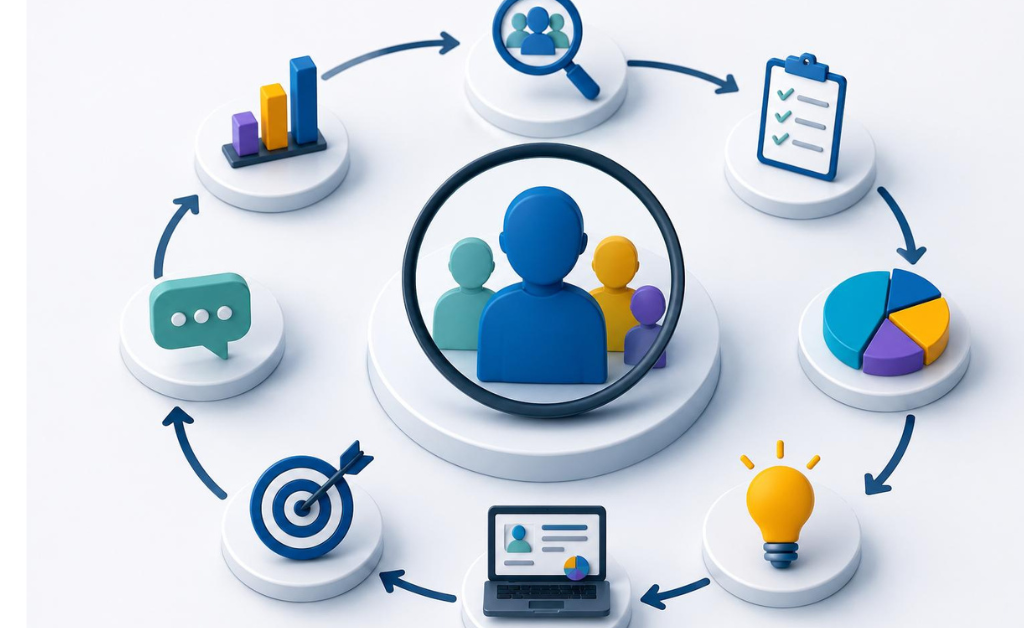
The XPERIA Buyer Persona Research Framework™ provides an eight-phase methodology for building research-backed personas that drive business outcomes.
Phase 1: Research Planning
Define research objectives, scope, and success criteria. Determine how persona research will inform marketing, sales, and product decisions in buyer persona research.
Phase 2: Participant Recruitment
Identify who to speak with: current customers, lost customers, prospects, competitor customers, internal stakeholders, and subject matter experts in buyer persona research.
Phase 3: Customer Discovery
Conduct qualitative research through interviews, focus groups, and observation. Capture rich, detailed insights into customer motivations, goals, and decision processes in buyer persona research.
Phase 4: Data Collection
Gather quantitative data through surveys, CRM analysis, web analytics, and secondary research. Measure patterns and validate qualitative findings at scale in buyer persona research.
Phase 5: Behavior Analysis
Analyze both qualitative and quantitative data to identify patterns, themes, and segments. Use affinity mapping, theme analysis, and behavior clustering in buyer persona research.
Phase 6: Persona Building
Create detailed persona profiles for each distinct segment. Include demographics, goals, pain points, buying triggers, decision criteria, and communication preferences in buyer persona research.
Phase 7: Validation
Test personas with internal stakeholders, sales teams, and actual customers. Confirm accuracy and refine before broad adoption in buyer persona research.
Phase 8: Optimization
Review and update personas regularly. Markets change, customer behavior evolves, and your product matures. Your personas must keep pace in buyer persona research .
Step-by-Step Buyer Persona Research Process
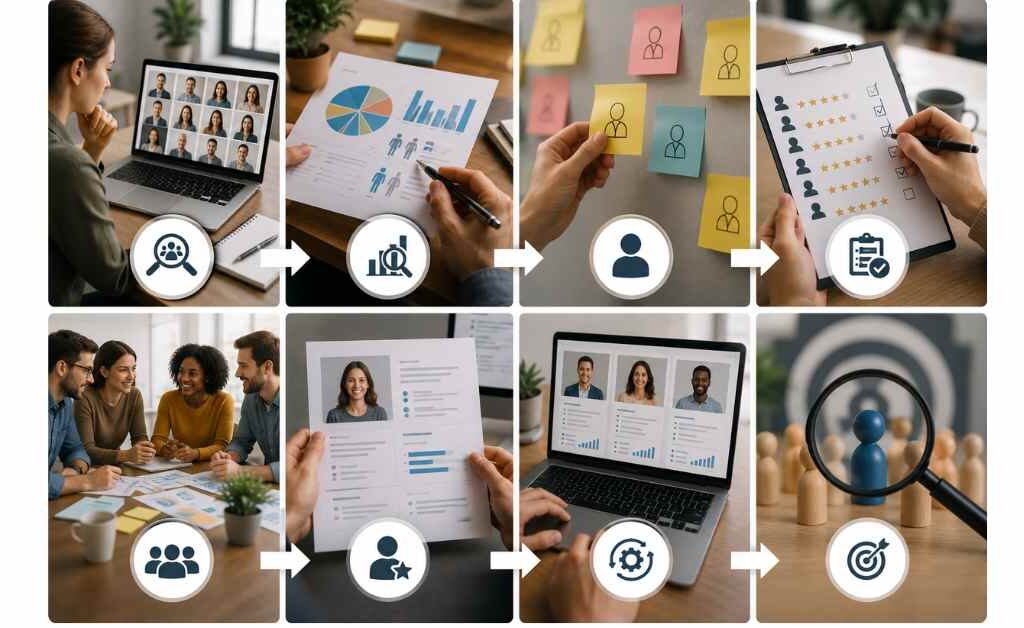
Step 1: Define Research Goals
Before conducting any research, clarify what decisions you’re trying to improve. This determines what questions to ask and whom to ask them of.
Marketing goals: Improve campaign targeting, content strategy, and messaging effectiveness
Sales goals: Shorten sales cycles, improve win rates, and reduce objections
Product goals: Prioritize features that solve real customer problems
Customer experience goals: Improve onboarding, retention, and satisfaction
Write down your research objectives. For example: “We need to understand why mid-market SaaS companies choose our product over competitors so we can improve our sales positioning.”
Step 2: Identify Research Participants
Your research is only as good as your participants. Include a mix of voices:
- Current customers: Why they bought, how they use your product, what value they get
- Lost customers: Why they left, what you could have done differently
- Prospects in the sales pipeline: What they’re evaluating, what’s holding them back
- Competitor customers: Why they chose a competitor instead of you
- Sales team: What objections they hear, what questions buyers ask
- Customer support: What problems customers encounter, what they praise
- Product team: What features are underutilized, what’s requested
- Partners: What they hear from mutual customers
Step 3: Choose Research Methods
Select methods based on your research goals, budget, and timeline. Effective persona research uses multiple methods across qualitative and quantitative approaches.
Comparison of primary research methods:
| Method | Best For | Cost | Time | Insights |
|---|---|---|---|---|
| Customer Interviews | Deep understanding of motivations, pain points, buying process | Low–Moderate | 2–4 weeks | Rich qualitative insights |
| Surveys | Validating patterns at scale, quantifying priorities | Low | 1–2 weeks | Quantitative segmentation |
| Focus Groups | Observing group dynamics, testing messaging | Moderate | 2–3 weeks | Group consensus and divergence |
| Observation | Understanding actual behavior vs. reported behavior | Moderate | 3–6 weeks | Behavioral patterns |
| CRM Analysis | Identifying firmographic and behavioral patterns | Low | 1–2 weeks | Data-driven segmentation |
| Sales Calls | Real buyer language, objections, decision factors | Low | 1–4 weeks | Qualitative buyer insights |
| Support Tickets | Customer pain points, feature requests, frustrations | Low | 1–2 weeks | Problem identification |
| Website Analytics | Digital behavior, content preferences, entry channels | Low | 1–2 weeks | Behavioral patterns |
Step 4: Conduct Customer Interviews
Interviews are the gold standard for buyer persona research. Done well, they reveal motivations and decision factors that surveys miss entirely.
Best Practices:
DO:
- Ask open-ended questions that invite storytelling
- Focus on “tell me about a time when…” questions
- Explore the actual purchase decision: what triggered it, who was involved, what criteria mattered
- Use the buyer’s language—their exact words are valuable for messaging
- Ask about the evaluation process for your product and competitors
- Ask about what almost derailed the purchase
- Record interviews with consent for accurate analysis
DON’T:
- Ask leading questions that bias responses
- Interrupt or steer the conversation to your assumptions
- Rely only on internal customers—include churned and competitor customers
- Ask vague questions that yield vague answers
- Conduct interviews without a structured guide
Interview length: 30–60 minutes is optimal. Any longer and fatigue sets in.
Recording tools: Otter AI, Fireflies AI, or standard recording apps with transcription.
Consent: Always obtain explicit consent to record. Explain how you’ll use the data and how you’ll protect participant privacy.
Step 5: Run Surveys
Surveys validate patterns discovered in interviews. They tell you how widespread a particular pain point or behavior is across your customer base.
Sample size: Survey response rates typically range from 10–30%. Plan accordingly. For a B2B audience with 1,000 customers, aim for 200–300 responses to achieve statistical significance.
Distribution channels:
- Email lists (targeted by segment)
- Website intercept surveys
- Social media
- In-app notifications
- After-purchase follow-up
Survey design:
- Limit to 10–15 questions to prevent drop-off
- Use a mix of multiple-choice and open-ended questions
- Include demographic and firmographic questions for segmentation
- Ask about priorities, satisfaction, and importance ratings
Avoiding bias:
- Word questions neutrally—”How important is ease of use?” is leading; “What factors most influenced your decision?” is neutral
- Randomize answer order
- Avoid double-barreled questions (asking two things at once)
- Test your survey with a small group before full launch
Step 6: Analyze Customer Data
Once you have collected qualitative and quantitative data, analyze systematically in buyer persona research:
Theme clustering: Group similar responses together. If multiple customers mention “integration problems,” that’s a theme. Count frequency to prioritize.
Coding responses: Label interview quotes and survey responses with tags like “pain point,” “goal,” “decision criterion,” or “objection.” This creates searchable data for analysis.
Identifying patterns: Look for commonalities across participants: same job titles, similar challenges, parallel decision processes, consistent objections.
Segmenting audiences: Group customers who share key characteristics. One segment may prioritize cost; another prioritizes features. These become separate personas.
Step 7: Create Buyer Personas
Translate research into persona profiles. Each persona should include:
- Name and photo (makes it tangible)
- Demographics: Age, location, job title, seniority
- Firmographics: Company size, industry, revenue
- Goals: What outcomes they’re trying to achieve
- Pain points: What frustrates them daily
- Buying triggers: Events that prompt evaluation
- Decision criteria: What they use to choose solutions
- Objections: Common reasons they hesitate
- Preferred channels: Where they research and consume content
- Representative quote: Captures their mindset in their own words
- Role on buying committee: Decision-maker, influencer, champion, or end user
Step 8: Validate Personas
Most competitor guides stop at persona creation. Validation is what separates useful personas from dusty documents.
Internal validation: Present personas to sales, marketing, customer success, and product teams. Do they recognize these people in their daily work? If someone says “that doesn’t match what I see,” investigate.
Customer validation: Share draft personas with select customers. Ask: “Does this profile accurately represent people like you?” Their feedback is your reality check.
Sales validation: Run draft personas past sales reps who close deals daily. They’ll catch inaccuracies in buying triggers, objections, and decision criteria.
Analytics validation: Check if persona segments behave as expected in your data. For example, if a persona is supposed to value features but your analytics show they only engage with pricing content, something is off.
Step 9: Update Regularly
Personas have a shelf life. Markets change, customer priorities shift, and your product evolves. Review and refresh at least once a year in buyer persona research .
When to update sooner:
- New market entry or expansion
- Major product launch
- Significant industry shift (regulatory changes, new competitors)
- Customer behavior changes (new buying patterns, emerging objections)
- Leadership changes in your organization
Primary Research Methods for Buyer Persona Research

Primary research involves collecting new data directly from sources rather than analyzing existing data in buyer persona research.
Customer Interviews
Pros: Deep insights, captures language, reveals “why” behind behavior
Cons: Time-consuming, requires skill to conduct well, smaller sample sizes
Best Practices: Conduct 15–30 interviews per persona segment. Use a structured guide but allow flexibility. Record and transcribe. Focus on the decision process, not just demographics.
Surveys
Pros: Scalable, quantifiable, identifies patterns across segments
Cons: Limited depth, response bias possible, self-reporting issues
Best Practices: Keep under 15 questions. Test for clarity. Offer incentives to boost response rates. Mix multiple-choice with open-ended.
Focus Groups
Pros: Group dynamics reveal consensus and divergence, efficient for testing messaging
Cons: Dominant personalities skew results, expensive to organize, group bias
Best Practices: Use a skilled moderator. Keep groups small (6–8 participants). Focus on specific topics. Record and analyze.
Ethnographic Research
Observing customers in their natural environment—their workplace, their daily routine.
Pros: Reveals actual behavior vs. reported behavior, uncovers unarticulated needs
Cons: Time-intensive, expensive, participants may behave differently when observed
Contextual Inquiry
Observing users as they perform tasks in their real environment, asking questions in context.
Pros: Rich behavioral data, identifies workflow friction
Cons: Requires training, expensive, not all customers agreeable
Usability Testing
Observing users interact with your product to identify friction points.
Pros: Direct product feedback, identifies usability issues
Cons: Limited to product interaction, may not reveal broader motivations
Customer Shadowing
Following a customer through their day to understand their role, challenges, and decision context.
Pros: Unfiltered insights, reveals unspoken needs
Cons: Intrusive, expensive, logistically challenging
Secondary Research Methods
Secondary research leverages existing data sources that may already contain valuable insights.
Website Analytics
GA4, Microsoft Clarity, Hotjar reveal:
- What content visitors consume before converting
- Where visitors drop off
- Entry channels and referral sources
- Device preferences (mobile vs desktop)
- Geographic concentrations
CRM
Salesforce, HubSpot, Pipedrive contain:
- Won and lost deal data
- Industry and job title patterns
- Deal cycle length
- Common objections
- Decision-maker vs influencer engagement
Support Tickets
- Most common problems customers encounter
- Feature requests and frustrations
- Language customers use to describe issues
Review Sites
- What customers praise and criticize
- Competitive comparisons
- Unmet needs your product could address
- Unfiltered discussions about your product, category, and competitors
- Buyer community conversations
- Emerging trends and concerns
- Profile details of buyers: job titles, career paths, skills
- Industry discussions and groups
- Content engagement signals
Industry Reports
- Market trends and customer behavior benchmarks
- Competitive landscape analysis
- Industry-specific insights
Google Search Console
- Search terms buyers use to find you
- Content topics with high demand
- Search intent patterns
Social Media Analytics
- Who engages with your content
- What topics generate conversation
- Sentiment patterns
Email Analytics
- Subject line performance by segment
- Content preferences
- Engagement timing patterns
Heatmaps
Where visitors click, scroll, and spend time on your site. Reveals what captures attention and what’s ignored.
Session Recordings
Recorded user sessions showing real behavior on your site. Identifies friction, confusion, and engagement patterns.
AI-Powered Buyer Persona Research (Major Content Gap)
AI powered buyer persona is transforming buyer persona research by accelerating data collection, analysis, and synthesis. The research phase—once taking weeks—now takes days. But human validation remains essential.
AI Use Cases
Interview summaries: AI tools can transcribe and summarize customer interviews, highlighting key themes, pain points, and quotes. Tools like Fireflies AI and Otter AI handle this automatically.
Survey analysis: AI platforms analyze open-ended survey responses at scale, categorizing text, detecting sentiment, and surfacing recurring themes.
Theme clustering: AI algorithms identify and group related themes across multiple data sources—interviews, surveys, support tickets, and social media.
Sentiment analysis: AI determines whether customer feedback is positive, negative, or neutral, and tracks emotional intensity.
Persona drafting: AI generates initial persona drafts based on data inputs, suggesting names, demographic profiles, goals, and pain points.
Journey mapping: AI maps customer touchpoints and identifies friction patterns across the buyer journey.
Pattern recognition: AI identifies patterns in large datasets that human analysts might miss—especially subtle correlations in demographic and behavioral data in buyer persona research .
Best AI Tools
| Tool | Best Use |
|---|---|
| ChatGPT | Brainstorming questions, analyzing interview transcripts, drafting personas |
| Claude | Theme extraction, sentiment analysis, persona documentation |
| Gemini | Pattern analysis, multi-modal research (text + image data) |
| Perplexity | Secondary research, competitor analysis, industry trend research |
| NotebookLM | Synthesizing research documents, generating key insights |
| Dovetail AI | Qualitative analysis, theme clustering, tag generation |
| Fireflies AI | Meeting transcription, conversation intelligence, interview summary |
| Otter AI | Interview transcription, note-taking |
| Typeform AI | Survey creation, intelligent question branching |
| SparkToro | Social audience intelligence, content consumption patterns |
| Hotjar AI | Behavior analysis, session summary |
The Human Validation Imperative
AI is powerful, but it cannot replace human judgment. Here’s why:
- Context matters: AI may misinterpret industry-specific language or nuanced emotions
- Research quality: AI-generated insights are only as good as the data you feed them
- Strategic context: Only humans understand your business strategy, competitive position, and organizational constraints
- Validation: Personas must be tested with real customers and internal teams—AI cannot do this
Best practice: Use AI to accelerate research and analysis. Use humans to validate, refine, and apply insights. Review every AI-generated insight for accuracy.
75+ Buyer Persona Research Questions
Organize your research around these categories.
Goals
- What are your primary responsibilities and key performance indicators?
- How do you define success in your role this year?
- What are your top business priorities for the next 6–12 months?
- What outcomes are you trying to achieve with a solution like ours?
- What would success look like six months after purchasing?
- How does your role contribute to larger company goals?
Pain Points
- What are your biggest challenges in achieving your goals?
- What frustrates you about your current process or tools?
- What tasks do you wish were easier or faster?
- What keeps you up at night about your role or department?
- What problems did you hope to solve when you started researching solutions?
- What’s the biggest obstacle preventing you from achieving what you want?
Challenges
- What are the top challenges facing your team this year?
- What initiatives are you currently working on that aren’t going as planned?
- What makes your job harder than it needs to be?
- What gaps have you identified in your current capabilities?
- What resources are you missing that would help you do your job better?
Buying Triggers
- What specific event prompted you to start looking for a solution?
- What was the final push that made you decide to buy?
- What would need to happen for you to accelerate a purchase decision?
- How did you recognize that you had a problem worth solving?
- What changed in your organization or market that created the need?
Budget
- What budget range are you working with for this type of solution?
- How does your budgeting process work and who is involved?
- What factors would justify a larger budget allocation?
- What budget considerations might block or delay the decision?
- How does your company typically allocate budget for software/tools?
Decision Makers
- Who is involved in the decision-making process for this purchase?
- What role does each stakeholder play in the decision?
- Who has final budget authority and sign-off power?
- How do stakeholders influence each other in the decision process?
- What does the internal approval workflow look like?
Competitors
- What alternatives are you considering, including competitors and doing nothing?
- What do you see as the strengths and weaknesses of each option?
- What would make you choose one provider over another?
- What concerns do you have about different options?
- What would make you reconsider or delay the decision?
Buying Journey
- How did you first learn about solutions in this space?
- What research have you done so far and what content helped?
- What sources do you trust most for information and recommendations?
- How long did your evaluation process take from start to finish?
- What would have made the buying process easier for you?
Objections
- What concerns do you have about making this purchase?
- What reservations might you or other stakeholders raise?
- What would need to be true for you to feel confident moving forward?
- What risks are you most concerned about with this decision?
- What questions do you still need answered?
Success Metrics
- How will you measure the success of this purchase?
- What metrics or KPIs will matter most to you?
- What would disappoint you or indicate a poor investment?
- How will you know if you made the right decision?
- How will this impact your team’s performance metrics?
Information Sources
- Where do you go for information about solutions in this space?
- What publications, websites, or newsletters do you follow?
- What events, webinars, or conferences do you attend?
- Who do you trust for recommendations and guidance?
- What content formats do you prefer (blogs, whitepapers, videos, case studies)?
Technology Stack
- What tools and platforms are you currently using for related functions?
- What technologies does your organization require compatibility with?
- How important is integration with your existing stack?
- What are your constraints around data security and compliance?
- What tech infrastructure challenges might impact adoption?
Preferred Communication
- How do you prefer to be contacted by vendors?
- What channels and content formats engage you most?
- How often do you want to hear from potential vendors?
- What would make you respond positively to outreach?
- What communication approaches are you most likely to ignore?
Customer Expectations
- What do you expect from vendors during the evaluation process?
- What makes a vendor relationship successful after purchase?
- What support or resources will you need to succeed? research
- How do you define exceptional customer experience?
- What would make you become a loyal, long-term customer?
Buyer Persona Research Sample Sizes
How many interviews and surveys do you need? The answer depends on your business size and complexity.
| Business Stage | Minimum Interviews | Recommended Surveys | Saturation Point |
|---|---|---|---|
| Startup (pre-product/market fit) | 10–15 | 100–200 | When new interviews stop revealing new insights |
| SMB (established product, expanding) | 15–25 | 200–500 | When themes consistently repeat across segments |
| Mid-size (multiple market segments) | 25–40 | 500–1,000 | When patterns are clear and validated across groups |
| Enterprise (complex buying committees) | 40–60+ | 1,000+ | When all buying committee roles are represented and saturated |
Research saturation: The point at which additional interviews no longer reveal new information. You’ve heard the same pain points, goals, and objections repeated. That’s your signal to stop and synthesize.
Buyer Persona Research Tools
| Tool | Category | Best For |
|---|---|---|
| GA4 | Analytics | Website behavior, traffic sources, conversion patterns |
| HubSpot CRM | CRM | Customer demographics, deal history, engagement patterns |
| Salesforce | CRM | Complex sales data, account-level analysis |
| Dovetail | Research Analysis | Qualitative analysis, tag clustering, theme discovery |
| Typeform | Surveys | Engaging, interactive survey experiences |
| SurveyMonkey | Surveys | Standard survey creation and distribution |
| Qualtrics | Advanced Surveys | Complex survey logic, enterprise research |
| Hotjar | Behavior Analytics | Heatmaps, session recordings, feedback polls |
| Microsoft Clarity | Behavior Analytics | Free session recordings, heatmaps |
| SparkToro | Audience Intelligence | Content consumption patterns, social following |
| Semrush | Competitive Intelligence | SEO, content, and competitive analysis |
| Fireflies AI | Interview Automation | Transcription, conversation intelligence |
| Otter AI | Interview Automation | Real-time transcription and note-taking |
| ChatGPT | AI Analysis | Interview analysis, persona drafting, brainstorming |
| Claude | AI Analysis | Long-form analysis, theme extraction, sentiment |
| Gemini | AI Analysis | Multi-modal analysis, pattern recognition |
How to Analyze Buyer Persona Research Data
Raw data doesn’t create personas. Analysis does. Here’s how to transform research into insights.
Affinity Mapping
Group related ideas, quotes, or observations into clusters. Each cluster represents a theme: “customers mention integration problems,” “recurring concern about cost,” “consistent praise for ease of use.”
Process: Write each key observation on a sticky note. Physically or digitally group them by similarity. Name each group. This visual process reveals patterns you might miss in raw data.
Theme Analysis
Systematically identify and categorize themes across your qualitative data. Each theme becomes a persona attribute.
Process: Code interviews and open-ended survey responses with tags. Count tag frequencies. Prioritize themes based on frequency and impact.
Behavior Clustering
Group customers based on behavioral patterns—not just demographics. Common patterns include:
- Speed of purchase: Fast decision-makers vs. methodical researchers
- Channel preference: Mobile-first vs desktop-first
- Content consumption: Video enthusiasts vs. documentation readers
- Engagement: Highly engaged vs. passive
Sentiment Analysis
Assess the emotional tone of customer feedback. What aspects of your product evoke strong positive or negative emotions? What problems trigger frustration? What outcomes produce satisfaction?
Frequency Analysis
Count how often specific pain points, goals, or objections appear. The most frequent issues are the most important to address.
Journey Mapping
Map each persona’s path from problem recognition to purchase. Where do they seek information? What channels do they use? What’s smooth, and what’s friction?
Decision Tree Analysis
Map the factors that lead to purchase or rejection. What criteria do buyers weigh? At what decision points do they drop off?
Pain Point Prioritization
Not all pain points are equal. Prioritize based on:
- Frequency: How often does it come up?
- Severity: How much does it hurt?
- Decision impact: Does it influence whether they buy?
Building a Buyer Persona from Research
Here’s a complete persona example based on real research.
Marketing Manager Maria
Demographics: 32 years old, based in Chicago, Bachelor’s in Marketing
Role: Marketing Manager at a mid-size B2B SaaS company (500 employees)
Seniority: Manager, reports to CMO
Role on Buying Committee: Champion and influencer—she’ll champion solutions that help her team, but budget approval goes to CMO
Goals:
- Generate more qualified leads for the sales team
- Improve campaign ROI and attribution
- Reduce time spent on manual reporting and creative resizing
Pain Points:
- Waiting 2–3 days for design team to resize ads for different platforms
- Spending hours each week manually compiling performance reports
- Campaign windows closing before creative assets are ready
- Inconsistent data in reports that don’t align with sales
Buying Triggers:
- CMO demanding better lead generation results
- Competitors outperforming in digital channels
- Team burnout from manual processes
Decision Criteria:
- Ease of integration with existing marketing stack (HubSpot, Salesforce)
- Time savings from automation
- ROI proof and case studies from similar companies
- Support and training availability
Objections:
- “We’ve tried similar tools before with poor results”
- “Budget is tight—can we justify this?”
- “I’m not convinced it will work for our specific industry”
Preferred Communication Channels:
- LinkedIn for professional content
- Email for vendor outreach (she responds best to specific, relevant messages)
- Conferences and webinars for education
- Case studies and customer testimonials for validation
Representative Quote: “I know what campaigns I want to run. I just can’t execute fast enough to test everything I want to test.”
Daily Responsibilities:
- Leading a team of 4 marketing professionals
- Digital campaign planning and execution (paid social, display, email)
- Reporting to the CMO on marketing KPIs
- Coordinating with design, content, and sales teams
KPIs:
- Lead generation volume and quality
- Campaign ROI
- Team productivity and efficiency
How We Help: Our platform automates creative resizing and reporting, enabling Marketing Manager Maria to execute campaigns 2x faster and prove ROI with accurate, consistent data.
B2B vs B2C Buyer Persona Research
B2B and B2C buyer persona research differs significantly. Here’s a comparison:
| Aspect | B2B | B2C |
|---|---|---|
| Research Participants | Decision-makers, influencers, champions, end users within buying committees | Individual consumers, sometimes household decision-makers |
| Decision Process | Complex, multi-stakeholder, extended evaluation cycle | Simpler, fewer stakeholders, often emotional |
| Sales Cycle | Weeks to months, sometimes years | Minutes to weeks |
| Pain Points | Business outcomes, efficiency, ROI, risk | Personal goals, convenience, social status, lifestyle |
| Interview Questions | Focus on business objectives, workflow, budget, approval processes | Focus on personal motivations, habits, lifestyle, emotional triggers |
| Buying Committee | Multiple roles: economic buyer, user, champion, influencer, approver | Usually individual or shared household decision |
| Data Sources | CRM, firmographics, technographics, intent data | Consumer data, lifestyle profiles, social media, purchase history |
| Validation Methods | Sales team feedback, win/loss analysis, quota attainment | A/B testing, conversion tracking, retention analysis |
| Persona Fields | Job title, industry, company size, buying authority | Age, lifestyle, values, household composition |
| Preferred Channels | LinkedIn, industry publications, email, conferences | Social media, search, review sites, in-person |
B2B personas must account for an average of 13 stakeholders . B2C personas typically represent individuals with simpler decision criteria.
Industry-Specific Buyer Persona Research
SaaS
B2B SaaS personas focus heavily on tech stack compatibility, implementation timeline, and integration requirements. Research should probe what existing tools buyers use, what integration constraints exist, and what implementation resources are available.
Key questions: What’s your current tech stack? How does your team adopt new software? What’s the typical vendor evaluation process?
Ecommerce
Ecommerce personas emphasize shopping behavior, price sensitivity, and channel preference. Research should explore purchase frequency, cart abandonment patterns, and what triggers loyalty.
Key questions: How do you discover new products? What makes you complete a purchase? What would make you shop with us again?
Healthcare
Healthcare personas account for regulatory constraints, compliance requirements, and decision-making hierarchies. Research must probe HIPAA compliance, integration with EHR systems, and clinical workflow impact.
Key questions: How does your organization evaluate health tech? What regulatory concerns matter most? What would make adoption easier?
Manufacturing
Manufacturing personas focus on operational efficiency, reliability, and ROI. Research should explore production pain points, downtime costs, and integration with factory systems.
Key questions: What production bottlenecks are most costly? How do you evaluate efficiency gains? What’s your decision process for equipment/software?
Education
Education personas consider budget cycles, administrative approval, and teacher adoption. Research must address procurement regulations, implementation support needs, and pedagogical fit.
Key questions: How does your institution evaluate edtech? What adoption barriers exist? How do you measure learning outcomes?
Financial Services
Financial services personas emphasize risk, compliance, and security. Research should probe data protection concerns, regulatory requirements, and stakeholder buy-in.
Key questions: What security and compliance criteria must vendors meet? What’s your due diligence process? What risk factors could block adoption?
Agencies
Agency personas focus on client management, efficiency, and creative workflows. Research should explore project management pain points, resource constraints, and client satisfaction drivers.
Key questions: What inefficiencies slow your team? How do you measure client success? What tools do you rely on daily?
Startups
Startup personas emphasize speed, budget constraints, and growth. Research should probe founding stage, funding status, and team size dynamics.
Key questions: What’s your growth stage and funding? How do you prioritize spending? What’s your tolerance for implementation complexity?
Real-World Buyer Persona Research Case Studies
Case Study 1: SaaS Startup
Problem: A B2B SaaS startup selling sales intelligence software was struggling with low conversion rates from free trials to paid subscriptions. Marketing messages emphasized features; sales conversations led with product capabilities.
Research: The team conducted 25 customer interviews with trial users—10 who converted to paid and 15 who churned. They analyzed CRM data for firmographic patterns and surveyed 200 trial participants.
Insight: Converted customers were consistently Sales Development Managers at mid-market companies (200–800 employees) who cared about data quality and team efficiency. Churned customers were VPs of Sales at enterprise companies