


Table of Contents
Product marketing strategy sits at the intersection of product development, customer understanding, and revenue growth. This guide breaks down exactly how to build one that drives successful launches and sustained market traction.
What Is Product Marketing Strategy?

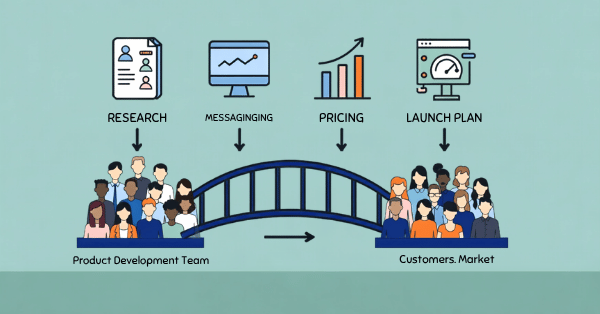
Product marketing strategy is the framework that translates product features into customer value and executes the plan to bring that product to market. It focuses on understanding who the product serves, why they need it, how it stands out, and the most effective way to deliver it to them.
Unlike broader marketing that promotes the company as a whole, product marketing centers on individual products or features. It differs from product management, which focuses on building the right product, by concentrating on communicating its value and driving adoption after development.
Core responsibilities include:
- Conducting deep market and customer research
- Developing positioning and messaging
- Creating pricing and packaging models
- Designing and executing go-to-market (GTM) plans
- Enabling sales and customer success teams
- Analyzing post-launch performance and iterating
Product marketing operates throughout the product lifecycle but becomes most visible during launches and major updates. Effective teams act as the voice of the customer inside the organization while serving as the bridge to external audiences.
Why Product Marketing Strategy Matters
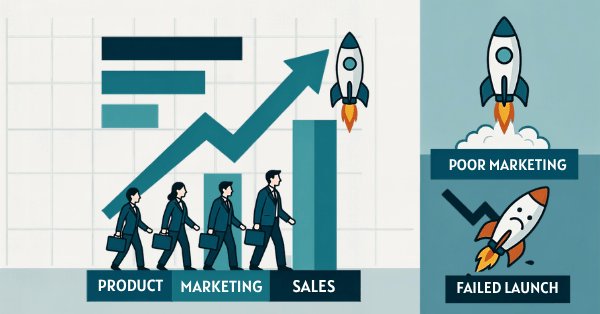
A solid product marketing strategy directly influences win rates, customer acquisition costs, and time-to-revenue. Products with clear positioning and targeted GTM plans achieve faster adoption and higher retention compared to those relying on generic promotion.
Strong product marketing aligns teams. When product, marketing, sales, and customer success share the same understanding of target customers and value propositions, internal friction decreases and external execution sharpens.
In competitive categories, differentiation becomes essential. A thoughtful strategy helps products avoid commoditization by emphasizing unique benefits rather than feature lists. Companies that invest here report stronger market share gains and more resilient pricing power.
The absence of strategy creates visible problems: launches that miss revenue targets, sales teams struggling with objections, marketing campaigns that generate awareness but not qualified leads, and products that fail to reach product-market fit despite strong development.
Key Components of a Product Marketing Strategy
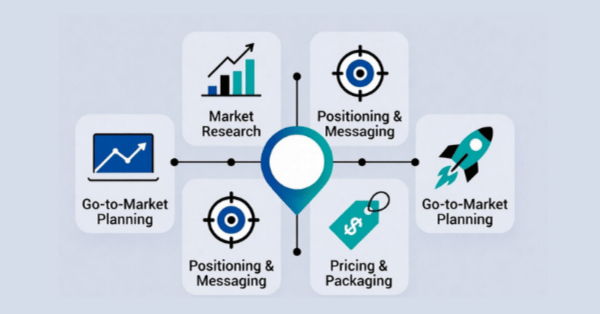
Successful strategies rest on four interconnected pillars: market research and customer insights, positioning and messaging, pricing and packaging, and go-to-market planning.
Market Research and Customer Insights
Every effective product marketing strategy starts with data about real people and their problems. This goes beyond surface-level demographics to uncover motivations, behaviors, and decision-making processes.
Begin with a mix of qualitative and quantitative methods:
- One-on-one customer interviews
- Surveys and feedback forms
- Usage data analysis
- Competitor product testing
- Win/loss interviews with prospects
Build detailed buyer personas that include goals, challenges, objections, and preferred buying channels. Update these personas regularly as markets evolve.
Map the customer journey from awareness through consideration, purchase, and expansion. Identify key touchpoints where targeted messaging can influence decisions.
Frameworks like Jobs to Be Done (JTBD) help frame research around the specific “job” customers hire the product to perform. SWOT analysis paired with competitor feature comparisons reveals gaps and opportunities.
Tools that support this work include Typeform or SurveyMonkey for feedback, Hotjar or FullStory for behavior insights, and Gong or Chorus for sales call analysis.
Positioning and Messaging
Positioning defines how the market perceives the product relative to alternatives. Strong positioning answers three questions: What category does this belong to? What makes it different? Why should customers care?
Effective positioning often creates or redefines a category. Instead of competing directly on existing terms, leaders establish new ones where they hold natural advantage.
Messaging translates positioning into words that resonate. A strong value proposition focuses on outcomes rather than features. Use frameworks like the Message House to organize:
- Top-level claim (headline)
- Supporting pillars (3-4 key benefits)
- Proof points and examples
Create messaging variations for different audiences—technical users, economic buyers, end users—and channels. Test messages through A/B experiments on landing pages, email subject lines, and ad copy.
Maintain consistency while allowing flexibility. Core messages remain stable, but tactical execution adapts to context, such as industry-specific use cases or seasonal campaigns.
Pricing and Packaging Strategy
Pricing decisions communicate value and shape market perception. Align pricing with customer willingness to pay, competitive context, and business model goals.
Common models include:
- Subscription (recurring revenue)
- Freemium (low barrier entry)
- Tiered packaging (good/better/best)
- Usage-based (pay for what you use)
- One-time license with maintenance
Value-based pricing ties cost to the outcomes delivered rather than development expenses. Test pricing through conjoint analysis, price testing on sales calls, or limited-time offers.
Packaging groups features into logical bundles that match different customer segments. Consider usage frequency, team size, or advanced capabilities when designing tiers. Include clear upgrade paths to reduce friction as customers grow.
Monitor competitor pricing movements and gather feedback on perceived value. Regular price testing and adjustments keep offerings competitive without eroding margins.
Go-to-Market (GTM) Planning
GTM planning operationalizes the strategy into executable steps. It coordinates all activities needed to reach target customers and drive revenue.
Key elements include:
- Target segment prioritization
- Channel selection (direct, self-service, partners, marketplaces)
- Launch timeline with milestones
- Content and asset creation
- Sales enablement materials
- Success metrics and tracking
Create phased rollouts when appropriate—beta programs, early access, regional launches—to gather feedback and reduce risk. Develop a launch playbook that includes press materials, sales decks, demo scripts, and support documentation.
Sales enablement proves critical. Equip teams with battle cards that address competitor comparisons, objection handlers, and value stories. Marketing supports with campaigns timed to different funnel stages.
Define clear KPIs such as pipeline generated, win rate, customer acquisition cost (CAC), lifetime value (LTV), activation rate, and expansion revenue. Track these from day one to enable rapid iteration.
Product Marketing Strategy Examples
Slack’s Shift to Enterprise Positioning
Slack began as a consumer-friendly team communication tool but expanded into enterprise with a deliberate product marketing strategy approach. They researched large organization needs around security, compliance, and integrations. Positioning evolved from “better internal chat” to “the platform that transforms how organizations communicate and get work done.” Tiered enterprise plans, targeted case studies from major companies, and sales enablement focused on ROI helped them win larger deals while maintaining their self-service base.
Notion’s Community-Driven Growth
Notion used product marketing strategy to turn users into advocates. Their strategy emphasized templates and customizable workspaces rather than rigid features. Messaging highlighted flexibility across personal, team, and company use cases. GTM relied heavily on organic channels, user-generated content, and ambassador programs. Pricing remained accessible with generous free tiers, driving viral adoption before converting power users to paid plans.
HubSpot’s Inbound Methodology Integration
HubSpot built its entire product marketing strategy around the inbound methodology they popularized. Each product (Marketing Hub, Sales Hub, Service Hub) received clear positioning within the broader flywheel concept. They created extensive educational content, free tools, and certifications that served as top-of-funnel entry points. This approach built trust and authority while guiding customers through natural expansion paths.
Key takeaway across examples: Successful strategies deeply integrate customer insights, maintain consistent yet adaptable messaging, and treat launches as ongoing processes rather than one-time events.
Common Mistakes to Avoid
Many product marketing strategy efforts stumble on predictable issues.
Assuming product excellence alone drives success ranks among the top errors. Even superior products require clear communication and targeted distribution to gain traction.
Inconsistent messaging across channels confuses buyers and weakens brand perception. Teams that fail to align on core positioning deliver fragmented experiences that hurt conversion.
Poor cross-functional alignment creates internal problems that surface externally. When product teams ship features without marketing input, or sales promises capabilities that don’t exist, trust erodes.
Neglecting pricing research leads to models that either leave money on the table or create unnecessary barriers. Similarly, launching without documented GTM plans results in uncoordinated efforts and missed opportunities.
Over-emphasizing features instead of benefits remains common. Customers buy outcomes and emotional relief, not technical specifications.
Failing to establish success metrics before launch makes optimization difficult. Teams that operate without clear KPIs cannot distinguish between successful and failing tactics.
Best Practices for Success
Build product marketing strategy as living documents that evolve with market conditions and customer feedback. Schedule regular reviews—quarterly at minimum—to incorporate new insights and adjust tactics.
Prioritize continuous research. Maintain ongoing dialogue with customers through interviews, community channels, and usage data rather than treating research as a pre-launch activity only.
Foster tight collaboration between functions. Regular alignment meetings, shared documentation, and joint ownership of metrics improve outcomes significantly.
Use storytelling within messaging. Real customer stories and specific scenarios prove more compelling than abstract benefit statements.
Test relentlessly. A/B test messaging, pricing pages, and campaign elements. Small improvements compound into meaningful results over time.
Focus on measurable outcomes. Connect activities to business results rather than vanity metrics. Track leading indicators that predict revenue impact.
Stay aware of emerging approaches. Community-led growth, personalized experiences at scale, and integration-focused ecosystems increasingly shape successful strategies in many categories.
Document processes and create reusable templates. This builds institutional knowledge and accelerates future launches.
Conclusion
A comprehensive product marketing strategy connects customer needs with product capabilities and executes the delivery with precision. The framework of research, positioning, pricing, and GTM planning provides a reliable foundation that adaptable teams can customize for their specific context.
Start by auditing current efforts against the components outlined here. Identify the weakest areas and address them systematically. Even incremental improvements in customer insight, messaging clarity, or launch execution can deliver outsized returns.
The most successful organizations treat product marketing strategy as a strategic function that evolves alongside their products and markets. By following this guide, teams can build strategies that not only support individual launches but create sustainable competitive advantages.
FAQs
What is the difference between product marketing and product management?
Product management defines what to build and ensures delivery. product marketing strategydetermines how to position, price, and promote what gets built to drive market success.
How do you measure the success of a product marketing strategy?
Key metrics include pipeline influence, win rates, customer acquisition cost, retention/expansion rates, time-to-productivity for new customers, and qualitative feedback on messaging effectiveness.
When should you start building your GTM plan?
Begin during late-stage development when core features stabilize. Full execution planning typically starts 3-6 months before intended launch, with research beginning much earlier.
How often should you update your product marketing strategy?
Review core elements quarterly and after major market shifts, competitive moves, or significant product updates. Buyer personas and messaging benefit from more frequent refinement.